

- Description
- Specifications
Product Overview
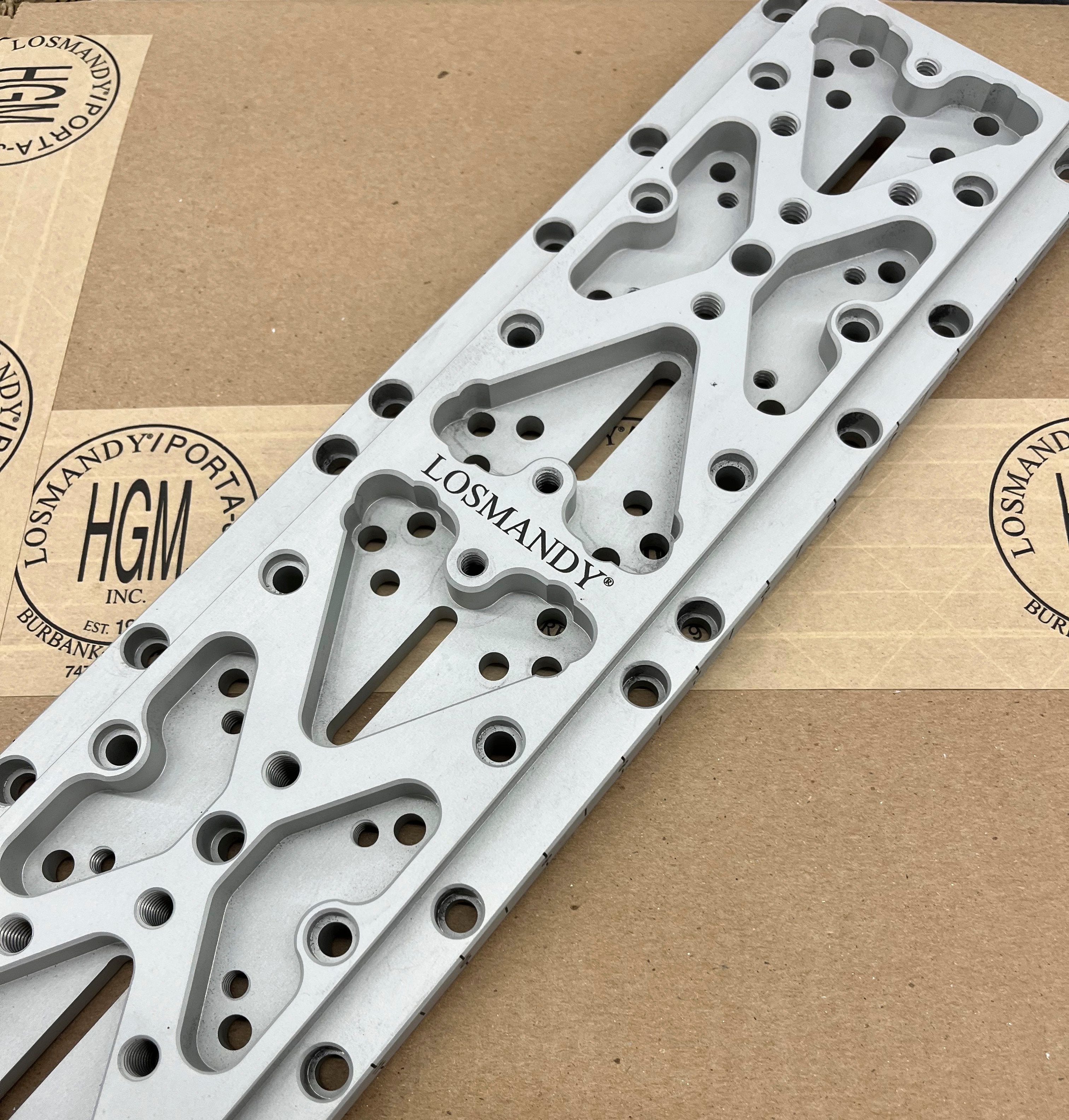
This is Losmandy's 14-inch universal D-series dovetail plate in a special-edition clear anodized finish rather than the usual black. Mechanically it is the standard DUP14: five sets of mounting holes at 60 mm, 2.00", 35 mm, 1.5" and 1.25" separations, 14 inches long, 0.7 inches thick, 2.4 lb, with one safety stop screw included.
Who It's For
The reason to choose this one is the finish. Clear anodizing leaves the aluminium bright rather than black, which suits a white or natural-finish tube, and makes the plate easier to find on a dark observing field. Everything else matches the standard plate, so the choice costs nothing in function.
Key Features & Design
- Special-edition clear anodized finish in place of the standard black.
- Five mounting hole separations: 60 mm, 2.00", 35 mm, 1.5" and 1.25".
- 14 inches long, 0.7 inches thick, at 2.4 lb.
- Fits rings and cradles from Astro-Physics, Astro-Tech, Borg, Celestron, Explore Scientific, Meade, Orion, Parallax, Questar, Stellarvue, Takahashi, Tele Vue, Vixen and William Optics.
- One safety stop screw included.
- D-series profile, accepted by every current Losmandy saddle.
Recommended Uses
Mounting a refractor or SCT in third-party rings onto a Losmandy saddle, where a bright finish is wanted. Matching a white or natural-anodized tube assembly. Any application the standard DUP14 covers.
Compatibility and Accessory Notes
- Saddles: any Losmandy D-series saddle — the G-11 saddle, the GM8 saddle plate, and the twin saddles on the AZ8.
- Standard finish: the black DUP14 is the same plate in the regular finish.
- Other lengths: the 19" and 24" plates, in black.
- Rings: the DVR108 guide scope rings mount onto the plate.
- Male-to-male: the DMM adapter plate mates to any DUP plate to create a male-to-male dovetail.
Good to Know Before You Order
- This is a finish option, not a different plate. Dimensions, hole patterns and weight match the standard DUP14.
- Special edition means limited. Clear anodize is not a standing Losmandy line, so availability depends on what we hold — ask us before planning a matched pair.
- Check your ring spacing against the five separations before ordering, and we will confirm the fit with you.
- Specifications are Losmandy's published figures for the DUP14.
Frequently Asked Questions
Is it difficult to set up?
No. It bolts to your tube rings through whichever hole separation matches them, slides into the saddle and clamps.
Is it different from the standard DUP14?
Only in finish. Clear anodize rather than black, with the same dimensions, hole patterns and weight.
Does the finish affect anything mechanically?
No. Anodizing is a surface treatment; the plate underneath is the same machined aluminium.
Will it fit my rings?
Five separations from 1.25" to 60 mm cover most major makers. Send us your ring model and we will check.
Can I still get the black one?
Yes — the standard DUP14 is a stocked item.
Bottom Line
In short: the standard 14-inch Losmandy D-series universal plate — five hole separations, 0.7" thick, 2.4 lb, safety stop screw included — in a limited clear anodized finish instead of black.
| Model | Losmandy DUP14 universal D-series dovetail plate, special edition clear anodize |
|---|---|
| Finish | Clear anodized (special edition; standard plate is black) |
| Length | 14" |
| Thickness | 0.7" |
| Weight | 2.4 lb |
| Mounting hole separations | 60 mm, 2.00", 35 mm, 1.5", 1.25" |
| Dovetail profile | Losmandy D-series |
| Listed ring compatibility | Astro-Physics, Astro-Tech, Borg, Celestron, Explore Scientific, Meade, Orion, Parallax, Questar, Stellarvue, Takahashi, Tele Vue, Vixen, William Optics |
| Included | One safety stop screw |
| Hole pattern drawing | Losmandy DUP hole pattern (PDF) |
| Source | Losmandy DUP product data; finish per Ontario Telescope product listing |
You may also like
Recently viewed
Recent Blog Posts
View all
Your Guide Graph Is Lying to You
Read More

D-Size vs V-Size: A Complete Guide to Telescope Dovetail Systems
Read More

What Is Back Focus in Astrophotography? Telescope Reducers, Flatteners, and Spacing Explained
Read More