
Start here
Your first telescope, without the disappointment
Most first telescopes let people down, and it is almost never the telescope's fault - it is that nobody explained what to expect. So before we sell you anything: five minutes on how these things actually work, in plain language, and then four we would genuinely recommend.
The three things that matter
How a telescope actually works
Three ideas, and you'll understand every telescope in the shop — including why the "525× POWER!" one at the department store is a trap.
It's a light bucket, not a magnifier
The most important number on any telescope is its aperture — the width of the main lens or mirror. It decides how much light the telescope collects, and light is what lets you see faint things at all. Magnification comes second. A big blurry image is still blurry.
The eyepiece sets the magnification
A telescope doesn't have "a magnification". It has a focal length, and so does each eyepiece. Divide one by the other and that's your power — so you change magnification by swapping eyepieces, not by buying a bigger number on the box.
The mount matters as much as the optics
At 100× a small nudge throws your target right out of view, and a wobbly tripod ruins good optics. This is why Dobsonians feel so pleasant to use: the mount is a simple, smooth box that stays exactly where you put it.
Aperture, drawn to scale
Light gathering goes up with the area of the opening, not its width — so doubling the aperture collects four times the light. That's why the difference between these four is far bigger than the numbers suggest. "× light" is measured against the smallest one here.
The one bit of arithmetic
Working out magnification
Telescope focal length ÷ eyepiece focal length = magnification
Both numbers are printed in millimetres — the telescope's on its tube or box, the eyepiece's on its barrel. A 1200 mm telescope with a 25 mm eyepiece gives you 48×. Swap in a 10 mm eyepiece and the same telescope gives 120×.
There's a ceiling, and it's lower than you'd think. The highest magnification worth using is roughly two times the aperture in millimetres — about 200× on a 102 mm refractor. Push past it and you're just magnifying blur. On top of that, the atmosphere itself usually limits you to somewhere around 150–250× no matter what you own. Steady air beats big numbers, every time.
Have a play — pick a telescope and an eyepiece:
Honest expectations
What you'll actually see
This is the part nobody tells beginners, and it's the reason most first telescopes end up in a closet. None of it is a disappointment once you know what you're looking at.
| Object | Through the eyepiece | On a smart telescope |
|---|---|---|
| The Moon | Spectacular from the very first night — craters, mountain ranges, long shadows. Better in a small telescope than almost anyone expects. | Sharp, and easy to share or print. |
| Saturn | A tiny but unmistakable disc with the rings clearly separated from about 100×. Most people go quiet for a second. | Small. Smart telescopes are built for deep sky, not planets. |
| Jupiter | Two dark cloud belts and four moons strung out in a line — and they visibly move from one night to the next. | Small, same reason. |
| Mars | An orange dot most of the time. Near opposition, a small disc with dark markings and a polar cap. | Small. |
| Orion Nebula | A glowing grey-green cloud wrapped around four bright stars. Genuinely beautiful — but not colourful. | Full colour, red and blue, after a few minutes of stacking. |
| Andromeda Galaxy | A faint oval smudge. That smudge is 2.5 million light years away, which is rather the point. | Spiral structure and dust lanes. |
| Star clusters | The best-kept secret in the hobby. M13 or the Double Cluster under a dark sky is unforgettable in any aperture. | Good, though this is one your eye wins. |
| Distant galaxies | Faint grey smudges, and only from a dark site — but there are hundreds of them. | Where these instruments really earn their keep. |
Why isn't any of it colourful?
Because the colour receptors in your eye need more light than a faint nebula can deliver. Your eye switches to its low-light system, which sees in greyscale. A camera has no such limit — it just keeps collecting photons — which is why photographs look nothing like the view through an eyepiece. Neither is cheating; they're two different instruments. A smart telescope simply shows you the photograph version, live, on your phone.
Light pollution matters more than money
Driving forty-five minutes north of the GTA will do more for your view of a galaxy than doubling your budget. The Moon, Saturn and Jupiter, on the other hand, look perfectly good from a driveway in Mississauga — so if you live downtown, start with the Solar System and plan a road trip for the rest.
Four we'd actually recommend
The four we put in beginners' hands
Four different answers to four different questions, not better and worse. Prices are live, in Canadian dollars, and everything ships from Bolton.

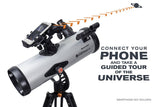
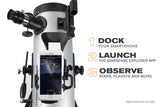
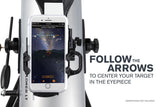
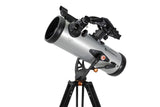
Celestron StarSense Explorer LT 114AZ Smartphone App-enabled Newtonian Reflector Telescope
Your phone clips into a mirror dock on the tube, the app reads the actual star field above you, and arrows on the screen tell you which way to push. No alignment stars, no hand controller, no learning the constellations first. For the money, this is the most telescope a beginner can actually point at something on their first night.
Finding things. The app turns a blank sky into a menu, and the 114 mm mirror is enough for the Moon, the planets, bright clusters and the Orion Nebula.
The long 1000 mm focal length gives a fairly narrow view, and the tripod is the lightest of the four - fine, but don't lean on it.

Celestron StarSense Explorer DX 102AZ Smartphone App-enabled Refractor Telescope
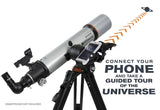
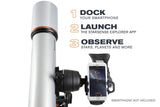
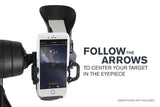
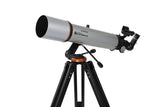
A refractor is a sealed tube with a lens at the front. Nothing to align, nothing to collimate, nothing that goes out of adjustment when you put it in the car. It gathers slightly less light than the 114 mm reflector but gives noticeably cleaner, higher-contrast star images - and it uses the same phone-guided StarSense app.
Crisp, contrasty views of the Moon, Saturn and Jupiter, and a wider field than the LT. Sets up in two minutes and needs no maintenance, ever.
Costs nearly twice the LT for slightly less aperture. You are paying for image quality and simplicity, not raw light.

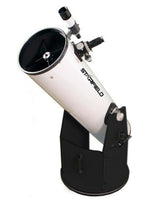
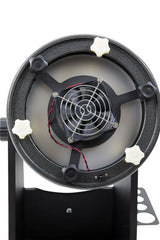
Starfield Optics 8" f/6 Dobsonian
This is the telescope experienced observers push beginners toward, and the aperture chart above is why: it collects about four times the light of the 102 mm refractor. Deep-sky objects stop being smudges and start showing shape and structure. There is nothing electronic about it - you sit on a stool, nudge it by hand and learn the sky, which a lot of people end up preferring to being told where to point.
Light. Globular clusters resolve into individual stars, galaxies show their shape, and the Moon at 200x is genuinely overwhelming. The mount is rock steady and stays exactly where you put it.
It is big - roughly the size of a large kitchen bin - so it lives in a corner, not a cupboard. The mirror needs collimating from time to time; we will show you how, and it takes two minutes.
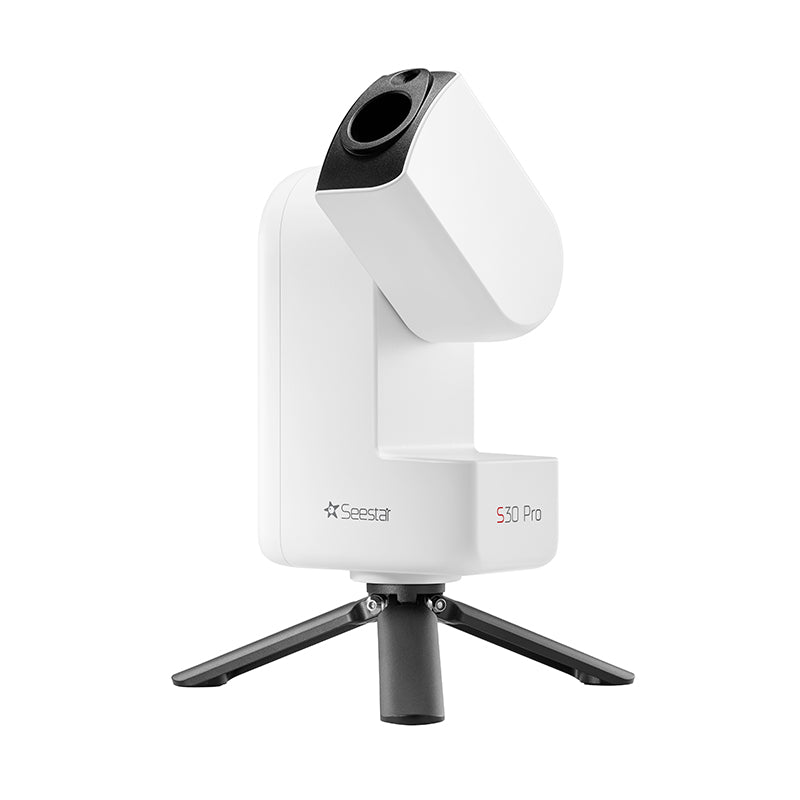
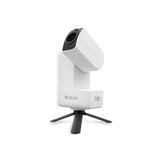
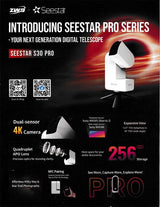
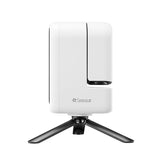
ZWO Seestar S30 Pro — All-In-One Smart Telescope
You do not look through this one. Telescope, camera, mount and computer are a single 1.65 kg unit: you tap a target in the app, it finds it, tracks it and stacks exposures, and a colour image builds up on your phone over a few minutes. It will show you things no 8-inch Dobsonian will ever show your eye - nebulae in full colour, from a light-polluted backyard.
Colour deep-sky images within minutes, from the city, with no experience at all. Sets up in under a minute and packs into a shoulder bag.
A 30 mm lens is small, so planets stay small - and with no eyepiece you miss the feeling of photons that left Saturn an hour ago landing in your own eye. For some people that feeling is the entire point.
Still can't decide? Pick the sentence that sounds like you.
I want to look through it myself, and I want to spend the least I sensibly can.StarSense LT 114AZ →$361
I want the cleanest possible view of the Moon and planets, and I never want to adjust anything.StarSense DX 102AZ →$681
I want to see as much as possible and I do not mind carrying something substantial outside.Starfield 8-inch Dob →$920
I want photographs I can share, and I would rather look at a screen than squint through an eyepiece.ZWO Seestar S30 Pro →$1,013
Before you unbox it in the dark
Six things worth knowing about your first night
Let it cool down
Put the telescope outside half an hour before you observe. Warm air inside a cold tube shimmers and blurs everything.
Start on the Moon, at low power
Always find your target with the lowest-power eyepiece — the widest view — then swap to more magnification once it's centred.
Avoid the full Moon
A half or crescent Moon shows far more. The shadows along the day-night line are what make craters look three-dimensional.
Give your eyes twenty minutes
Dark adaptation takes about that long, and one glance at a white phone screen resets it. Use a red flashlight and night mode.
Don't buy accessories yet
The eyepieces in the box will keep you busy for months. Come back once you know what you're actually missing — we'd rather sell you the right thing later.
Expect a learning curve, not a fight
Everyone's first hour is clumsy. By the third night you'll be finding things on purpose. If you get stuck, phone us — that's genuinely part of what you bought.
Still not sure? That is exactly what we are here for.
Phone us and describe your sky, your budget and what you are hoping to see. We will happily talk you down to a cheaper telescope - that is a much better outcome than selling you one that ends up in a closet. Or come to the Bolton showroom and look through them yourself.