




- Description
- Specifications
Product Overview
The AZ8 is Losmandy's manually controlled alt-azimuth mount, built with twin saddle plates so two instruments ride side by side. It is machined aluminium and stainless throughout, black anodized, with 360-degree slow-motion control on both axes, a 2.812-inch 180-tooth 7075 aluminium worm gear against a ground high-precision brass worm, and a variable slip clutch on each axis. Losmandy publishes 35 lb instrument capacity per side on a 13 lb head. A Gemini 2 GOTO system is available as an option, and it supports alt-az mode.
Who It's For
This is a good match if you observe rather than image, and you want the mount out of the way of that. There is no polar alignment, no cable to trip over and nothing to boot — you set it up, grab the tube and push. The twin saddles are the real reason people choose it: a big refractor on one side and a short wide-field or a solar scope on the other, balanced against each other, switching between them without touching a counterweight. It also suits binocular-style pairs, side-by-side visual comparison, and daytime terrestrial or solar work where an equatorial's tilted axes are simply awkward.
Key Features & Design
- 35 lb instrument capacity per side, on a 13 lb head.
- Twin saddle plates, accepting Losmandy D-series and Vixen-style V-series dovetail plates.
- 2.812-inch, 180-tooth 7075 aluminium worm gear, against a dual-supported, ball-bearing-housed ground high-precision brass worm.
- 360-degree slow-motion control on both axes — continuous, with no dead stop to work around.
- Variable slip clutch on both axes, one knob per axis, so you set the friction you want and move the instrument by hand.
- One 2.100-inch and one 2.000-inch needle thrust bearing plus two 1.500-inch needle bearings.
- 3.5-inch laser-engraved setting circles and a built-in bubble level, on 1.250-inch aluminium shafts.
- All machined aluminium and stainless steel, black anodized, with stainless hardware throughout.
- Optional Gemini 2 GOTO system, which supports alt-az mode.
Mechanical Design
The variable slip clutch is what makes an alt-az mount pleasant or unpleasant to use, and it is where the AZ8 spends its engineering. Rather than a lock you release and re-tighten, each axis has a clutch you set once to the friction you like — enough to hold a 30 lb refractor where you point it, loose enough to nudge by hand. From there the 360-degree slow-motion control handles fine positioning without ever hitting a limit, which matters at high power when a planet drifts out of an eyepiece field in seconds.
Behind that sits the same gear architecture Losmandy uses on its equatorials: a 2.812-inch, 180-tooth 7075 aluminium gear driven by a ground brass worm that is dual supported and housed in ball bearings at both ends. It is the GM 8's gear, in a mount asked to do far less with it — which is why the AZ8 feels solid under load rather than merely adequate. The twin saddles let two instruments counterbalance each other across the altitude axis, so a paired setup often needs no counterweight at all.
Recommended Uses
Visual observing with one or two instruments, at up to 35 lb per side. Side-by-side pairings — a long refractor with a short wide-field, or a solar scope alongside a white-light setup. Lunar and planetary observing at high power, using the 360-degree slow motion. Daytime terrestrial and solar work, where an alt-az's level axes are the natural fit. Public outreach and star parties, where set-up time and simplicity matter more than tracking. Grab-and-go sessions with no alignment routine.
Compatibility and Accessory Notes
- Saddles: twin plates taking Losmandy D-series and Vixen-style V-series dovetails. We stock the D-series universal plates in 14", 19" and 24" lengths, and V-series plates in 11" and 14".
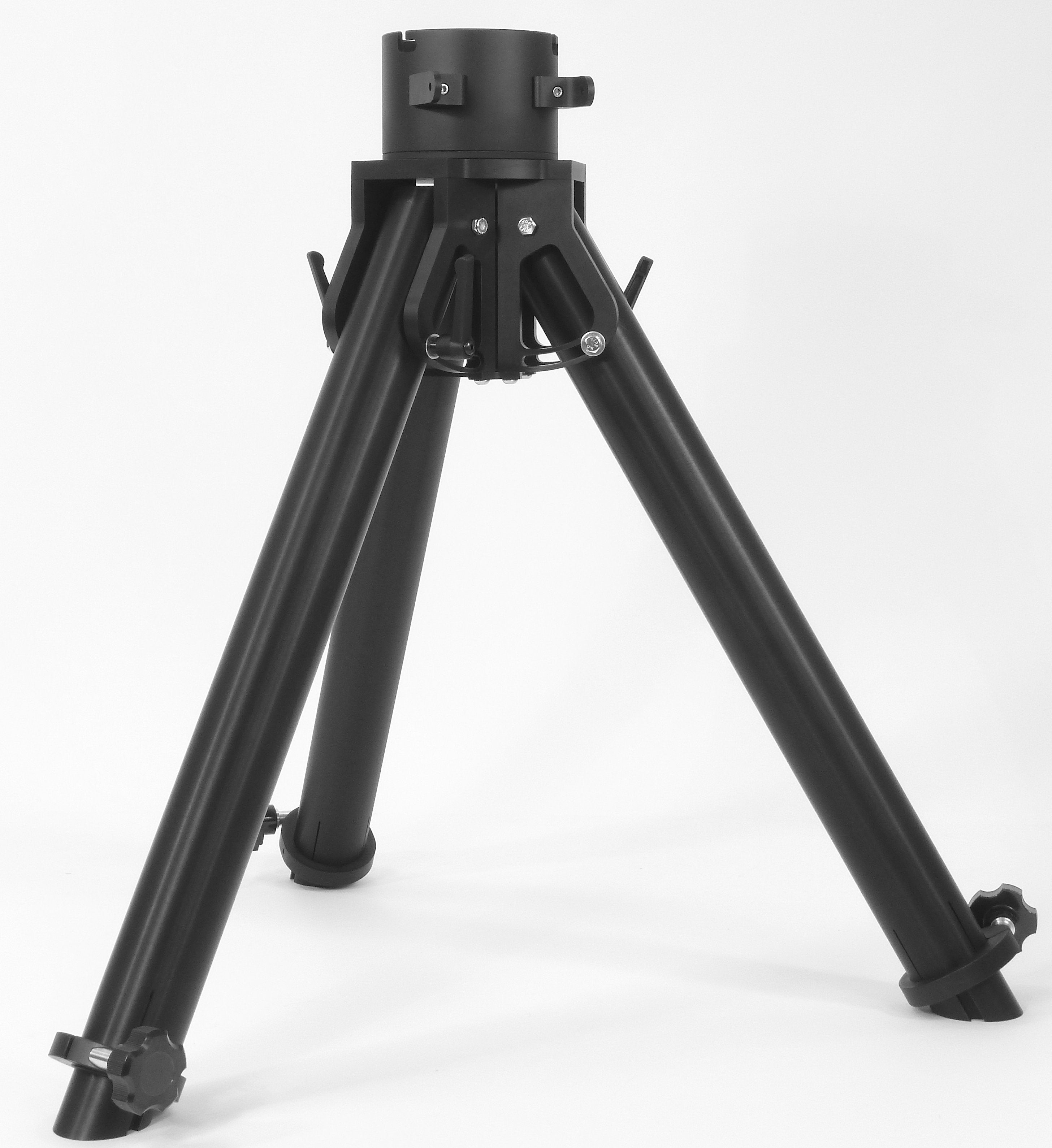
- Tripod: the AZ8 tripod coupling connects the AZ8 to a Losmandy G-11 or GM 8 tripod — so the LW tripod or the HD tripod with MA top both work under it. An AZ8 riser is available where extra height is wanted.
- Counterweights: a single-instrument setup wants balancing. The AZ8 weight system is Losmandy's lightweight option for the AZ8, and standard 7 lb, 11 lb and 21 lb weights fit a 1.25-inch shaft.
- GOTO: the Gemini 2 system is an option on the AZ8 and supports alt-az mode. We stock the Gemini 2 standalone unit — tell us your AZ8 configuration and we will confirm what else the conversion needs.
- Vibration: glow-in-the-dark vibration pads fit Losmandy HD tripod legs.
Good to Know Before You Order
- This is a manual mount as standard. There is no tracking unless the Gemini 2 option is fitted, so at high power you nudge the slow-motion controls to follow an object. For visual work that is the appeal; for long-exposure imaging it is not the right tool.
- 35 lb is per side, not total. Two instruments inside that figure is what the twin saddle is for.
- The AZ8 is configurable at Losmandy — single- or dual-sided head, tripod choice, counterweight options and Gemini 2. If you want a specific combination, send us the configuration and we will quote it and confirm what is in stock.
- It needs a tripod and the AZ8 coupling to sit on Losmandy legs. If you already own a G-11 or GM 8 tripod, the coupling is the only extra part.
- Specifications are Losmandy's published figures for the AZ8.
Frequently Asked Questions
Is it difficult to set up?
It is the easiest kind of mount there is. Tripod, coupling, head, instrument on the saddle, set the clutches, observe. There is no polar alignment and nothing to power up.
Does it track?
Not as standard — it is manually controlled, with 360-degree slow motion on both axes for following by hand. The optional Gemini 2 system adds GOTO and tracking in alt-az mode.
Can I really put two telescopes on it?
Yes, that is the design. Twin saddle plates, 35 lb capacity per side, and two instruments will often counterbalance each other with no counterweight needed.
Will it take my existing dovetail plates?
If they are Losmandy D-series or Vixen-style V-series, yes — both saddles accept either.
What tripod do I need?
A Losmandy G-11 or GM 8 tripod plus the AZ8 tripod coupling. The LW and HD tripods both work.
Can I image with it?
Short exposures and lunar or planetary video, within the limits of manual following. For long-exposure deep-sky work an equatorial mount is the right choice.
Bottom Line
In short: a machined alt-azimuth mount with twin saddles, 35 lb capacity per side on a 13 lb head, variable slip clutches and 360-degree slow motion on both axes — built for observing with one or two instruments, with Gemini 2 GOTO available if you want it later.
| Model | Losmandy AZ8 alt-azimuth mount |
|---|---|
| Mount type | Manually controlled alt-azimuth, twin saddle plates |
| Instrument capacity | 35 lb per side |
| Head weight | 13 lb |
| Worm gear, both axes | 2.812" diameter 7075 aluminium, 180 teeth |
| Worm | Dual-supported, ball-bearing-housed ground high-precision brass |
| Bearings | One 2.100" needle thrust, one 2.000" needle thrust, two 1.500" needle |
| Slow motion | 360° on both axes |
| Clutch | Variable slip clutch on both axes, one knob per axis |
| Setting circles | 3.5" diameter, laser engraved |
| Shafts | 1.250" diameter aluminium |
| Level | Built-in bubble level |
| Saddle compatibility | Losmandy D-series and Vixen-style V-series dovetail plates, both saddles |
| Construction | All machined aluminium and stainless steel, black anodized, stainless hardware |
| Tripod interface | AZ8 tripod coupling, to Losmandy G-11 or GM 8 tripods |
| GOTO | Gemini 2 system optional; supports alt-az mode |
| Source | Losmandy AZ8 product data |
You may also like
Recently viewed
Recent Blog Posts
View all
Your Guide Graph Is Lying to You
Read More

D-Size vs V-Size: A Complete Guide to Telescope Dovetail Systems
Read More

What Is Back Focus in Astrophotography? Telescope Reducers, Flatteners, and Spacing Explained
Read More