
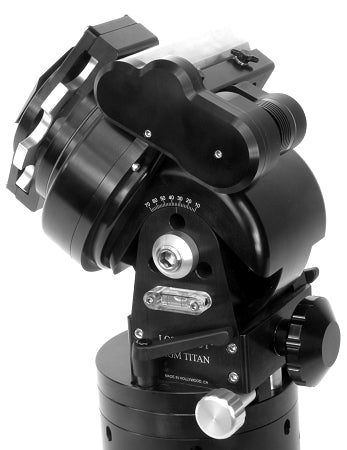

- Description
- Specifications
Product Overview
This is the HGM Titan right ascension axis sold on its own, listed by Losmandy for use with a G-11 declination axis. That pairing is the G11T: the Titan's 6.75-inch, 270-tooth RA gear against the G-11's 5.625-inch, 360-tooth DEC. Losmandy publishes 75 lb imaging capacity for the complete G11T, on a head of 46 lb RA plus 16 lb DEC. No motor is included — your existing G-11 RA servo motor transfers across, or a new one can be added.
Who It's For
This is the heaviest RA axis Losmandy sells outside a full Titan, and it is bought for one reason: to carry more instrument than a G-11 RA can while keeping the G-11 declination axis you already own. If your imaging train has grown past the G-11's 60 lb rating, or you want the Titan's larger gear under a long refractor or a big SCT, this is the part that gets you there without buying a complete mount.
Key Features & Design
- 6.75-inch, 270-tooth RA worm gear — larger in diameter than the G-11's 5.625-inch gear.
- Published 75 lb imaging capacity for the complete G11T, against 60 lb for a G11G.
- 46 lb RA axis weight, with the G-11 DEC adding 16 lb.
- Published altitude range of 12° to 72° for the G11T configuration.
- Takes the MAL tripod/pier adapter, the larger 7-inch adapter used by Titan and G11T mounts.
- Adjustable friction clutch rather than a locking bolt.
- Motor not included. The existing G-11 RA servo motor fits.
Mechanical Design
The Titan RA gear trades tooth count for diameter: 270 teeth on 6.75 inches against the G-11's 360 on 5.625. Diameter is what carries load — a larger gear, a larger casting around it and heavier bearings are what let the axis hold a long instrument steady with a camera hanging off the back. The published capacity going from 60 lb to 75 lb is the visible result of that, and the head weight going from 33 lb to 46 lb on the RA side is the price of it.
Because the axis brings its own altitude and azimuth adjusters and its own base, the G11T configuration also inherits the Titan's published altitude range of 12° to 72° rather than the G-11's. For a Canadian site that is not a constraint, but it is a different figure from the mount you are upgrading and worth knowing before the first polar alignment.
Recommended Uses
Upgrading a G-11 to G11T configuration for a heavier imaging train. Long-focal-length imaging where RA stiffness and gear diameter set the limit. Observatory and permanent-pier installations, on the MAL adapter. Building a G11T from parts alongside the G11 DEC axis.
Compatibility and Accessory Notes
- Pairs with: the G-11 declination axis, which is what makes it a G11T. The complete mount is listed as the G11T with Gemini 2 GOTO and HD tripod.
- Tripod and pier: this axis takes the MAL tripod/pier adapter — 7 inches in diameter against the MA's 6 — on the HD tripod with MAL top or a permanent pier. A MAL to MA adapter is available if you need to sit it on MA-topped hardware.
- Motor: not included. Your existing G-11 RA servo motor fits, joined by the G11 motor-to-worm coupling. A new servo motor can be added if you would rather leave the old axis complete.
- Polar alignment: the iPolar electronic polar scope fits with the G11/G11T adapter.
- Counterweights: a heavier instrument wants more counterweight. We stock the 7 lb, 11 lb and 21 lb weights and the counterweight shaft.
- Saddle: unchanged — Losmandy D-series and Vixen-style V-series dovetails, including the D-series universal plates in 19" and 24" lengths for long tubes.
Good to Know Before You Order
- No motor in the box. The axis assumes the G-11 RA motor moves across.
- It takes the MAL adapter, not the MA. If your tripod is MA-topped, you need either the MAL adapter and a MAL-topped tripod, or the MAL to MA adapter — worth settling before the axis arrives.
- 46 lb on the RA side. This is a heavier axis than the one it replaces, and a G11T is a mount you site rather than carry. Worth planning where it will live.
- The altitude range becomes 12° to 72° in this configuration rather than the G-11's 14° to 64°.
- Specifications are Losmandy's published figures for the G11T configuration.
Frequently Asked Questions
Is it difficult to set up?
The assembly itself is straightforward — the G-11 RA axis comes off, the Titan axis goes on, the DEC axis and motor transfer across. The part that takes planning is the tripod interface, because this axis uses the larger MAL adapter.
How much more can it carry?
Losmandy publishes 75 lb imaging capacity for the resulting G11T against 60 lb for a G11G. Capacity is a property of the whole head, so the figure applies to the finished configuration rather than the axis alone.
Can I keep my G-11 DEC axis?
Yes — that is exactly what this axis is listed for. The G-11 DEC and its 5.625-inch, 360-tooth gear stay.
Does my existing motor work?
Yes. Losmandy lists it as using your existing G-11 RA servo motor, with a new servo motor available if you prefer to leave the old axis intact.
Do I need a new tripod?
You need a MAL interface. That can be a MAL-topped HD tripod, a pier with the MAL adapter, or the MAL to MA adapter on existing MA-topped hardware.
Bottom Line
In short: the Titan right ascension axis on its own, 6.75-inch 270-tooth gear, motor not included — paired with a G-11 DEC it makes a G11T, published at 75 lb imaging capacity on a 46 lb RA axis.
| Part | Losmandy HGM Titan RA axis, no motor |
|---|---|
| Function | Right ascension axis for G11T configuration, paired with a G-11 DEC axis |
| Worm gear | 6.75" diameter, 270 teeth |
| Axis weight | 46 lb RA (G-11 DEC adds 16 lb) |
| Resulting capacity | Losmandy publishes 75 lb imaging for a complete G11T |
| Altitude range | 12° to 72° in G11T configuration |
| Clutch | Adjustable friction clutch |
| Motor | Not included — reuses the existing G-11 RA servo motor, or a new servo motor can be added |
| Tripod interface | MAL tripod/pier adapter, 7" diameter |
| Saddle compatibility | Losmandy D-series and Vixen-style V-series dovetail plates |
| Source | Losmandy G11T datasheet and Losmandy product data |
You may also like
Recently viewed
Recent Blog Posts
View all
Your Guide Graph Is Lying to You
Read More

D-Size vs V-Size: A Complete Guide to Telescope Dovetail Systems
Read More

What Is Back Focus in Astrophotography? Telescope Reducers, Flatteners, and Spacing Explained
Read More