
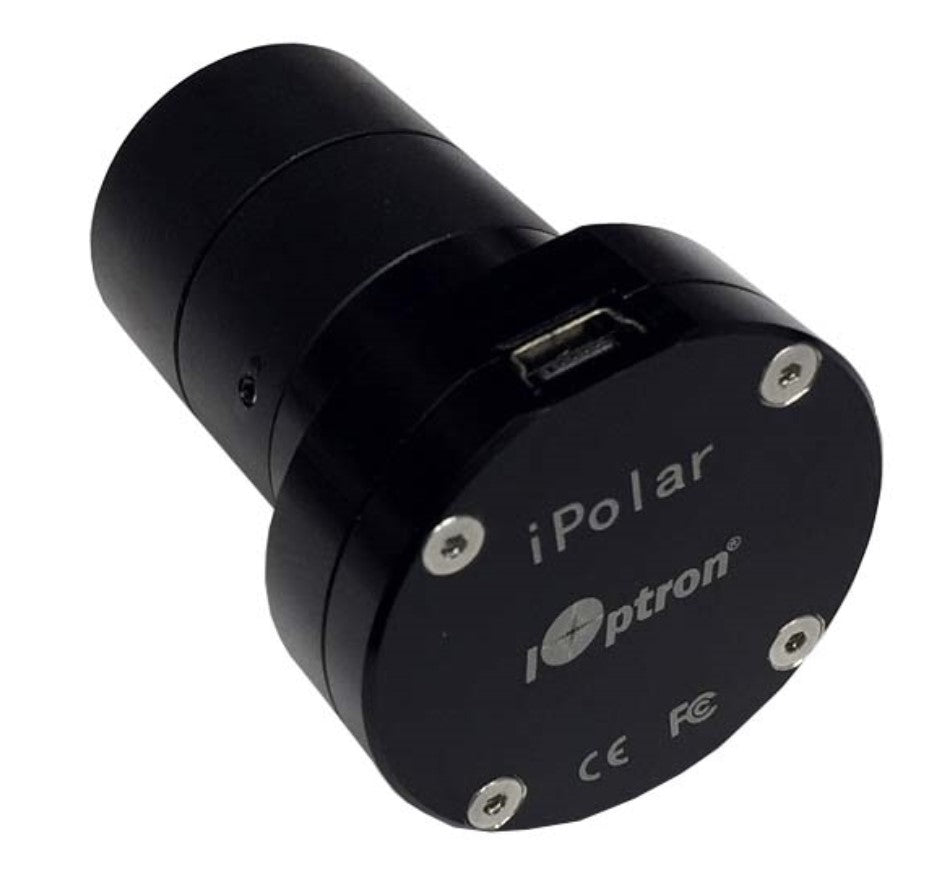

- Description
- Specifications
Product Overview
The iPolar replaces an optical polar finder with a small digital camera that mounts in the polar scope port of a Losmandy mount and aligns through software on a Windows PC. Because it plate-solves what the camera sees rather than asking you to match a reticle against Polaris, it aligns accurately anywhere on Earth — including where the pole star is not visible, or the sky is hazy or light polluted. Power comes down the included 24-inch USB cable that tethers it to the computer, and it is plug-and-play with no drivers to install. Windows only. A mount-specific adapter is required and sold separately.
Who It's For
This is the answer to the two things an optical polar finder cannot do. The first is align without a sightline to the pole — a fence, a house, a tree, a permanent pier in the wrong spot. The second is align repeatably without lying on the ground squinting through the mount. If you already run a laptop at the telescope for imaging, the iPolar adds no new hardware to the setup and takes the guesswork out of the one step everything else depends on.
Key Features & Design
- Digital camera in place of an optical reticle, mounting in the mount's polar scope port.
- Aligns anywhere on Earth, even when the pole stars are not visible, the night is cloudy or the sky is light polluted.
- On-screen alignment instructions in the downloadable Windows software.
- Powered by the included 24-inch USB cable, tethered to the computer — no separate supply.
- Plug-and-play, with no drivers to install before the computer recognises it.
- Windows compatible only.
Recommended Uses
Polar aligning where the northern sky is obstructed. Aligning a permanent pier setup precisely and repeatably. Imaging sessions already running from a Windows laptop. Aligning under light-polluted or hazy skies where a reticle against Polaris is hard to judge. Setups where an accurate alignment matters more than avoiding a computer.
Compatibility and Accessory Notes
- An adapter for your mount is required and sold separately. We stock the G11/G11T adapter. Losmandy also makes a GM8/GM811 adapter — if that is your mount, ask us and we will get one in for you.
- Computer: a Windows PC, with the software downloaded from Losmandy. There is no macOS or Linux version.
- Cable: a 24-inch USB cable is included, and it both powers the camera and carries the image. On a mount that will rotate in RA, plan where that cable runs.
- Optical alternative: the PS polar scope with illuminator needs no computer at all, and fits the GM 8, G-9 and G-11.
- Titan and G11T: the HGM TPS polar scope is the optical option for those mounts.
- Port plug: the DEC axis polar scope knob plugs the DEC housing hole.
Good to Know Before You Order
- The adapter is a separate part, and it is mount-specific. The camera alone will not mount to anything — tell us your mount and we will make sure the right adapter goes in the box.
- Windows only. If you run a Mac or a Raspberry Pi at the telescope, this is the one thing worth checking before you order.
- It needs the computer connected to align. That is not a limitation in an imaging session, but it does mean a visual observer would be starting a laptop purely to polar align.
- Losmandy publishes no sensor, field-of-view or accuracy figures for the iPolar. We would rather say so than quote numbers we cannot source — ask us and we will put the question to Losmandy.
- Specifications are Losmandy's published figures.
Frequently Asked Questions
Is it difficult to set up?
No. The adapter fits the polar scope port, the camera goes into the adapter, the USB cable runs to the laptop, and the software walks through the alignment on screen. There are no drivers to install.
Do I need an adapter?
Yes, and it is specific to your mount. We stock the G11/G11T adapter and can supply the GM8/GM811 one on request.
Does it work if I cannot see Polaris?
Yes — that is the main reason people buy it. It solves from the stars the camera can see rather than needing the pole star itself.
Will it run on a Mac?
No. Losmandy states Windows compatibility only.
Does it need its own power supply?
No. The included 24-inch USB cable powers it from the computer.
Can I leave it in the mount permanently?
It is designed to live in the polar scope port, which is where a fixed pier setup usually leaves it. Cable routing is the thing to think about if the mount swings in RA.
Bottom Line
In short: a USB-powered digital camera that mounts in the Losmandy polar scope port and polar aligns from a Windows PC, working even without a view of the pole star — with a mount-specific adapter required separately.
| Model | Losmandy iPolar electronic polar scope |
|---|---|
| Type | Digital camera polar alignment system, mounting in the polar scope port |
| Alignment | On-screen instructions via downloadable Windows software |
| Works without pole stars visible | Yes — including under cloud or light pollution |
| Power | Included 24" USB cable, from the computer |
| Drivers | None — plug and play |
| Operating system | Windows only |
| Mount adapter | Required, sold separately — G11/G11T and GM8/GM811 versions exist |
| Sensor and accuracy figures | Not published by Losmandy |
| Source | Losmandy iPolar product data |
You may also like
Recently viewed
Recent Blog Posts
View all
Your Guide Graph Is Lying to You
Read More
D-Size vs V-Size: A Complete Guide to Telescope Dovetail Systems
Read More
What Is Back Focus in Astrophotography? Telescope Reducers, Flatteners, and Spacing Explained
Read More