

- Description
- Specifications
Product Overview
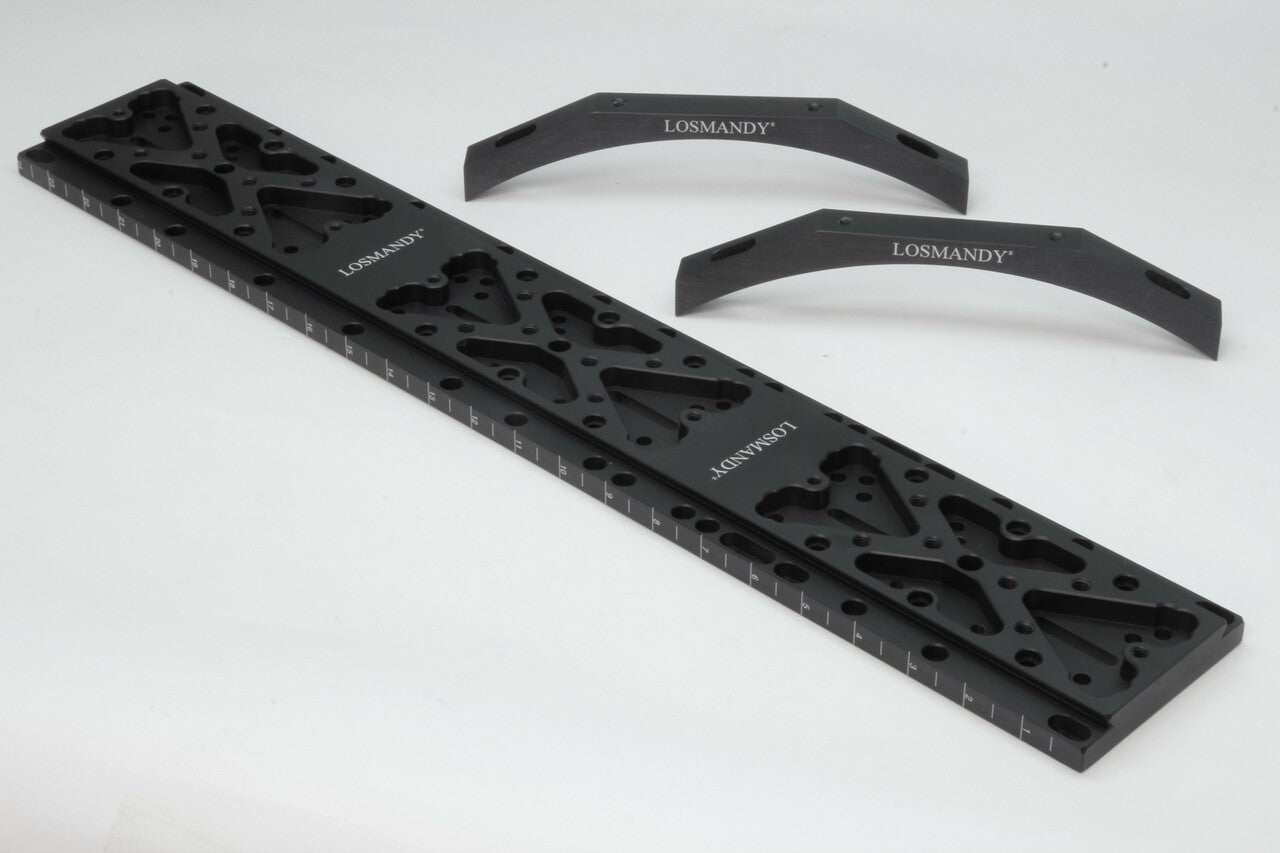
This is Losmandy's D-series dovetail plate cut for the Meade 14-inch tube. It bolts to the tube's existing holes at a 22.00-inch separation, so there is no drilling. The plate is 24 inches long and 0.75 inches thick, weighs 5.5 lb, and puts the top of the dovetail bar 1.20 inches above the top of the tube. One safety stop screw and the mounting screws are included.
Who It's For
A 14-inch SCT is at the heavy end of what any German equatorial will carry, and the dovetail under it is not the place to economise. This is a 24-inch plate on a 22-inch hole separation — the full length of the tube's own mounting points, with clamping surface to match and enough travel to rebalance a long imaging train.
Key Features & Design
- Cut for the Meade 14" OTA, bolting to existing holes at 22.00" separation.
- 24 inches long, 0.75 inches thick, at 5.5 lb.
- 1.20 inches from the top of the tube to the top of the dovetail bar.
- Safety stop screw and mounting screws included.
- D-series profile, accepted by every current Losmandy saddle.
Recommended Uses
Mounting a Meade 14-inch SCT on a G-11, GM811 or G11T. Observatory and permanent-pier installations with a large catadioptric. Long-focal-length imaging where the camera train is substantial and balance changes between sessions. Visual observing with a large aperture on a mount sized for it.
Compatibility and Accessory Notes
- Telescope: the Meade 14" OTA, using its existing 22.00" hole pattern.
- Saddles: any Losmandy D-series saddle. For a tube this size, the mount matters more than the saddle — Losmandy publishes 60 lb imaging capacity for a G11G and 75 lb for a G11T.
- Guide scope: the DVR108 rings clamp to the dovetail, with the DVR66 camera ring to steady a guide camera.
- Front counterbalance: a 14-inch SCT with a camera is markedly rear-heavy. The 5" counterbalance system bolts to the plate to trim it.
- Safety: the dovetail safety knob set is worth having under a tube of this mass.
Good to Know Before You Order
- 5.5 lb of plate, before the telescope. With a 14-inch SCT and a camera train you are working near the capacity of most mounts — send us the full list and we will add it up before you order.
- It is cut for the Meade 14" specifically, at a 22.00" hole separation. The 16" tubes use different patterns and have their own plates.
- 24 inches is a long, heavy bar to handle while bolting a 14-inch tube to it. It is a two-person job on a bench rather than a solo one in the dark.
- Mounting screws are included.
- Specifications are Losmandy's published figures.
Frequently Asked Questions
Is it difficult to set up?
The bolting is straightforward — existing holes, supplied screws. The awkward part is the mass: plan on a bench and a second pair of hands.
Do I need to drill the tube?
No. It uses Meade's own 22.00" hole pattern.
What mount do I need under it?
More than the plate decides that. Losmandy publishes 60 lb imaging for a G11G and 75 lb for a G11T — tell us your full setup and we will work out which applies.
Will it fit a Meade 16"?
No — the 16" f/8 and f/10 tubes have their own plates.
Can I mount a guide scope on it?
Yes, and on a plate this long there is room for it well clear of the tube.
Bottom Line
In short: a 24-inch Losmandy D-series plate cut for the Meade 14-inch tube, 0.75" thick at 5.5 lb, bolting to its existing 22.00" holes with screws and a safety stop included.
| Model | Losmandy DM14 D-series dovetail plate for Meade 14" OTA |
|---|---|
| Telescope | Meade 14" OTA — bolts to existing holes |
| Hole separation | 22.00" |
| Length | 24" |
| Thickness | 0.75" |
| Weight | 5.5 lb |
| Height, top of tube to top of dovetail bar | 1.20" |
| Dovetail profile | Losmandy D-series |
| Included | One safety stop screw and mounting screws |
| Source | Losmandy DM14 product data |
You may also like
Recently viewed
Recent Blog Posts
View all
Your Guide Graph Is Lying to You
Read More

D-Size vs V-Size: A Complete Guide to Telescope Dovetail Systems
Read More

What Is Back Focus in Astrophotography? Telescope Reducers, Flatteners, and Spacing Explained
Read More