


- Description
- Specifications
Product Overview
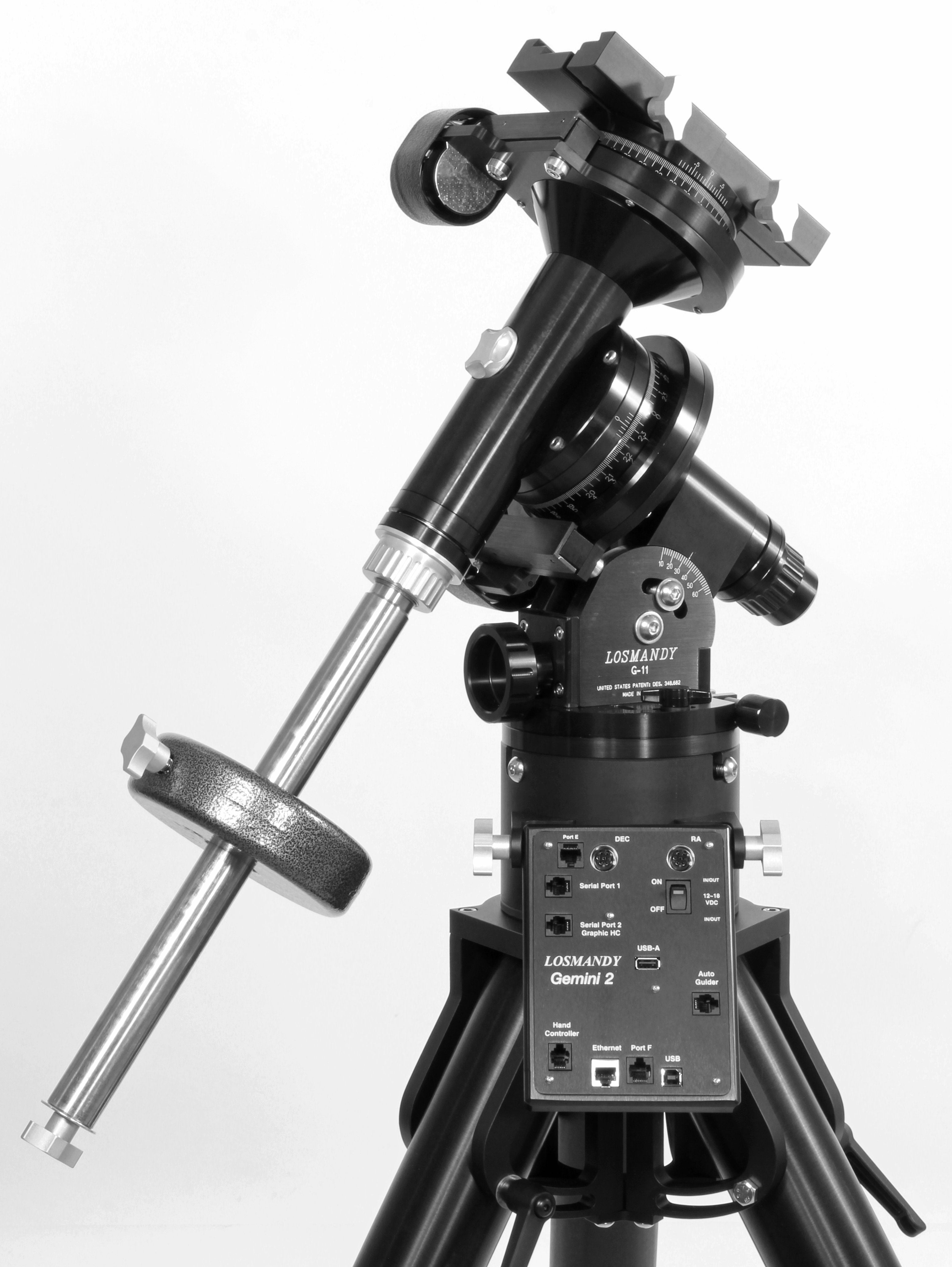
The Losmandy G11G is a precision German equatorial mount supplied with the Gemini 2 GOTO servo system, a counterweight shaft, one 21 lb counterweight and the folding heavy-duty tripod. Losmandy publishes an instrument capacity of 60 lb for imaging and 75 lb for visual use, on a 33 lb equatorial head. Both axes run 5.625-inch, 360-tooth worm gears machined from 7075 aluminium, and Losmandy rates uncorrected tracking at ±5 arcseconds or better, with corrected periodic error often at ±2.5 arcseconds or better. This example ships with Level 6 firmware and the servo upgrade.
Who It's For
This is a good match if you image with a substantial refractor, astrograph or SCT and want a mount whose capacity is not the limiting factor in the setup. A 60 lb imaging rating leaves genuine headroom once camera, filter wheel, guider and cabling are attached. It suits a permanent pier or an observatory as readily as a regularly transported rig, and it suits an observer who would rather own one mount for a long time than step up through several.
Key Features & Design
- 60 lb imaging / 75 lb visual instrument capacity on a 33 lb equatorial head.
- 5.625-inch, 360-tooth 7075 aluminium worm gears on both axes — the same large gear on RA and DEC rather than a smaller DEC gear.
- Dual-supported, ball-bearing-housed ground high-precision brass worm on both axes.
- ±5 arcsecond or better uncorrected tracking, with corrected periodic error often at ±2.5 arcseconds or better.
- Built-in permanent periodic error correction — the correction is stored in the mount rather than re-trained each session.
- Gemini 2 GOTO: a DC servo motor based computerised positioning system, with GOTO accuracy published at up to half an arcminute.
- Supports altitudes from 0° to 68°, covering equatorial through high-latitude sites.
- Runs on 12–18 V DC.
- Level 6 firmware and servo upgrade included on this configuration.
Mechanical Design
The defining figure on the G11G is that both axes carry the same 5.625-inch, 360-tooth worm gear. A larger gear turns more slowly for a given tracking rate, which reduces the angular contribution of any single tooth error — that is the mechanical reason behind the published ±5 arcsecond uncorrected figure. The worm itself is a ground high-precision brass component, dual supported and housed in ball bearings at both ends rather than cantilevered.
Periodic error correction is built in permanently, so the mount carries its own correction rather than relying on a session-by-session training run. Losmandy's own sample frame for this mount is a 300-second unguided hydrogen-alpha exposure at 840 mm focal length with 3.8 µm pixels, taken with a Sky-Watcher 120ED Esprit and a ZWO ASI1600MM monochrome camera, unguided and with no periodic error correction applied, under Bortle 9+ skies.
Recommended Uses
Long-exposure deep-sky imaging with a heavy refractor, astrograph or SCT plus a full imaging train. Observatory and permanent-pier installations, using the MA adapter in place of the tripod. Visual observing with large instruments at up to the 75 lb visual rating. Remote and automated operation through the Gemini 2 system. High-latitude observing, within the published 0° to 68° altitude range.
Compatibility and Accessory Notes
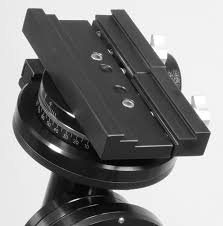
Saddle: Losmandy mounts in this family take the G-11 saddle plate, which accepts both Losmandy D-series and Vixen-style V-series dovetail plates. We stock the D-series universal plates in 14", 19" and 24" lengths along with the OTA-specific plates.
Counterweights: one 21 lb weight is included. Losmandy offers additional counterweights in 7, 11 and 21 lb sizes, and we stock all three.
Pier and tripod: supplied on the folding HD tripod. For a permanent installation the MA tripod/pier adapter fits this mount and also sits on top of permanent piers.
Polar alignment: the iPolar electronic polar scope mounts in the polar scope port, and a G11/G11T iPolar adapter is available for it.
Power: 12–18 V DC. We stock the Losmandy 120 V AC to 15 V DC adapter for mains use and a 12 V power cord for field use.
Good to Know Before You Order
The head alone is 33 lb. With the HD tripod at 35 lb and a 21 lb counterweight, this is a mount you site and leave, or move in pieces. Worth planning where it will live.
Published altitude range is 0° to 68°. That covers all of Canada comfortably; it is a figure that matters only for far-northern work.
Tracking figures are Losmandy's published specifications, measured on their equipment. Real performance at the eyepiece or sensor also depends on balance, polar alignment and seeing.
Level 6 firmware and the servo upgrade are included on this configuration. If you are comparing against an older G11G, that is a difference worth noting.
Frequently Asked Questions
Is it difficult to set up?
The mount arrives assembled as a head, tripod, shaft and weight. A session means setting the tripod, dropping the head on, fitting the shaft and weight, balancing, and polar aligning — then the Gemini 2 handles the pointing. The learning is in the Gemini 2 interface rather than the mechanics, and Losmandy's manuals cover it.
How much can it really carry?
Losmandy publishes 60 lb for imaging and 75 lb for visual use. The imaging figure is the one to plan against, because it accounts for the tighter tracking demands of a long exposure.
What is the difference between the G11G and the G11T?
The G11T uses a Titan RA axis: a 6.75-inch, 270-tooth RA gear against the G11G's 5.625-inch, 360-tooth, and a published 75 lb imaging capacity against 60 lb. Its head is heavier at 46 lb RA plus 16 lb DEC, and its published altitude range is 12° to 72° rather than 0° to 68°.
Does it need a computer to run?
No. The Gemini 2 operates from its hand controller as a self-contained GOTO system. It can also be driven from a computer if you want to.
Can I put it on a pier?
Yes — the MA adapter is made for both the tripod and permanent piers.
Bottom Line
A 60 lb-capacity German equatorial with 5.625-inch 360-tooth gears on both axes, permanent periodic error correction, Gemini 2 GOTO and the folding HD tripod. It is a mount sized to stop being the limiting factor in an imaging rig.
| Model | G11G |
|---|---|
| Mount type | German equatorial, Gemini 2 GOTO servo |
| Instrument capacity | 60 lb imaging · 75 lb visual |
| Equatorial head weight | 33 lb |
| Worm gears | 5.625" diameter, 360 tooth, 7075 aluminium — both axes |
| Worm | Dual supported, ball-bearing housed, ground high-precision brass |
| Uncorrected tracking | ±5 arcseconds or better |
| Corrected periodic error | Often ±2.5 arcseconds or better |
| Periodic error correction | Built-in, permanent |
| GOTO accuracy | Up to 1/2 arcminute |
| Altitude range | 0° to 68° |
| Power | 12–18 V DC |
| Firmware | Level 6 firmware and servo upgrade included on this configuration |
| Supplied tripod | Folding heavy-duty tripod: height 33" to 52", tip-to-tip 34" retracted / 53" extended, folds to 14" x 14" x 39", 29" between leg centres retracted and spread, carries up to 425 lb, 35 lb |
| Included | Equatorial head, Gemini 2 GOTO, counterweight shaft, one 21 lb counterweight, folding HD tripod |
| Counterweight options | 7, 11 and 21 lb available separately |
| Source | Losmandy G11G datasheet and Losmandy product data |
You may also like
Recently viewed
Recent Blog Posts
View all
Your Guide Graph Is Lying to You
Read More

D-Size vs V-Size: A Complete Guide to Telescope Dovetail Systems
Read More

What Is Back Focus in Astrophotography? Telescope Reducers, Flatteners, and Spacing Explained
Read More