


- Description
- Specifications
OAG-L is the latest iteration of M68 OAG with a larger prism size of 12*12mm. The bigger clear aperture brings wider field of view in guiding. It is easy to use, and suitable for users who are interested in long focal length photography. To take the most advantage of it, we recommend you to match it with large format guiding cameras.
Features
- Lightweight and exquisite, 17.5mm thickness.
- Prism size: 12*12mm.
- The effective light-passing aperture is 11.7mm*8.3mm.
- Can be used to connect the main camera and guide camera simultaneously. No guide telescope required.
- Packaged with an M48 sensor tilt plate (5mm).
- For guiding, OAG-L can only work with ASI Mini cameras like ASI174MM Mini, ASI290MM Mini and ASI120MM Mini.

- Considering the large prism size, we don’t recommend you use OAG-L with telescopes whose clear aperture is smaller than M48.
- Yet it is recommended to use with 2” EFW or 7x36mm EFW, and with APS-C cameras (ASI2600) or full frame cameras (ASI6200/2400). The large clear aperture supports full frame cameras without vignetting.
- The major differences between OAG-L and M68 OAG are about the prism size and the threads. OAG-L removed the inner threads so you can directly use the screws to connect it to other equipment.
- If the thread of your telescope side is M48, then you don’t need to remove the M48 sensor tilt plate coming with OAG-L. On the contrary, you need to remove it and use some other sensor tilt plate at the corresponding thread of your telescope.
The pictures below show how to remove the sensor tilt plate:


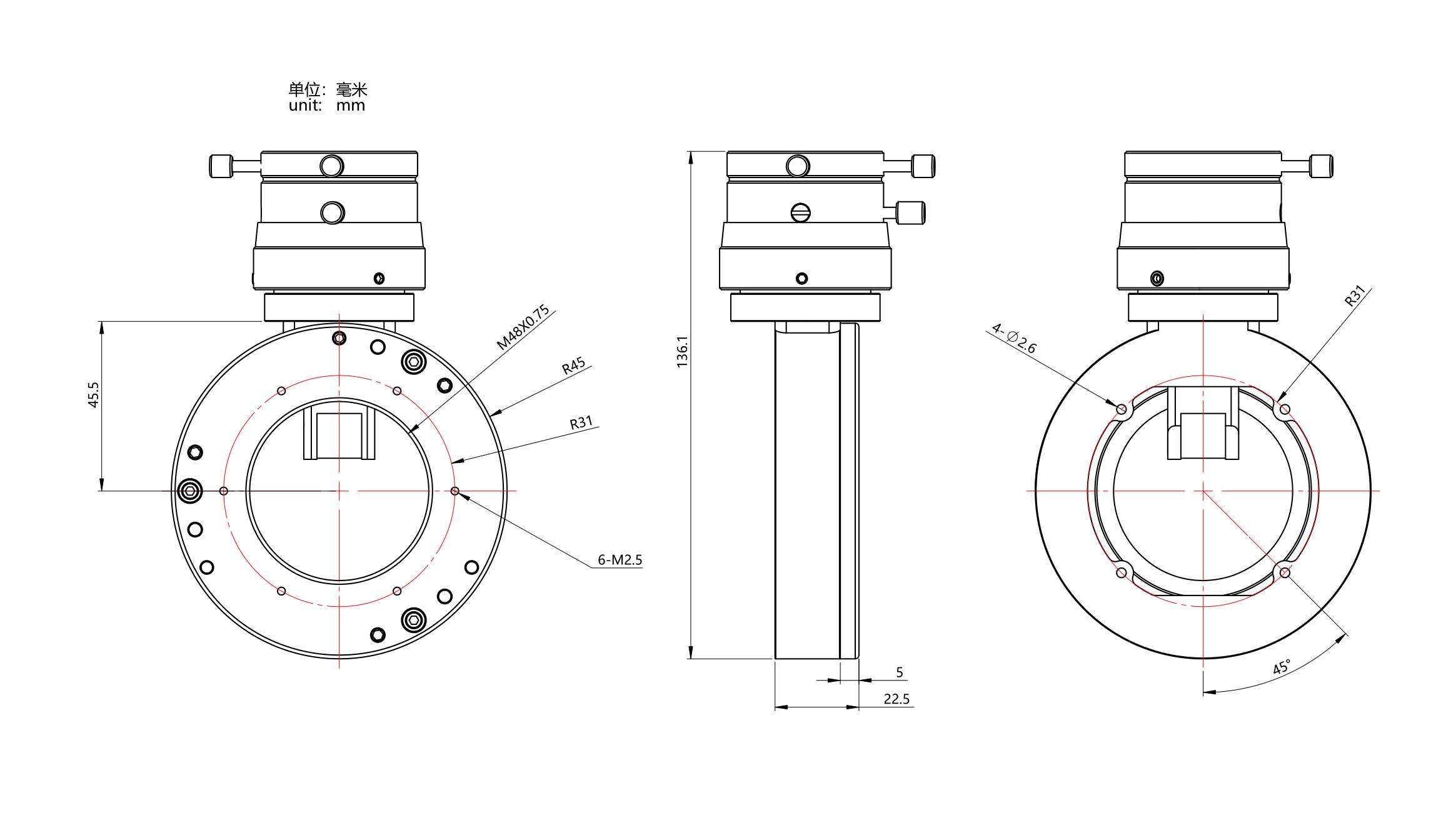
Mechanical Diagram:
Connection Guide:


You may also like
Recently viewed
Recent Blog Posts
View all
Your Guide Graph Is Lying to You
You drove ninety minutes to dark sky, PHD2 held 0.4 arcseconds all night, and half your subs still have eggs for stars. Here are the three things your
Read More
Read More

D-Size vs V-Size: A Complete Guide to Telescope Dovetail Systems
What's the difference between D-size and V-size telescope dovetails? Here's everything you need to know.
Read More
Read More

What Is Back Focus in Astrophotography? Telescope Reducers, Flatteners, and Spacing Explained
What Is Back Focus in Astrophotography? Telescope Reducers, Flatteners, and Spacing Explained
Back focus is one of those astrophotography terms that c
Read More
Read More