
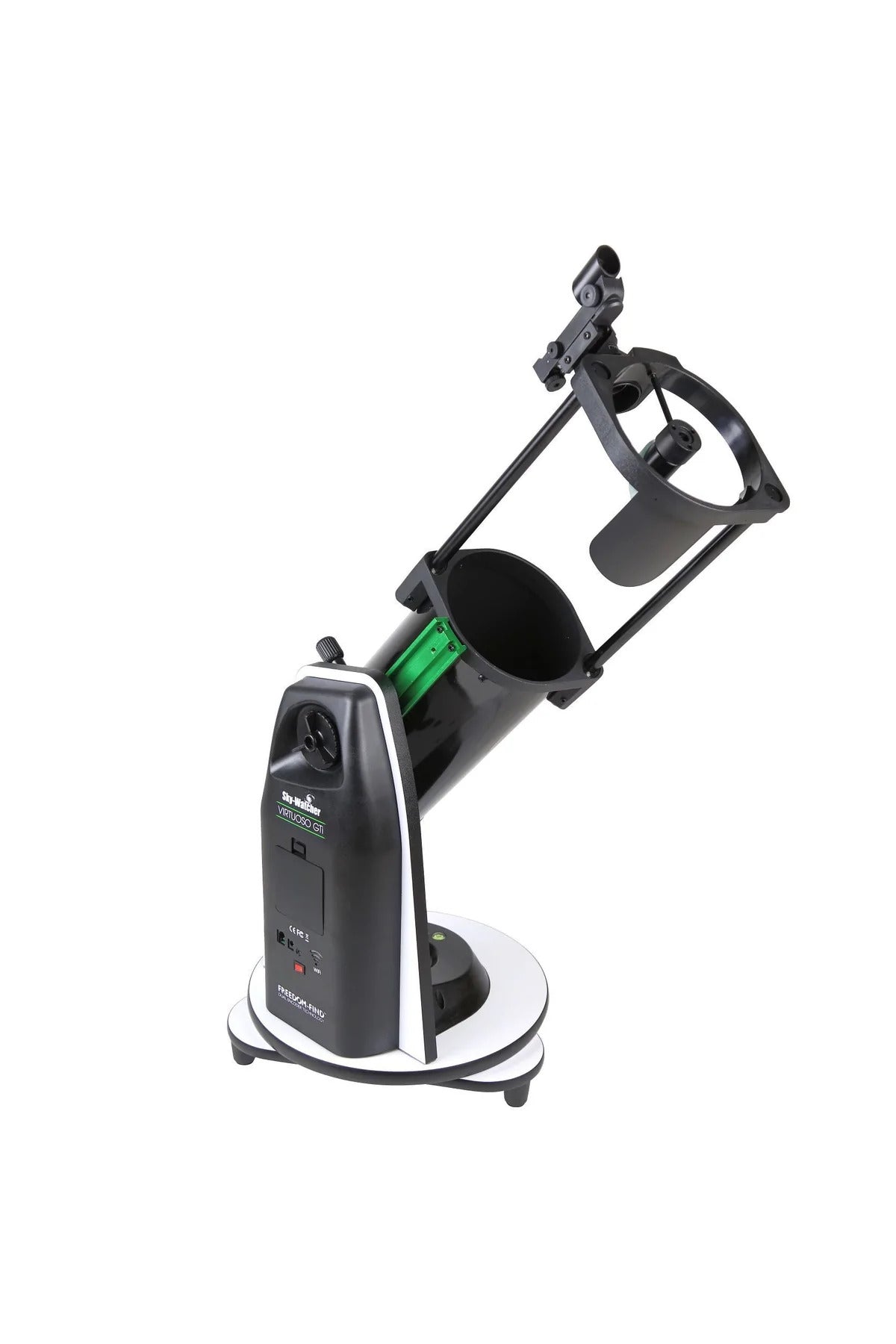
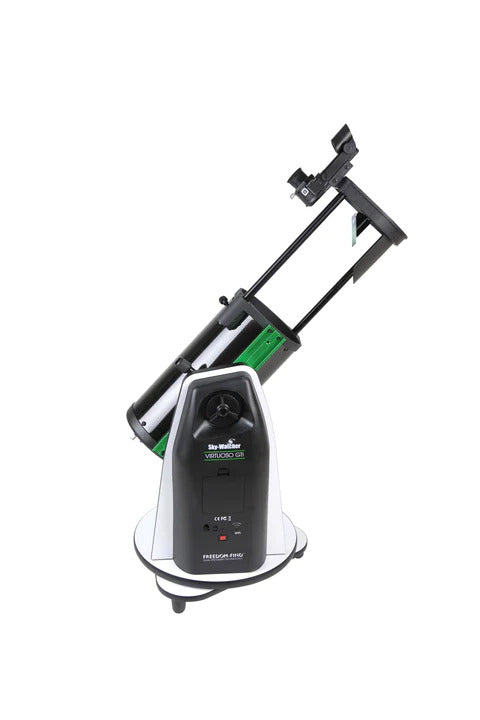
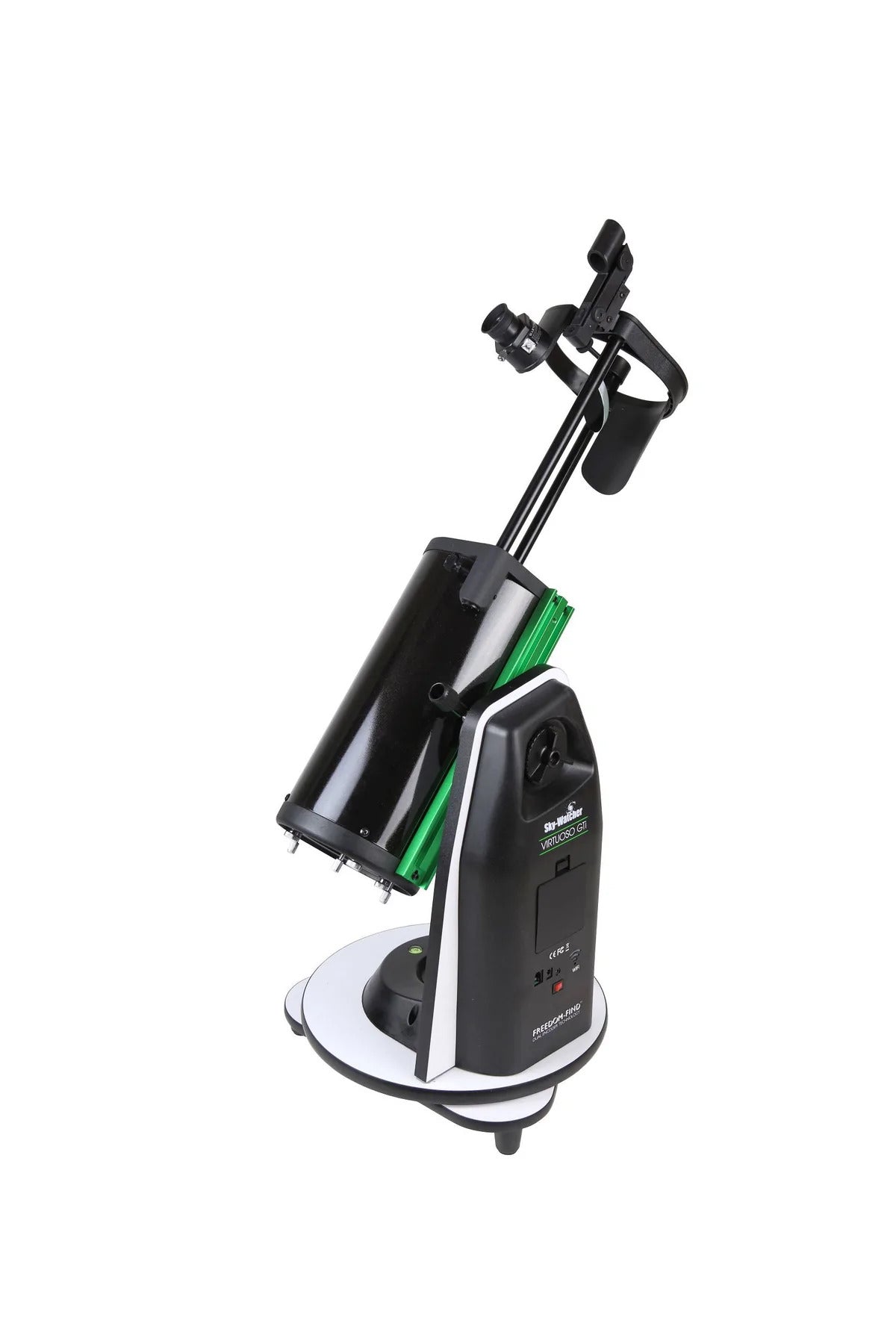


- Description
- Specifications
At a Glance
- Aperture: 150 mm
- Focal length: 750 mm
- Focal ratio: f/5
- Mirror coating: Radiant Aluminum Quartz (RAQ), 94% reflectivity
- Control: Built-in Wi-Fi, SynScan Pro app, 10,000+ object database
- Power: 8x AA batteries or external 12 V supply, neither included
Product Overview
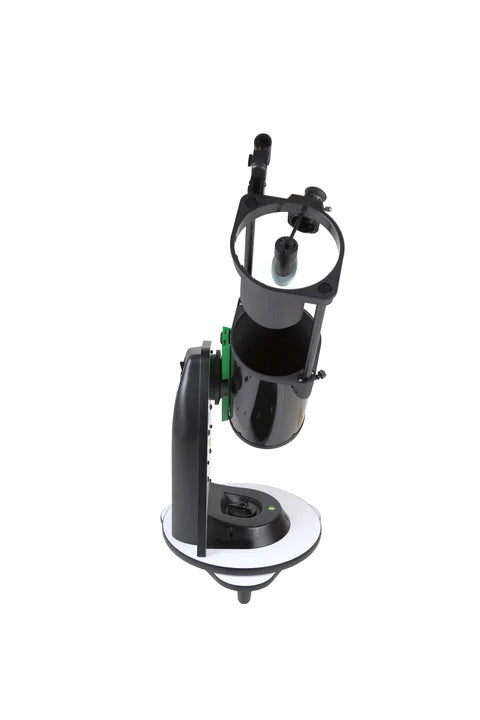
The Sky-Watcher Virtuoso GTi 150P is a 150 mm f/5 tabletop Dobsonian on a motorised, Wi-Fi-equipped GoTo base. It is the larger of the two Virtuoso GTi models, pairing six inches of aperture with a collapsing optical tube and a base you drive from a phone or tablet using Sky-Watcher's free SynScan Pro app.
At 750 mm focal length it stays wide-field and easy to use, with the Radiant Aluminum Quartz coating on all optical surfaces at 94% reflectivity. The app carries a database of more than 10,000 objects spanning the Messier, NGC, IC and Caldwell catalogues, and the mount tracks at sidereal, lunar and solar rates once aligned.
Who It's For
This is a good match if you want the most aperture available in a driven tabletop package. Six inches on a GoTo base is a genuinely capable combination, and the collapsing tube keeps it in the category of telescope you carry out with one hand rather than plan an evening around.
It works well as a first telescope for someone who is confident they will stay interested, and as a grab-and-go second scope for observers who own something larger and want a driven instrument for casual nights, camping and travel. It is also a strong outreach scope, since it can be aimed from a phone while someone else is at the eyepiece.
Key Features & Design
- 150 mm aperture on a driven base: the largest optic in the Virtuoso GTi range, so faint targets the app can find are also targets the mirror can actually show.
- Wi-Fi GoTo without a hand controller: the mount broadcasts its own network and the SynScan Pro app does the pointing, so there is no separate controller to charge, store or lose.
- 10,000+ object database: Messier, NGC, IC and Caldwell, which is a deeper observing list than this aperture will work through quickly.
- Freedom Find dual encoders: the scope can be pushed by hand at any time without losing its alignment, so browsing manually and slewing to a target are both available all evening.
- Four alignment routines: One-Star, Brightest Star, North-Level and Three-Star, letting you trade setup time against pointing precision to suit the night and your horizon.
- Collapsible optical tube: the tube shortens for storage and transport while holding collimation, which is what keeps a six-inch driven scope portable.
- V-style dovetail saddle: the base takes a standard V bar, so it is not locked to the tube it arrives with.
Optical / Mechanical Design
150 mm at 750 mm focal length gives f/5. The supplied 25 mm eyepiece produces 30x over a wide field, which is exactly what you want alongside a GoTo system — a generous field means a target only has to land approximately right to be visible, so small pointing errors do not become a hunt. The 10 mm eyepiece gives 75x for lunar and planetary detail.
The larger mirror is the reason to choose this over the 130P. Light collection scales with mirror area rather than diameter, so the step from 130 mm to 150 mm is a bigger gain than the numbers look, and it shows most on the faint galaxies and nebulae the app will happily slew to.
Underneath, an encoder on each axis reports true position independently of the motors. That is what allows Freedom Find to work: nudging the telescope by hand does not desynchronise the computer's model of where it is aimed, where on most GoTo mounts the same action forces a fresh alignment.
Recommended Uses
Guided deep-sky observing is where this scope is strongest — working through a target list without spending the session searching, which matters most under suburban skies where faint objects are hard to locate by eye.
Lunar and planetary observing benefits from tracking holding the object still at higher magnification. The scope also suits family and outreach observing, camping and travel, and smartphone photography of the Moon and bright planets with the mount tracking underneath.
Compatibility and Accessory Notes
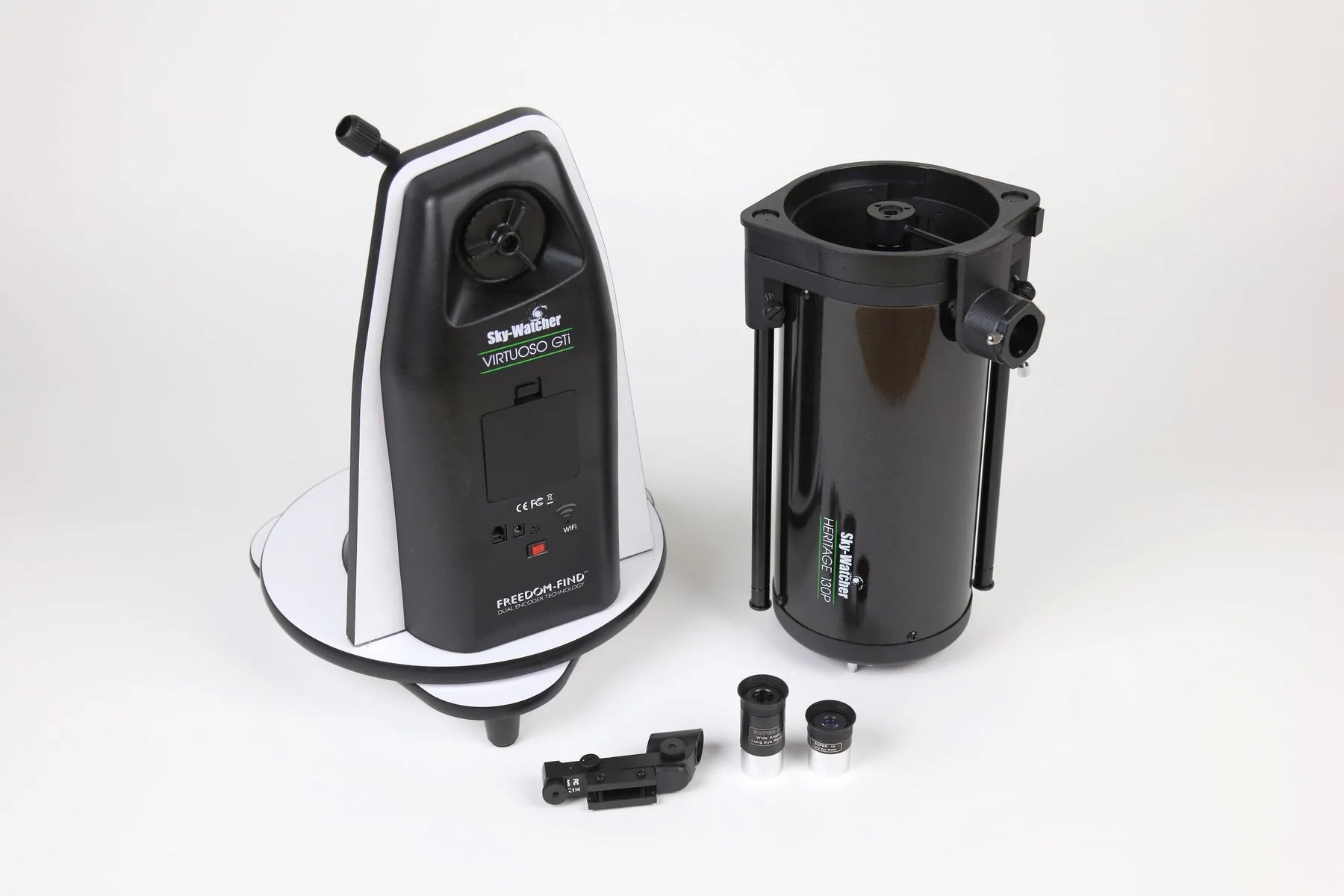
Sky-Watcher supply the Virtuoso GTi base and mount assembly, the optical tube, a red dot finder, and 25 mm and 10 mm Super eyepieces, so the scope is usable on the first evening without additional purchases.
Power is eight AA batteries or an external 12 V supply, and neither is included. Rechargeable AAs or a compact 12 V pack both work, and it is worth deciding before the first clear night.
The free SynScan Pro app for iOS and Android is the main interface, and the mount also has a port for a SynScan hand controller if you would rather use physical buttons — that controller is a separate purchase. A collimation cap belongs with any Newtonian.
If you would like a hand picking a power solution or a next eyepiece, tell us how you plan to observe and we will suggest something that fits.
Good to Know Before You Order
No solar filter is included, and the telescope must never be aimed at the Sun without one. The mount does offer solar tracking, which is a real feature — but it is only usable with a properly fitted, undamaged full-aperture solar filter over the front of the tube. Sky-Watcher's original Virtuoso included a solar filter; the GTi does not. Get in touch and we will make sure you have the correct filter for this aperture before you try it.
Power is not supplied. Budget for eight AA cells or a 12 V external supply as part of the purchase.
It is a tabletop telescope and needs a surface. No tripod is included. A firm table or stool at seated height is what it wants, and because this is the heavier of the two GTi models, a stable one is worth choosing carefully.
Alignment is a start-of-session routine. The app guides you through one of four methods in a few minutes, and Freedom Find means handling the scope afterwards will not undo it.
Deep-sky imaging is outside what this mount does. An alt-azimuth base rotates the field during an exposure even while tracking keeps the object centred, so long exposures smear. Smartphone shots of the Moon and bright planets work well; anything further needs an equatorial mount.
Frequently Asked Questions
Is it difficult to set up?
No. Set the base on a table, fit and extend the tube, add batteries, join the mount's Wi-Fi network from your phone, and run an alignment in the app. Allow extra time on the first evening for learning the app, and a few minutes on every evening after that.
How much more does it show than the Virtuoso GTi 130P?
Noticeably more on faint objects, because light collection follows mirror area rather than diameter. Both share the same base, the same app, the same database and the same accessories — the difference is purely the size of the mirror and the size and weight of the package around it.
Do I need mobile signal or internet?
No. Your phone joins the network the mount broadcasts, so nothing depends on cellular coverage. That matters more than it sounds, since dark sites and good signal rarely coincide.
How does it compare to the Heritage 150?
Same aperture and focal ratio in the same collapsible tabletop format. The Virtuoso adds the motorised GoTo base, Wi-Fi control, tracking, Freedom Find, a red dot finder and two eyepieces. The Heritage costs less and shows the same view; the Virtuoso finds and follows things for you.
Can I move it by hand once it is aligned?
Yes. Freedom Find uses an encoder on each axis to track true position, so pushing the tube to look at something does not cost the alignment. Hand control back to the app and it still knows where it is pointing.
What is in the box?
The Virtuoso GTi base and mount assembly, the optical tube assembly, a red dot finder, and 25 mm and 10 mm Super eyepieces. Batteries, a power supply and a solar filter are not included.
Bottom Line
In short: a 150 mm f/5 collapsible tabletop Dobsonian on a Wi-Fi GoTo base you drive from your phone, with dual encoders that let you move it by hand without losing alignment. It ships with a finder and two eyepieces, it needs power and a table, and it is the most aperture Sky-Watcher put on this base.
| SKU | S21205 |
| UPC | 050234212052 |
| Optical Specifications | |
|---|---|
| Optical Design | Newtonian |
| Mirror Coating | Protected Aluminum |
| Reflectivity | 94% |
| Mirror Type (Monolithic/Conical/Fused conical) | Monolithic |
| Glass Type | Borosilicate |
| Primary Aperture (mm) | 150 |
| F/Ratio | 5 |
| Focal Length (mm) | 750mm |
| Secondary Diameter (minor axis) | 48mm |
| Secondary Obstruction by Diameter | 32% |
| Secondary Obstruction by Area | 10% |
| Primary cell supports (how many support points) | Edge Support |
| Optical Quality | Diffraction limited (1/4 wave) |
| Collimatable Cell | Secondary & Primary |
| Mechanical Specifications | |
| Focuser Type | Helical |
| Focuser Size | 1.25" |
| Focuser: Dual or Single Speed | Single |
| Compression Ring | No |
| Optical Tube length (exten/retract) | 27"/16" |
| Optical Tube weight | 8 pounds |
| Assembled base weight | 10.9 pounds |
| Total Weight | 19.15 pounds |
| Type of bearing used (telfon/roller) | Roller |
| Hardware included with base | Yes |
| Collapsible Tube | Yes |
| Tripod Mount | 3/8 thread block |
| Electronic Specifications (GoTo only models) | |
| Required Power | 12v/AAs (8x) |
| Power port diameter | 2.1mm |
| Freedom Find | Yes |
| Clutch Type | Hand Clutch |
| Can clutches be adjusted | Yes |
| Built-in WiFi | Yes |
| Hand Controller | Optional |
| Database | Complete Messier, Caldwell, NGC, IC and SAO catalogs, user defined objects. Total 10,000+ objects |
| Accessories | |
| Eyepieces | 25mm and 10mm SUPER eyepiece (1.25") |
| Collimation eyepiece | Yes |
| Included finder | Red Dot |
| Mounting Hardware | Dobsonian |
| Additional Accessories | None |
| Manual | Yes |
| Case | No |
| Shipping Weight | 21 pounds |
| Shipping Dimensions (Box 1 / Box) | 25"x17"x17" |
| Observational Info | |
| Dawes Limit | 0.77 |
| Rayleigh Limit | 0.93 |
| Limiting Magnitude | 13.36 |
| Minimum Magnification | 21x |
| Maximum Magnification | 295x |
| Magnification with included eyepieces | 30x (25mm)/75x (10mm) |
| Light Gather (compared to next size down) | 44% (Compared to Heritage 130mm telescope) |
| Intended use | Visual |
You may also like
Recently viewed
Recent Blog Posts
View all
Your Guide Graph Is Lying to You
Read More

D-Size vs V-Size: A Complete Guide to Telescope Dovetail Systems
Read More

What Is Back Focus in Astrophotography? Telescope Reducers, Flatteners, and Spacing Explained
Read More