




- Description
One of the most important obstacles for the exploration of the night sky is the brightening of the night sky by artificial lights, such as streetlights. The night sky is not really dark in the vicinity of towns or cities, which reduces the visibility of objects bejond the solar systems enourmously. Depending on the type of the celestial object it is possible to increase the contrast dramatically by blocking the annoying artifical light.
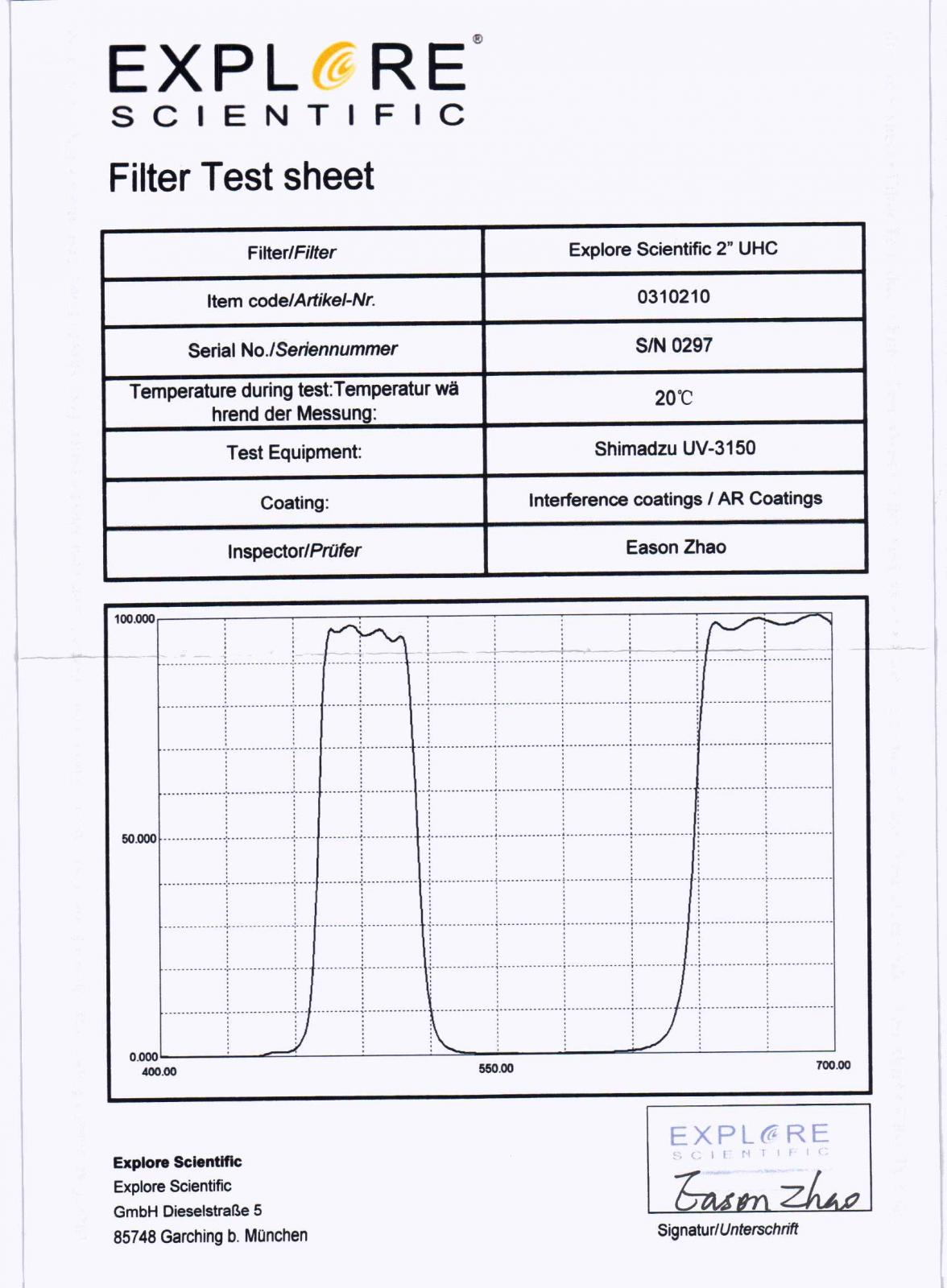
The Explore Scientific UHC filter uses a characteristic property of the so called emmission nebulae. Those objects glow in special colors, the so called emmission lines. Those emmission lines are linked to chemical elements - in this case hydrogen at 486nm and 656nm, plus oxygen at 496nm and 501nm.
The Explore Scientific UHC nebula filter blocks all other colors (and thereby nearly all of the artificial light) and only the emmission line of the hydrogen and oxygen can pass the filter. The result is astonishing: suddenly nebulae are visible at locations that were completely empty without filters. In suburbian skies for example the Owl-nebula M97, the Veil-nebula Ngc 6992 or even the bright Dumbell-nebula M27are not clearly visible.
By using this filter you can see the nebulae and their structures without problems. A must for every visual observer. The Explore Scientific nebula filters come with a individual test certificate - your guarantee to receive a premium filter.
UHC Nebula Filter. Range from 458nm to 508nm with peak at 488nm. Peak transmission 96.7%
You may also like
Recently viewed
Recent Blog Posts
View all
Your Guide Graph Is Lying to You
You drove ninety minutes to dark sky, PHD2 held 0.4 arcseconds all night, and half your subs still have eggs for stars. Here are the three things your
Read More
Read More

D-Size vs V-Size: A Complete Guide to Telescope Dovetail Systems
What's the difference between D-size and V-size telescope dovetails? Here's everything you need to know.
Read More
Read More

What Is Back Focus in Astrophotography? Telescope Reducers, Flatteners, and Spacing Explained
What Is Back Focus in Astrophotography? Telescope Reducers, Flatteners, and Spacing Explained
Back focus is one of those astrophotography terms that c
Read More
Read More