
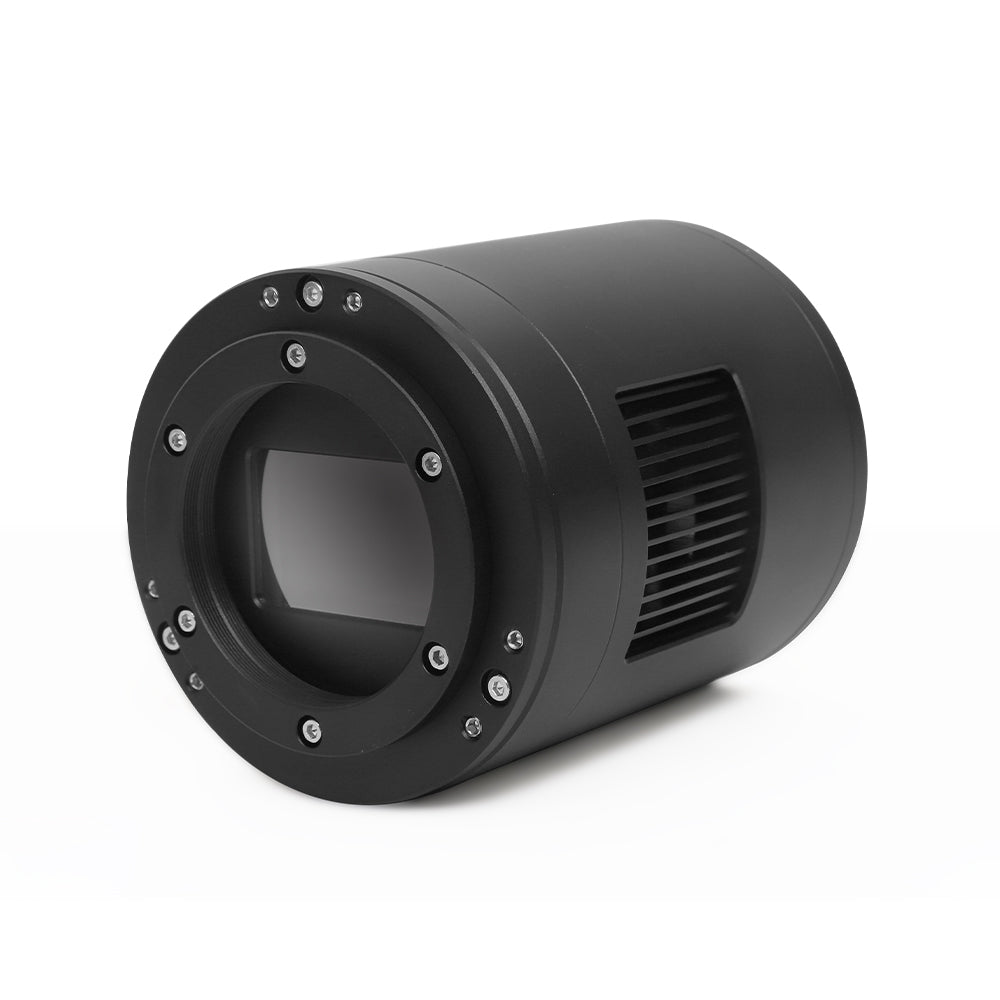

- Description
- Specifications
The ToupTek SkyEye62AM is ToupTek's flagship monochrome full-frame deep sky cooled camera, built around the Sony IMX455 full-frame back-illuminated CMOS monochrome sensor. The IMX455M is widely regarded as one of the finest full-frame monochrome sensors available for deep sky astrophotography — delivering extraordinary quantum efficiency, ultra-low read noise, and maximum flexibility for narrowband and LRGB imaging across an enormous 36×24mm image circle.
Who Is This Product Best For?
The SkyEye62AM is for the most demanding astrophotographers who want the ultimate full-frame monochrome performance for narrowband and LRGB deep sky imaging. It is the ideal choice for serious SHO Hubble Palette imaging, large-scale mosaic projects, and any application where maximum sensor sensitivity, precision cooling, and full-frame image circle coverage are required.
Why Choose This Product?
- Sony IMX455M Full-Frame Monochrome Sensor: 36×24mm image circle, exceptional QE, ultra-low read noise — the premier full-frame monochrome sensor for deep sky imaging.
- Dual-Stage TEC Cooling: Up to 45°C below ambient with ±0.1°C precision control for long narrowband exposures.
- Anti-Dew Window Heater: Four-level adjustable heating for all-condition reliability.
- 512 MB DDR3 Buffer + USB 3.0 5 Gbps: Handles large full-frame monochrome image files without data loss.
- Zero/Low Glow Design: Minimizes amp glow for pristine long-exposure narrowband frames.
- Up to 1-Hour Exposures: Essential for capturing faint nebular structure in narrowband.
- HCG/LCG/HDR Multi-Mode: Adapts sensor performance to different imaging targets and sky conditions.
- Bonus Inclusion: Free SkyEye Tilter included for precision flat field correction across the full-frame sensor.
Recommended Uses
- Full-frame narrowband (Ha, SII, OIII) Hubble Palette imaging of emission nebulae
- LRGB monochrome full-frame deep sky astrophotography
- Large-scale full-frame multi-panel mosaic projects
- Long-exposure scientific and photometric imaging
Compatibility and Accessory Notes
- Requires external 12V 3A DC power supply or stable 11–14V lithium battery
- Requires a full-frame capable telescope or astrograph to cover the 36×24mm sensor
- Compatible with ToupTek OAG-X, AFW-L filter wheel, and StellaVita controller
- Full-frame sensor requires 2" filters at minimum; 48mm or 50mm recommended for edge-to-edge coverage
- M42 thread connection; adapters may be required for some telescopes
- Compatible with INDI, ASCOM, SharpCap, NINA, and APT
Important Limitations
- External power supply required — not USB-powered
- Monochrome sensor — requires filter sets for colour imaging
- Requires a full-frame capable telescope for full image circle coverage
- Full-frame sensor requires a field flattener for edge-of-field sharpness
- Not recommended for beginners without prior monochrome imaging experience
Frequently Asked Questions
Why choose a monochrome full-frame camera over a colour one?
The monochrome sensor delivers full pixel-level sensitivity without the colour filter Bayer array losses, delivering maximum performance for narrowband and LRGB imaging where every photon counts.
What filter size is required?
48mm or 50mm filters provide full coverage without vignetting. 2" filters may show minor vignetting at the extreme corners of the full-frame sensor.
What is the Free SkyEye Tilter for?
The tilter allows precise adjustment of the camera sensor plane relative to the telescope focal plane, achieving a perfectly flat illuminated field across the full 36×24mm sensor.
Our Recommendation
The ToupTek SkyEye62AM is the pinnacle of monochrome deep sky camera performance. If you are a serious astrophotographer who demands the very best from your monochrome imaging system — maximum sensitivity, full-frame coverage, professional cooling, and the flexibility of complete narrowband and LRGB filter workflows — the SkyEye62AM delivers without compromise. Not for beginners.
| Specification | Detail |
|---|---|
| Sensor | Sony IMX455 (Monochrome, Full-Frame, BSI) |
| Sensor Format | Full-Frame (35.6 × 23.8mm) |
| Resolution | 61 MP (9576 × 6388) |
| Pixel Size | 3.76 µm |
| Cooling | Dual-stage TEC (ΔT -45°C below ambient) |
| ADC | 16-bit |
| Buffer | 512MB DDR3 |
| Full Well | 51 ke⁻ |
| Read Noise | 1.0 e⁻ min |
| Dynamic Range | ~87 dB |
| Interface | USB 3.0 |
| Power | 12V DC |
| Back Focus | 17.5 mm |
| Front Thread | M54×0.75 |
| Anti-Dew | Yes |
| Amp Glow | Zero amp-glow |
| Included | SkyEye Tilter (free) |
| OS Compatibility | Windows, Linux, macOS (INDI) |
| Software | ToupSky, SharpCap, NINA, PHD2, ASCOM |
You may also like
Recently viewed
Recent Blog Posts
View all
Your Guide Graph Is Lying to You
Read More
D-Size vs V-Size: A Complete Guide to Telescope Dovetail Systems
Read More
What Is Back Focus in Astrophotography? Telescope Reducers, Flatteners, and Spacing Explained
Read More