

- Description
- Specifications
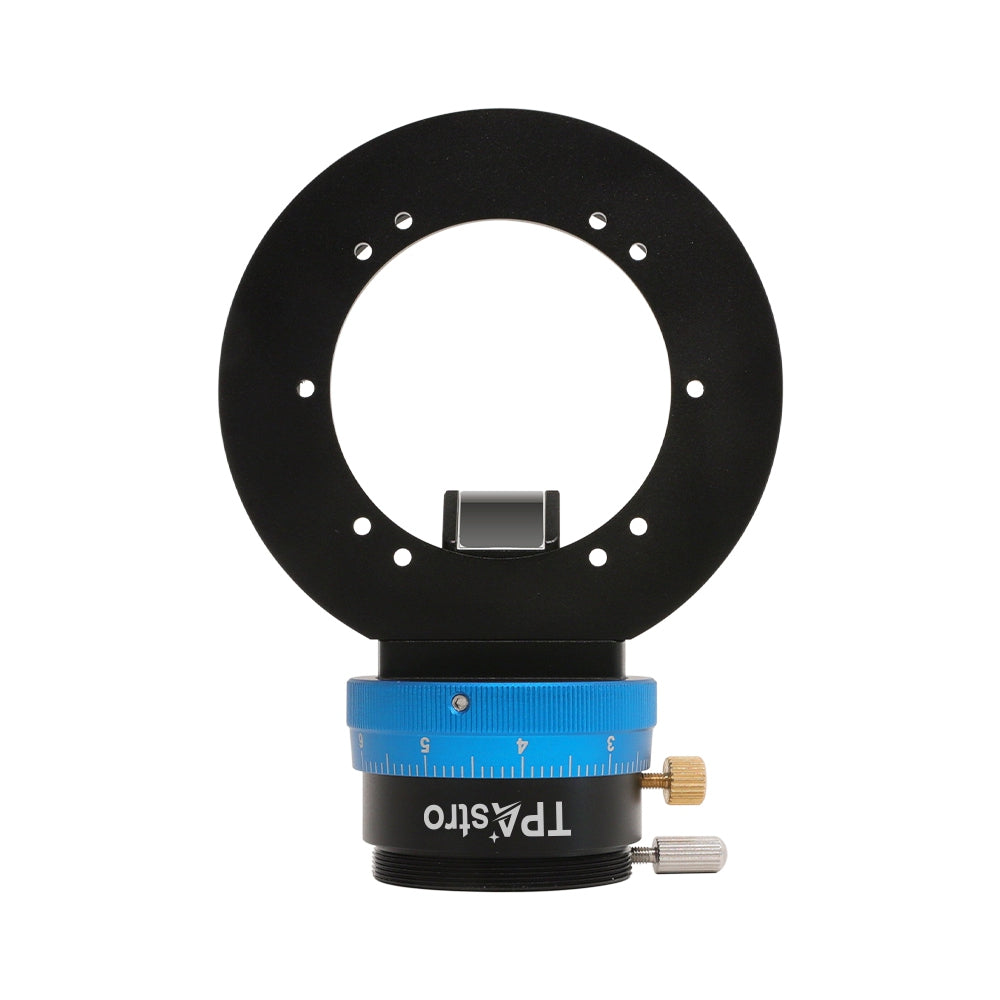
The ToupTek OAG-X is an extra-thin off-axis guider designed for imaging setups where back-focus distance is at a premium. Its slim body profile and large 14×10mm prism make it the preferred choice when the standard OAG-L does not fit within the available back-focus budget — while the larger prism aperture actually provides a wider guide field than the OAG-L, making guide stars easier to find in the OAG port.
Product Overview
The OAG-X uses a 14×10mm high-transmission prism in a precision CNC-machined aluminium body with a reduced optical path thickness compared to the OAG-L. Like the OAG-L, it connects via M54×0.75 threads for direct integration with ToupTek DSO cooled cameras, and accepts any standard 1.25" guide camera in its guide port. The integrated optical path design eliminates differential flexure for precise, stable guiding across long exposures.
Who Is This Product Best For?
Astrophotographers using telescopes or camera systems with limited back-focus distance who cannot accommodate the OAG-L, or those who want the widest possible guide field in their OAG port. The OAG-X's larger prism gives more guide stars to choose from compared to the OAG-L.
Why Choose This Product?
- Extra-thin body — minimal back-focus consumption; fits where the OAG-L does not
- 14×10mm large prism — wider guide field than the OAG-L; more guide star options in the OAG port
- Eliminates differential flexure — guide and imaging cameras share the same optical train
- M54 connection threads — integrates directly with ToupTek ATR and SkyEye camera systems
- 1.25" guide port — accepts any standard ToupTek guide camera
- Precision CNC aluminium construction
Recommended Uses
- Long-exposure deep sky imaging on telescopes with tight back-focus budgets
- Any setup where the OAG-L's body thickness is too large to achieve focus
- Setups requiring the widest possible guide star field in the OAG port
Compatibility and Accessory Notes
- Front/rear thread: M54×0.75
- Guide port: 1.25" — accepts ToupTek GPM174M, GPM462M, GPM290M/C, GPCMOS series
- Compatible cameras: ToupTek SkyEye, ATR, and G3CMOS series with M54 connections
Important Limitations
- Back-focus budget must still be confirmed — while slimmer than the OAG-L, back-focus still needs to be checked for your specific telescope/camera combination
- Guide camera sold separately
Frequently Asked Questions
OAG-X vs OAG-L — which should I choose?
Choose the OAG-X if back-focus is tight or if you want the widest guide field. Choose the OAG-L if back-focus is not a concern and you want the standard-body option. Both eliminate differential flexure equally well.
Our Recommendation
The ToupTek OAG-X is the recommended OAG for tight back-focus setups and for imagers who want the maximum guide star coverage in the OAG port. Its larger prism and slim body make it the more versatile of the two ToupTek OAG options. Pair with the GPM174M for maximum OAG guiding performance.
| Specification | Detail |
|---|---|
| Type | Off-Axis Guider (OAG), Extra-Thin |
| Prism | 14×10mm high-transmission prism |
| Body Thread | M54×0.75 (front and rear) |
| Guide Port | 1.25" (accepts standard guide cameras) |
| Body Thickness | Slim — less back-focus consumption than OAG-L |
| Construction | CNC machined aluminium |
| Compatible Cameras | ToupTek SkyEye62AC/AM, SkyEye24AC, ATR series |
| Compatible Guide Cameras | ToupTek GPM174M, GPM462M, GPM290M, GPCMOS series |
You may also like
Recently viewed
Recent Blog Posts
View all
Your Guide Graph Is Lying to You
Read More

D-Size vs V-Size: A Complete Guide to Telescope Dovetail Systems
Read More

What Is Back Focus in Astrophotography? Telescope Reducers, Flatteners, and Spacing Explained
Read More