

- Description
- Specifications
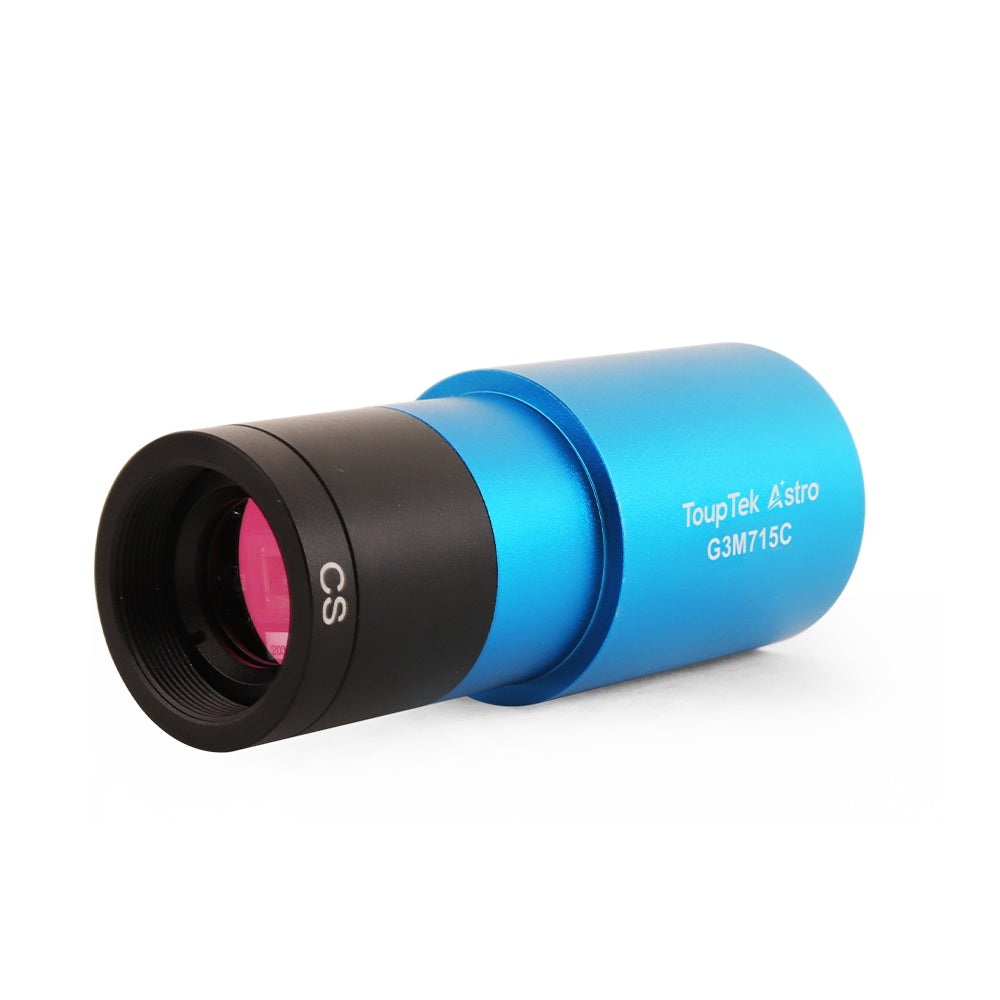
The ToupTek G3M715C is a compact colour planetary camera featuring the Sony IMX715 back-illuminated CMOS sensor. Designed for high-frame-rate planetary imaging, the IMX715 delivers a balance of speed, sensitivity, and colour fidelity that makes it an excellent all-around choice for beginners and intermediate imagers alike. Its compact C-mount body fits seamlessly into any planetary imaging setup — from guide scopes to main imaging telescopes — powered entirely by USB 3.0.
Product Overview
The G3M715C uses Sony's IMX715 BSI sensor in a compact C-mount body with native 12-bit ADC, hardware ROI for boosted frame rates at reduced resolution, and hardware-level zero amp-glow for clean captures at any gain setting. USB 3.0 bus power means no external power supply is needed.
Who Is This Product Best For?
The G3M715C is a strong entry point for beginner and intermediate planetary imagers who want Sony IMX quality at an accessible price. It is equally useful as a compact guide camera on a guide scope or OAG.
Why Choose This Product?
- Sony IMX715 BSI sensor — proven back-illuminated CMOS for strong sensitivity and clean imaging
- High frame rate — captures many frames per second for effective lucky imaging stacks
- Zero amp-glow at hardware level — clean backgrounds at all gain settings
- Native 12-bit ADC — smooth tonal gradation throughout captures
- C-mount compatibility — works with standard telescope nose pieces, OAGs, and guide scopes
- USB 3.0 bus-powered — simple plug-and-play setup with no extra power cables
- Compact, lightweight body — minimal setup burden; ideal for portable or travel rigs
Recommended Uses
- Planetary imaging — Jupiter, Saturn, Mars, Venus
- Lunar detail and surface imaging
- Solar photography with a solar filter
- Lucky imaging and video stacking
- Autoguiding on a guide scope or OAG
Compatibility and Accessory Notes
- Connection: C-mount (Standard and Extended versions available)
- Filters: 1.25" mounted filters via included extension tube
- Software: ToupSky, SharpCap, FireCapture, NINA, PHD2, ASCOM; INDI for Linux
- Power: USB 3.0 bus-powered
Important Limitations
- Not for deep-sky imaging — uncooled sensor; long exposures accumulate thermal noise
- Not for visual observing — requires a computer and capture software
- Colour output — for narrowband imaging, the monochrome equivalent is recommended
Frequently Asked Questions
Is the G3M715C good for a first planetary camera?
Yes. The Sony IMX715 sensor, compact form factor, and broad software support make this an excellent first planetary camera. Plug it in via USB 3.0, download SharpCap or ToupSky, and you are ready to image.
Can I use it for autoguiding?
Yes. The C-mount body is standard for guide scopes and OAGs, and PHD2 supports ToupTek cameras natively.
What software is compatible?
ToupSky, SharpCap, FireCapture, NINA, PHD2, and all ASCOM-compliant platforms. INDI drivers are available for Linux-based systems.
Our Recommendation
The ToupTek G3M715C is a reliable, easy-to-use colour planetary camera that punches above its price point thanks to the Sony IMX715 BSI sensor and ToupTek's proven G3M platform. It is a sound choice for anyone starting out in planetary imaging or looking for a compact guide camera with good sensitivity. For higher resolution or narrowband capability, consider the G3M678 series. For deep-sky imaging, see ToupTek's ATR and SkyEye cooled cameras.
| Specification | Detail |
|---|---|
| Sensor | Sony IMX715 (Colour, RGGB Bayer, BSI) |
| Resolution | 4 MP (2688 × 1520) |
| Pixel Size | 2.0 µm |
| ADC | Native 12-bit |
| Buffer | None (USB 3.0 direct) |
| Hardware ROI | Yes |
| Interface | USB 3.0 |
| Mount | C-mount / CS-mount |
| Back Focus (Standard) | 17.5 mm |
| Back Focus (Extended) | 12.5 mm |
| Filter Compatibility | 1.25" mounted filters via extension tube |
| Cooling | None (uncooled) |
| Amp Glow | Zero amp-glow (hardware level) |
| Power | USB 3.0 bus-powered |
| OS Compatibility | Windows, Linux, macOS (INDI) |
| Software | ToupSky, SharpCap, FireCapture, NINA, PHD2, ASCOM |
You may also like
Recently viewed
Recent Blog Posts
View all
Your Guide Graph Is Lying to You
Read More

D-Size vs V-Size: A Complete Guide to Telescope Dovetail Systems
Read More

What Is Back Focus in Astrophotography? Telescope Reducers, Flatteners, and Spacing Explained
Read More