

- Description
- Specifications
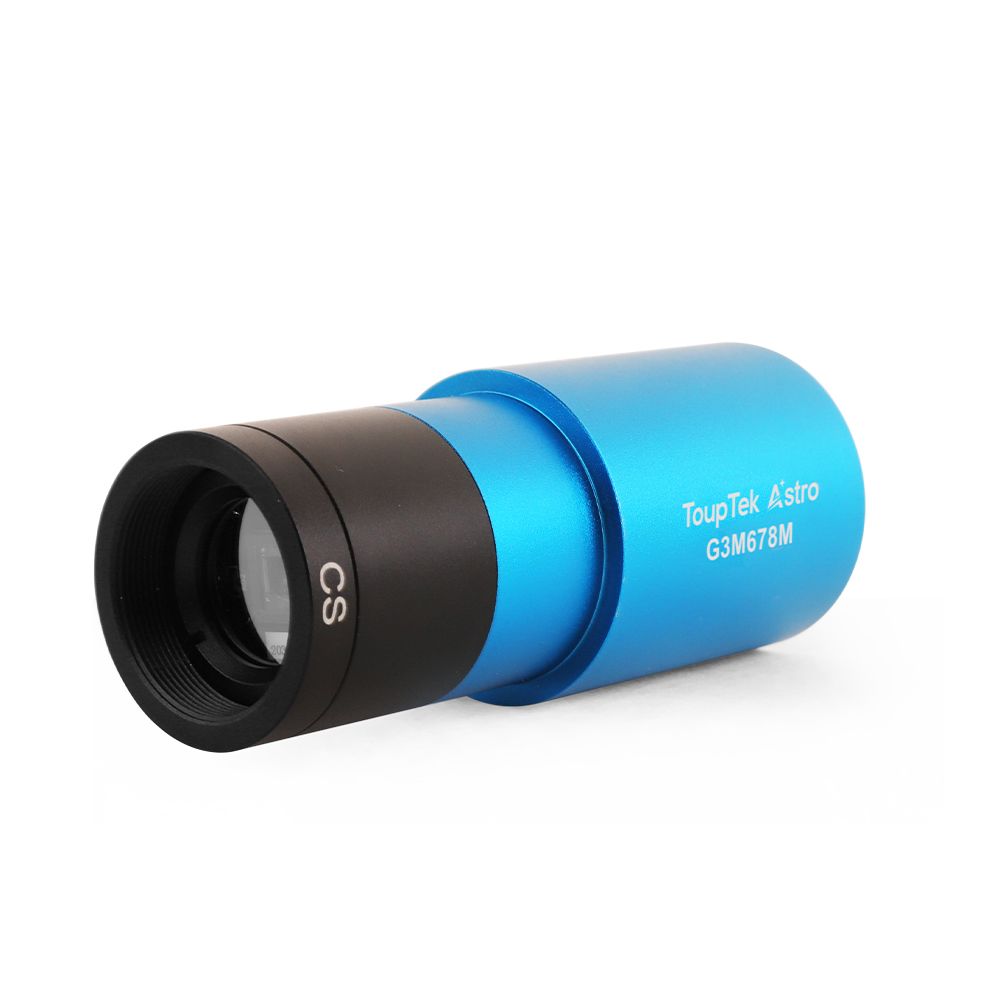
The ToupTek G3M678M is the monochrome version of the G3M678C — a 4K, 8.3-megapixel compact planetary camera built around the Sony IMX678 STARVIS 2 back-illuminated sensor. Without a Bayer colour filter, every pixel on the IMX678M captures the full light input, delivering higher per-pixel sensitivity and resolution than the colour equivalent. The G3M678M is purpose-built for LRGB planetary sequences, near-infrared imaging, and serious high-resolution lunar and planetary work where maximum detail is the goal.
Product Overview
The G3M678M uses the Sony IMX678 sensor in a monochrome configuration with a 1/1.8" format, 2.0 µm pixels, and a peak QE exceeding 83% — with strong near-infrared response extending to 1100nm. HCG and LCG gain modes allow optimization for dim or bright planetary targets. The 512MB DDR3 buffer handles the high 4K data stream with zero amp-glow at the hardware level. Up to 47 FPS at full resolution with significantly higher rates available via hardware ROI.
Who Is This Product Best For?
Advanced planetary imagers who want the maximum detail per frame — particularly those working in LRGB, near-infrared, or narrowband solar imaging workflows. The 4K monochrome IMX678 captures detail that smaller-sensor or colour cameras simply cannot match.
Why Choose This Product?
- 8.3MP 4K monochrome IMX678 STARVIS 2 — maximum resolution and sensitivity in a compact camera body
- No Bayer filter — full per-pixel sensitivity and sharpness, ideal for LRGB and narrowband workflows
- Extended NIR response to 1100nm — excellent for infrared planetary and lunar imaging
- >83% peak QE — outstanding sensitivity across visible and near-infrared spectrum
- 0.5 e⁻ minimum read noise — ultra-low noise floor at maximum gain
- HCG / LCG mode switching — adapt from faint targets to bright planetary discs
- 512MB DDR3 buffer + zero amp-glow — rock-solid, clean 4K data delivery
Recommended Uses
- LRGB planetary imaging with separate colour filter passes (R, G, B, L)
- Near-infrared planetary imaging for seeing penetration and detail enhancement
- High-resolution lunar imaging and mosaic construction
- H-alpha and narrowband solar imaging (with appropriate solar telescopes/filters)
- Lucky imaging and video stacking workflows
- Autoguiding via guide scope or OAG
Compatibility and Accessory Notes
- Connection: Standard C-mount (17.5mm back focus) or Extended version (12.5mm OAG-compatible)
- Filters: 1.25" mounted filters via extension tube; LRGB, narrowband, and IR-pass filters all compatible
- Spectral range: 380–1100 nm (monochrome, extended NIR)
- Software: ToupSky, SharpCap, FireCapture, NINA, PHD2, ASCOM; INDI for Linux
- Power: USB 3.0 bus-powered
Important Limitations
- Monochrome output — requires filters and multiple imaging sessions to produce colour images
- Not for deep-sky imaging — uncooled; not suitable for faint extended objects
- Not for visual observing — requires computer and software
- Higher data rate — fast USB 3.0 host and SSD recommended for sustained 4K capture
Frequently Asked Questions
How does the G3M678M differ from the G3M678C?
The G3M678M is monochrome — no Bayer colour filter. This means every pixel captures all light rather than just one colour channel, resulting in higher per-pixel resolution and sensitivity. It requires RGB filters for colour imaging but delivers better resolution and is preferred for narrowband and LRGB workflows.
Is the G3M678M good for infrared imaging?
Yes. The monochrome IMX678's spectral response extends to 1100nm, making it highly capable for near-infrared planetary and lunar imaging where atmospheric dispersion is less of a factor and finer detail can be resolved.
What is the frame rate at reduced resolutions?
47 FPS at full 3840×2160. Hardware ROI allows significantly higher rates — for example, at 1920×1080 frame rates increase substantially, making it practical for high-speed lucky imaging even with the large sensor.
Our Recommendation
The ToupTek G3M678M is our recommended high-resolution monochrome planetary camera for advanced imagers. The 4K IMX678 sensor delivers detail that smaller or colour cameras cannot match, and the extended NIR response opens up infrared imaging capabilities most competitors lack. If you want colour in a single pass, choose the G3M678C. For LRGB, narrowband, or infrared imaging, the G3M678M is the right tool. For deep-sky imaging, step up to the ToupTek ATR or SkyEye cooled series.
| Specification | Detail |
|---|---|
| Sensor | Sony IMX678 STARVIS 2 (Monochrome) |
| Sensor Format | 1/1.8" |
| Resolution | 8.3 MP / 4K (3840 × 2160) |
| Pixel Size | 2.0 µm |
| Peak QE | >83% (NIR response to 850nm+) |
| Read Noise | 0.5–2.55 e⁻ |
| Full Well Capacity | 11.6 ke⁻ |
| Dynamic Range | 74 dB |
| Max Frame Rate | 47 FPS @ 3840×2160 (USB 3.0) |
| ADC | Native 12-bit (16-bit via 2×2 binning) |
| Buffer | 512MB DDR3 |
| Gain Modes | HCG, LCG |
| Interface | USB 3.0 |
| Back Focus (Standard) | 17.5 mm (C-mount) |
| Back Focus (Extended) | 12.5 mm (OAG-optimized) |
| Mount | C-mount / CS-mount |
| Filter Compatibility | 1.25" mounted filters via extension tube; LRGB, narrowband, IR-pass |
| Binning | Digital 1×1 to 8×8; Hardware 1×1 to 2×2 |
| Hardware ROI | Yes |
| Cooling | None (uncooled) |
| Amp Glow | Zero amp-glow (hardware level) |
| Power | USB 3.0 bus-powered |
| OS Compatibility | Windows, Linux, macOS (INDI) |
| Software | ToupSky, SharpCap, FireCapture, NINA, PHD2, ASCOM |
| Spectral Range | 380–1100 nm (monochrome, extended NIR) |
You may also like
Recently viewed
Recent Blog Posts
View all
Your Guide Graph Is Lying to You
Read More

D-Size vs V-Size: A Complete Guide to Telescope Dovetail Systems
Read More

What Is Back Focus in Astrophotography? Telescope Reducers, Flatteners, and Spacing Explained
Read More