
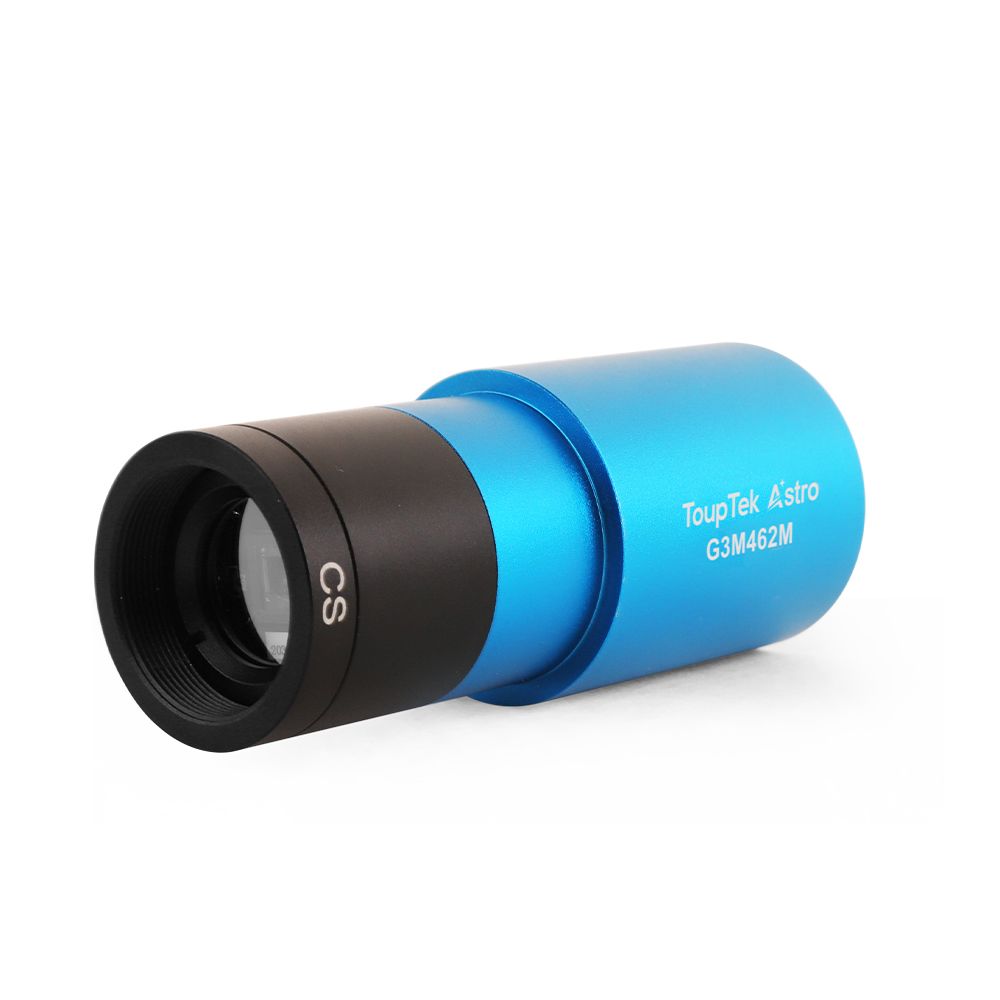

- Description
- Specifications
The ToupTek G3M462M is the monochrome counterpart to the G3M462C, built around the same Sony IMX462 back-illuminated sensor but without a Bayer colour filter. Removing the colour array boosts effective sensitivity and makes this camera the preferred choice for narrowband solar imaging, infrared planetary imaging, and any application where maximum light throughput matters. With 152 FPS at full resolution, a peak QE exceeding 91%, and ultra-low read noise of 0.49 e⁻, the G3M462M is one of the most capable compact monochrome planetary cameras available at its price point.
Product Overview
The G3M462M uses Sony's IMX462 1/2.8" back-illuminated sensor in a monochrome configuration, native 12-bit ADC, and a compact C-mount body powered by USB 3.0. Hardware-level zero amp-glow ensures clean frames at any gain setting, while hardware ROI support allows frame rates to climb even higher at reduced resolutions. The compact form factor fits guide scopes and off-axis guiders just as easily as it fits main imaging telescopes.
Who Is This Product Best For?
The G3M462M is ideal for intermediate and advanced planetary imagers who want to push image quality beyond what a colour camera can deliver — especially for narrowband solar work (H-alpha, Ca-K), near-infrared lunar and planetary imaging, and LRGB planetary sequences where each channel is captured separately for maximum detail.
Why Choose This Product?
- Monochrome sensor — no Bayer mosaic means higher native sensitivity and resolution than the colour equivalent
- 152 FPS at full 1920×1080 resolution — identical high-speed performance to the colour G3M462C
- >91% peak QE — exceptional quantum efficiency across the visible and near-infrared spectrum
- Ultra-low read noise (0.49 e⁻ min) — clean captures at high gain, ideal for dim planetary targets
- Zero amp-glow — hardware-level suppression of thermal artifacts
- Narrowband compatible — use H-alpha, Ca-K, or IR pass filters for specialized solar and planetary imaging
- C-mount body — standard compatibility with telescopes, OAGs, and guide scopes
Recommended Uses
- H-alpha and Ca-K solar imaging with a suitable solar telescope or filter
- Near-infrared planetary imaging for cutting through atmospheric dispersion
- LRGB planetary imaging sequences (R, G, B, and Luminance frames captured separately)
- High-resolution lunar surface imaging
- Autoguiding via guide scope or OAG
- Lucky imaging on bright deep-sky objects and double stars
Compatibility and Accessory Notes
- Connection: Standard C-mount (17.5mm back focus) or Extended version (12.5mm back focus for OAG use)
- Filter compatibility: Accepts 1.25" mounted filters via the included extension tube; works with narrowband, IR pass, and UV/IR cut filters
- Software: ToupSky, SharpCap, FireCapture, NINA, PHD2, ASCOM — full cross-platform INDI support for Linux
- Power: USB 3.0 bus-powered — no external supply required
Important Limitations
- Monochrome output only — requires colour filters (LRGB or narrowband) to produce colour images
- Not for deep-sky imaging — no TEC cooling; not suited for faint nebulae or galaxies
- Not for visual observing — requires a computer and capture software
- Small sensor — 1/2.8" format produces a narrow field on most telescopes
Frequently Asked Questions
What is the difference between the G3M462M and G3M462C?
The G3M462M is monochrome — no Bayer colour filter. This means higher sensitivity, better resolution per pixel, and the ability to use narrowband filters for specialized imaging. The G3M462C is a colour camera for simpler one-shot planetary imaging.
Can I use the G3M462M for autoguiding?
Yes. Monochrome sensors generally work better for guiding than colour sensors because they are more sensitive. This camera is an excellent guide camera on a guide scope or OAG.
Is it compatible with H-alpha solar filters?
Yes. Pair the G3M462M with a dedicated H-alpha solar telescope (Lunt, Coronado) or a broadband Herschel wedge and H-alpha filter for exceptional solar chromosphere imaging.
What capture software does it work with?
ToupSky, SharpCap, FireCapture, NINA, PHD2, and all ASCOM-compatible applications. INDI drivers are available for Linux-based systems including StellarMate.
Our Recommendation
If you are serious about getting the most out of planetary, lunar, and solar imaging — and you are comfortable using filters and post-processing LRGB or narrowband stacks — the G3M462M is the stronger choice over the colour G3M462C. It delivers more raw photons per pixel and opens the door to narrowband and IR imaging that colour sensors cannot match. For a simpler one-shot colour approach, choose the G3M462C. For deep-sky work, step up to the ToupTek ATR or SkyEye cooled series.
| Specification | Detail |
|---|---|
| Sensor | Sony IMX462 (Monochrome) |
| Sensor Format | 1/2.8" |
| Resolution | 2.1 MP (1920 × 1080) |
| Pixel Size | 2.9 µm |
| Peak QE | >91% |
| Read Noise | 0.49–2.1 e⁻ |
| Full Well Capacity | 11.8 ke⁻ |
| Dynamic Range | 75 dB |
| Max Frame Rate | 152 FPS @ 1920×1080 (USB 3.0) |
| ADC | Native 12-bit |
| Interface | USB 3.0 |
| Back Focus (Standard) | 17.5 mm (C-mount) |
| Back Focus (Extended) | 12.5 mm (OAG-optimized) |
| Mount | C-mount / CS-mount |
| Filter Compatibility | 1.25" mounted filters via extension tube; narrowband compatible |
| Binning | Digital 1×1 to 8×8; Hardware 1×1 to 2×2 |
| Hardware ROI | Yes |
| Cooling | None (uncooled) |
| Amp Glow | Zero amp-glow (hardware level) |
| Power | USB 3.0 bus-powered |
| OS Compatibility | Windows, Linux, macOS (INDI) |
| Software | ToupSky, SharpCap, FireCapture, NINA, PHD2, ASCOM |
| Spectral Range | 380–1000 nm (monochrome, no filter) |
You may also like
Recently viewed
Recent Blog Posts
View all
Your Guide Graph Is Lying to You
Read More
D-Size vs V-Size: A Complete Guide to Telescope Dovetail Systems
Read More
What Is Back Focus in Astrophotography? Telescope Reducers, Flatteners, and Spacing Explained
Read More