


- Description
- Specifications
- Downloads
Product Overview
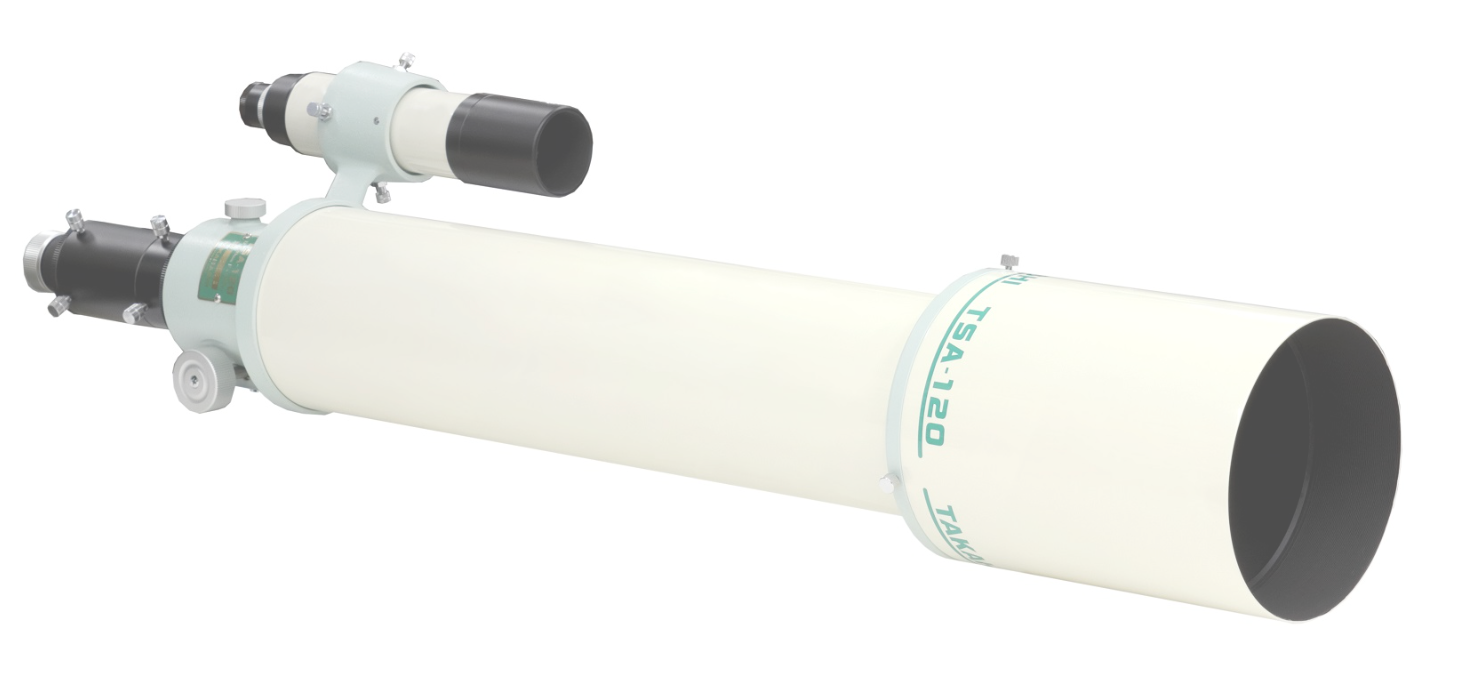
The TSA-120 is Takahashi's 120 mm air-spaced ED triplet apochromat, built around a native 900 mm focal length at f/7.5. The three-element, three-group design uses an ED lens between two conventional elements to control chromatic error across the visual and near-infrared range, and the tube is rated at 6.1 kg. It works as a visual instrument straight out of the box and as an imaging platform once paired with Takahashi's TOA-series correctors, with the drawtube extending from 870 mm to 990 mm for focus travel.
Who It's For
This is a good match if you want a mid-aperture apochromat that does both jobs well — sharp, high-contrast planetary and lunar views at f/7.5, and a capable imaging platform once you add a reducer or flattener. At 6.1 kg it sits comfortably on a mid-size equatorial mount, making it a reasonable step up for an observer moving past a smaller refractor toward more resolving power.
Key Features & Design
- Air-spaced ED triplet, 3 elements in 3 groups: controls chromatic aberration across the visual and imaging range.
- 900 mm focal length at f/7.5: resolves fine planetary and lunar detail and frames smaller deep-sky targets tightly.
- 227.5 mm back focus at prime focus: published by Takahashi for direct visual or imaging use without a corrector.
- 2.7-inch rack-and-pinion focuser: holds heavier imaging trains without sagging under a full camera and filter wheel.
- Retractable dew shield: tube length runs from 870 mm retracted to 990 mm extended for storage.
- 125 mm tube diameter, 160 mm at the dew shield: a substantial aperture-to-tube ratio built for stiffness.
Optical / Mechanical Design
The TSA-120's triplet objective places an ED element between two conventional glass lenses, air-spaced rather than cemented, which is how Takahashi controls both chromatic aberration and spherical correction across this aperture. At f/7.5 and 900 mm focal length it is slower than Takahashi's dedicated astrographs, trading imaging speed for the longer native focal length and higher resolving power that favor planetary and lunar work, along with tighter deep-sky framing. The design accepts Takahashi's TOA-35 series correctors: the TOA-35FL field corrector holds the native 900 mm focal length at f/7.3 with a 40 mm image circle and 117.5 mm back focus, while the TOA-35RD 0.7x reducer drops the system to 635 mm at f/5.3 with a 44 mm image circle and 62.5 mm back focus for wider-field imaging.
Recommended Uses
Visual observation of planets, the Moon, and double stars at f/7.5; deep-sky and planetary astrophotography once paired with a TOA-series corrector; a mid-aperture apochromat for an observatory or a portable mount setup.
Compatibility and Accessory Notes
At prime focus the back focus runs 227.5 mm, measured to the maximum drawtube extension from the rear of the 50.8 mm adapter. Adding the TOA-35FL corrector changes that to 117.5 mm at f/7.3, and the TOA-35RD reducer changes it to 62.5 mm at f/5.3 — each accessory resets both the focal ratio and the spacing your imaging train needs to hit. The Takahashi Back Focus Guide lists these figures alongside Takahashi's other refractor and corrector combinations, and we're glad to confirm a specific camera and filter setup against them before you order.
Good to Know Before You Order
Mount, tripod, and finder are sold separately: this listing is the optical tube assembly only.
Imaging performance depends on the matched corrector: the bare optical tube is optimized for visual use and longer-focal-length imaging; a TOA-35FL or TOA-35RD is what unlocks the flatter field and shorter effective focal length most deep-sky imaging trains want.
Frequently Asked Questions
Is it difficult to set up?
No — it is a fixed-mirror-free refractor with nothing to collimate in normal use, and the retractable dew shield and rack-and-pinion focuser are straightforward to operate.
What is it best used for?
High-resolution visual observation of planets and the Moon at native f/7.5, and deep-sky imaging once paired with the TOA-35FL or TOA-35RD.
Does it need extra accessories for imaging?
For flat-field imaging, yes — the TOA-35FL corrector or TOA-35RD reducer, matched to the back focus your camera train needs.
What mounts is it suited to?
A mid-size equatorial mount rated comfortably above 6.1 kg once a full imaging or visual accessory load is added.
How is this different from the TOA-130NS?
The TOA-130NS steps up in aperture to 130 mm with a longer 1000 mm focal length and a dual-speed Micro Edge focuser; the TSA-120 is the lighter, shorter-tube option at 120 mm.
Bottom Line
In short: a 120 mm f/7.5 air-spaced ED triplet apochromat that handles planetary and lunar visual work natively and steps into flat-field imaging with a matched TOA-35 corrector.
| Optical design | Air-spaced ED apochromatic triplet, 3 elements in 3 groups |
|---|---|
| Aperture | 120 mm |
| Focal length | 900 mm |
| Focal ratio | f/7.5 |
| Back focus (prime focus) | 227.5 mm |
| External tube diameter | 125 mm (160 mm at dew shield) |
| Tube length | 870–990 mm |
| Drawtube extension | 86.5 mm |
| Weight | 6.1 kg |
| With TOA-35FL | 880 mm, f/7.3, 40 mm image circle, 117.5 mm back focus |
| With TOA-35RD 0.7x | 635 mm, f/5.3, 44 mm image circle, 62.5 mm back focus |
Shopping Guide
- Takahashi English Catalog 2025 — PDF, 8.63 MB
System Charts, Diagrams and Adapter Guides
- Takahashi Telescope Backfocus Table — PDF, 71 kB
- TSA-120 System Chart (prime focus) — PDF
- TSA-120 System Chart (with TOA-35RD reducer) — PDF
- TSA-120 System Chart (with EXT-ED1.5X extender) — PDF
Manuals
You may also like
Recently viewed
Recent Blog Posts
View all
Your Guide Graph Is Lying to You
Read More

D-Size vs V-Size: A Complete Guide to Telescope Dovetail Systems
Read More

What Is Back Focus in Astrophotography? Telescope Reducers, Flatteners, and Spacing Explained
Read More