
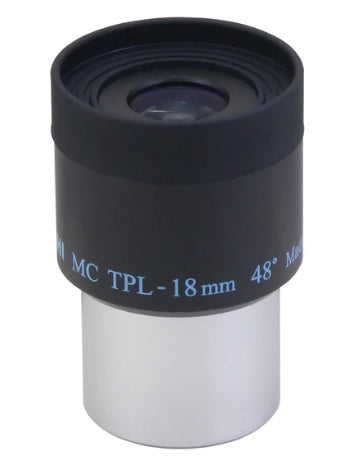

- Description
- Specifications
- Downloads
Product Overview
The TPL-18 is an 18 mm Plossl eyepiece from Takahashi's TPL series, the line that replaced the company's earlier Abbe and LE eyepieces. It gives a 48° apparent field with 13 mm of eye relief, from four elements in two groups — the classic Plossl configuration, built here in high-refraction, low-dispersion glass that Takahashi states cuts center-field chromatic aberration to roughly half the level of the Abbe series.
At 18 mm it sits toward the lower-power end of the TPL range: enough magnification to resolve lunar detail and closer double stars, with a true field wide enough that a target does not need constant re-centering on an undriven mount.
Who It's For
This is a good match if you want a general-purpose eyepiece for the Moon, planets, double stars and brighter deep-sky objects at moderate power, without paying for a wide-field design built for a use you may not need. The 48° field is the traditional Plossl width — narrower than a modern wide-field eyepiece, and correspondingly simpler and less expensive to produce well.
It is a visual eyepiece. Imaging trains connect a camera directly and do not use one.
Key Features & Design
- 18 mm focal length: moderate power on most Takahashi refractors and reflectors — see Compatibility for real figures.
- 48° apparent field: the traditional Plossl field width, sharp across the center with a mild softening toward the edge.
- 13 mm eye relief: a comfortable eye position for direct viewing.
- 4 elements in 2 groups: the symmetric Plossl configuration, unchanged in principle for decades because it works.
- High-refraction, low-dispersion glass: tightens center-field chromatic correction relative to Takahashi's earlier Abbe and LE eyepieces.
- Multi-coated optics: 99% visible-light transmission with a matte barrel finish to control stray light.
Optical Design
The Plossl design pairs two achromatic doublets symmetrically around the field stop — four elements in two groups. It is one of the oldest eyepiece formulas still in wide production, because the layout does the basic job well: a sharp, high-contrast image at a reasonable eye relief and manufacturing cost. Takahashi's TPL series updates the formula with higher-refraction, lower-dispersion glass than its own earlier Abbe and LE lines, which measurably tightens chromatic correction at the center of the field.
Takahashi's own literature describes the TPL series as sharp from the center out to roughly the halfway point of the 48° field, with mild star distortion toward the corners — a known characteristic of the Plossl form rather than a manufacturing shortfall. Takahashi also states that pairing the TPL series with the 2x Ortho Barlow clearly improves flatfieldness, with the combination approaching full-field correction.
Recommended Uses
- Lunar observing — crater walls, rilles and terminator relief at moderate power.
- Double star splitting where a moderate, well-corrected field is enough.
- Brighter deep-sky objects — open clusters, globular clusters and planetary nebulae.
- General-purpose visual observing across a range of telescope apertures and focal lengths.
- Paired with the 2x Ortho Barlow for a flatter field at roughly double the power.
Compatibility and Accessory Notes
- Magnification: divide your telescope's focal length by 18. An FS-60CB at 355 mm gives about 20x; an FC-100DZ at 800 mm gives about 44x; a Mewlon 210 at 2415 mm gives about 134x.
- Barrel: 31.7 mm — a standard 1.25-inch fit for Takahashi and most third-party diagonals and focusers.
- Diagonal: in a refractor you will normally use it behind a star diagonal. The Takahashi 1.25-inch prism diagonal is a direct pairing.
- 2x Ortho Barlow: Takahashi publishes that flatfieldness across the TPL series clearly improves when used through the 2x Ortho Barlow, at roughly double this eyepiece's magnification.
- Back focus: for adapter and spacing questions across your imaging or visual train, see the Takahashi Back Focus Guide.
Good to Know Before You Order
- 48° is a traditional field, not an ultra-wide one. An 82° or 100° eyepiece gives a more immersive view; the TPL trades that width for a simpler design that still delivers a sharp center field.
- Magnification depends on your telescope. The same 18 mm gives about 20x on a short 60 mm refractor and 134x on a Mewlon 210 — send us your telescope model and we will confirm where it lands in your eyepiece set.
- It is a visual eyepiece. Camera trains connect directly to the telescope or its corrector.
- 110 g is light — it will not register in most focuser-balance calculations.
Frequently Asked Questions
Is it difficult to set up?
No — it drops into a 1.25-inch diagonal or focuser and you focus. Nothing to assemble or adjust.
What magnification will I get?
Your telescope's focal length divided by 18. Send us your telescope model and we will work out where it fits alongside the eyepieces you already own.
How does it compare to Takahashi's older Abbe and LE eyepieces?
The TPL series uses higher-refraction, lower-dispersion glass, cutting center-field chromatic aberration to roughly half the Abbe level and about two-thirds of the LE level.
Is it good for deep-sky observing?
It works well on brighter clusters and planetary nebulae at moderate power. For a wider true field at lower power from the same series, the TPL-50 is the long-focal-length option.
Can I use it with glasses?
13 mm of eye relief is workable for some glasses wearers, depending on your frames.
Will it work with a Barlow?
Yes — the 2x Ortho Barlow doubles the magnification and, per Takahashi, improves the TPL series' flatfieldness at the same time.
Is it parfocal with other Takahashi eyepieces?
Expect to refocus when switching between eyepiece families.
Bottom Line
In short: an 18 mm Plossl eyepiece with a 48° field and 13 mm of eye relief, built from four elements in two groups with glass chosen to keep the center field free of chromatic aberration. It suits general lunar, double-star and moderate-power deep-sky viewing, and flattens out further when paired with Takahashi's 2x Ortho Barlow.
| Type | Eyepiece |
|---|---|
| Focal length | 18 mm |
| Apparent field of view | 48° |
| Eye relief | 13 mm |
| Optical design | 4 elements in 2 groups (Plossl) |
| Barrel diameter | 31.7 mm (1.25") |
| Weight | 110 g |
| Colour | Black |
| In the box | Takahashi TPL-18 Plossl eyepiece |
Shopping Guide
- Takahashi English Catalog 2025 — PDF, 8.63 MB
You may also like
Recently viewed
Recent Blog Posts
View all
Your Guide Graph Is Lying to You
Read More

D-Size vs V-Size: A Complete Guide to Telescope Dovetail Systems
Read More

What Is Back Focus in Astrophotography? Telescope Reducers, Flatteners, and Spacing Explained
Read More