

- Description
- Specifications
- Downloads
Product Overview
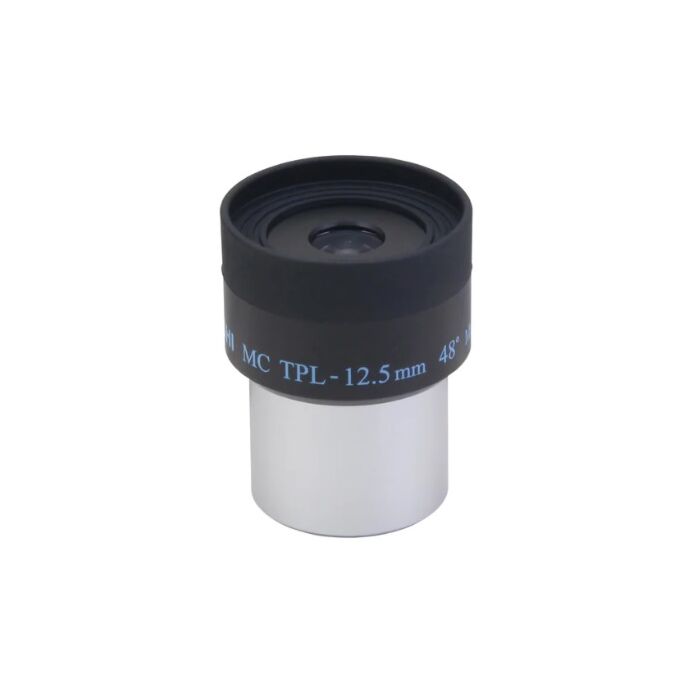
The TPL-12.5 is a 12.5mm eyepiece from Takahashi's TPL Plossl series, the successor to the older Abbe and LE lines. It uses a 4-elements-in-2-groups Plossl design built with high-refraction, low-dispersion glass, giving a 48° apparent field of view and 9mm of eye relief. It weighs 90g and uses the standard 31.7mm (1.25”) barrel.
Who It's For
This is a good match if you want a moderate-power eyepiece with comfortable eye relief — for general planetary and lunar viewing, brighter deep-sky objects, and as a mid-range step between a low-power finder eyepiece and the shortest, highest-power focal lengths in a TPL set.
Key Features & Design
- 4-element, 2-group Plossl design: the current evolution of Takahashi's Plossl line, replacing the older Abbe and LE series.
- High-refraction, low-dispersion glass: Takahashi states this cuts chromatic aberration at the center of the field to roughly half the level of the Abbe series and two-thirds that of the LE series.
- Multilayer coatings at 99% transmission: keeps the image bright across the four elements.
- Matte-finished interior: reduces stray light and internal reflections for better contrast.
- 48° apparent field of view and 9mm eye relief — the most comfortable eye relief of the three shorter TPL focal lengths in this batch.
Optical / Mechanical Design
Takahashi describes the TPL series as sharp from the center out to roughly halfway across the field, with only mild star distortion at the corners on its own — and notes that pairing a TPL eyepiece with the 2x Ortho Barlow (sold separately) measurably flattens the field, producing close to full-field correction. At 12.5mm, the TPL-12.5 trades some magnification for the easiest eye placement in the shorter end of the series.
Recommended Uses
On a Takahashi TSA-120 (900mm, f/7.5) the TPL-12.5 gives about 72x, a comfortable general-purpose magnification for planets, the Moon, and brighter deep-sky objects. On a Takahashi FS-60CB (355mm, f/5.9) the same eyepiece yields roughly 28x, a useful mid-power view on a small travel refractor. Divide any Takahashi tube's focal length by 12.5mm for the magnification on your own setup.
Compatibility and Accessory Notes
The 31.7mm (1.25”) barrel fits any Takahashi focuser, star diagonal, or 2″-to-1.25” adapter in the current lineup. Takahashi's own literature notes that combining a TPL eyepiece with the 2x Ortho Barlow improves flat-field performance across the whole view — worth considering if you already use a Barlow in your kit or are deciding whether to add one.
Good to Know Before You Order
Not parfocal: a refocus is needed when swapping the TPL-12.5 in from another eyepiece in your case.
Frequently Asked Questions
Is it difficult to set up?
No — it threads directly into a standard 1.25” focuser or diagonal, and the 9mm eye relief makes eye placement easy, glasses or not.
What is it best used for?
Moderate-power visual observing — general planetary and lunar viewing, and brighter deep-sky objects.
How does it compare to the TPL-9 and TPL-6?
Same 4-element Plossl design and glass; the TPL-12.5's longer focal length gives lower magnification, a larger exit pupil, and the most comfortable eye relief of the three.
What telescopes does it fit?
Any Takahashi refractor or reflector with a standard 1.25” focuser or diagonal.
Bottom Line
A 12.5mm Plossl eyepiece with a 48° field, 9mm eye relief, and a 90g weight — a moderate-power, comfortable-eye-relief option in Takahashi's TPL series. If you're building a full eyepiece set and want help matching focal lengths to your telescope, send us your setup and we'll work it out with you.
| Optical design | Plossl, 4 elements / 2 groups, high-refraction low-dispersion glass |
|---|---|
| Focal length | 12.5mm |
| Apparent field of view | 48° |
| Eye relief | 9mm |
| Weight | 90g |
| Barrel size | 31.7mm (1.25”) |
Shopping Guide
- Takahashi English Catalog 2025 — PDF, 8.63 MB
You may also like
Recently viewed
Recent Blog Posts
View all
Your Guide Graph Is Lying to You
Read More

D-Size vs V-Size: A Complete Guide to Telescope Dovetail Systems
Read More

What Is Back Focus in Astrophotography? Telescope Reducers, Flatteners, and Spacing Explained
Read More