
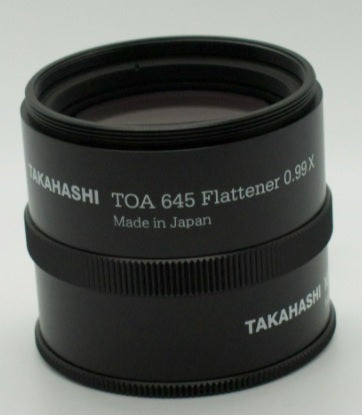

- Description
- Specifications
- Downloads
Product Overview
The TOA-645 Flattener is Takahashi's large-format field corrector for the TOA-130NS and TOA-130NFB, holding the focal length essentially unchanged at 990mm f/7.6 while opening the corrected image circle to 60mm — large enough for today's bigger CMOS sensors. Two lens elements in two groups thread between M72 x 1 male and female interfaces, in a compact 78mm diameter, 42mm long, 265 g housing.
Who It's For
This is a good match if you own a TOA-130NS or TOA-130NFB and are imaging with a large-format CMOS sensor where the older 67-series flatteners and the 40mm-circle TOA-35FL fall short of full corner coverage.
Key Features & Design
- 60mm corrected image circle: built for large modern CMOS sensors rather than the 40mm circle of the TOA-35FL.
- Near-unity focal ratio change: 1000mm f/7.7 native becomes 990mm f/7.6 — correction with almost no reach traded away.
- Tight spot diagrams: Takahashi publishes 1 micron RMS on-axis, rising to 5 microns at the full 60mm diameter.
- M72 x 1 threads on both sides, in a compact 78mm x 42mm housing at 265 g.
Optical / Mechanical Design
Where the TOA-35FL corrects the TOA-130NS/NFB to a 40mm circle, the TOA-645 uses two lens elements in two groups to hold correction out to 60mm, addressing the larger sensor formats that have become common since the earlier 67-series flatteners were designed. Takahashi states the newer design performs nearly aberration-free with today's smaller pixel pitches, where the older flatteners show their age.
Recommended Uses
Full-frame and medium-format CMOS deep-sky imaging on the TOA-130NS or TOA-130NFB, where corner correction across a 60mm circle is required.
Compatibility and Accessory Notes
Takahashi publishes this flattener for the TOA-130NS/NFB.
| Telescope | Native | With TOA-645FL | Image circle | Back focus |
|---|---|---|---|---|
| TOA-130NS / TOA-130NFB | 1000mm f/7.7 | 990mm f/7.6 | Φ60mm | 56.2mm |
The TOA-150B takes the same optical design in a separate kit, part TKA32587S, which Ontario Telescope lists separately — the two are not interchangeable at the mechanical level despite sharing the optical formula. For smaller-sensor use, the 40mm-circle TOA-35FL is also available. Full spacing detail is in the Takahashi Back Focus Guide.
Good to Know Before You Order
Not interchangeable with the TOA-150B kit: that telescope uses its own TOA-645 flattener kit (TKA32587S) rather than this TOA-130-specific part.
Built for imaging: the corrected field has no benefit for eyepiece observing.
Frequently Asked Questions
Is it difficult to set up?
No — it threads between M72 x 1 interfaces with a fixed 56.2mm back focus, so there is no spacing to calculate.
What is it best used for?
Full-frame and large-format CMOS deep-sky imaging on the TOA-130NS or TOA-130NFB.
How is this different from the TOA-35FL?
The TOA-35FL corrects a 40mm image circle; the TOA-645 corrects out to 60mm for larger sensors, at nearly the same resulting focal length.
Does this fit my TOA-150B?
The TOA-150B uses its own TOA-645 flattener kit rather than this part; send us your telescope model and sensor size and we will confirm which flattener you need.
Bottom Line
The TOA-645 Flattener corrects the TOA-130NS/NFB to a 60mm image circle at essentially its native 990mm f/7.6, built for the large CMOS sensors that have outgrown the older 40mm-circle flatteners.
| Type | Field flattener, 2 lenses in 2 groups (TOA-645FL) |
|---|---|
| For telescope | TOA-130NS / TOA-130NFB (1000mm f/7.7 native) |
| Resulting focal length | 990mm |
| Resulting f-ratio | f/7.6 |
| Image circle | Φ60mm |
| Back focus | 56.2mm |
| Input/output interface | M72 x 1, male and female |
| Diameter | 78mm |
| Length | 42mm |
| Weight | 265g |
| Spot diagram (RMS) | 1 micron on-axis, 2 microns at 30mm, 3 microns at 43mm, 5 microns at 60mm |
| Part number | TKA31587S |
Shopping Guide
- Takahashi English Catalog 2025 — PDF, 8.63 MB
- Takahashi Telescope Backfocus Table — PDF, 71 kB
You may also like
Recently viewed
Recent Blog Posts
View all
Your Guide Graph Is Lying to You
Read More

D-Size vs V-Size: A Complete Guide to Telescope Dovetail Systems
Read More

What Is Back Focus in Astrophotography? Telescope Reducers, Flatteners, and Spacing Explained
Read More