
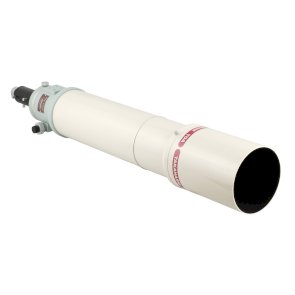
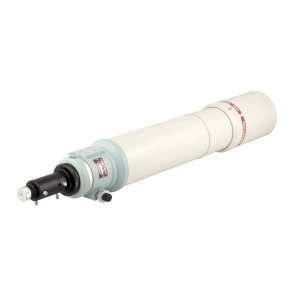
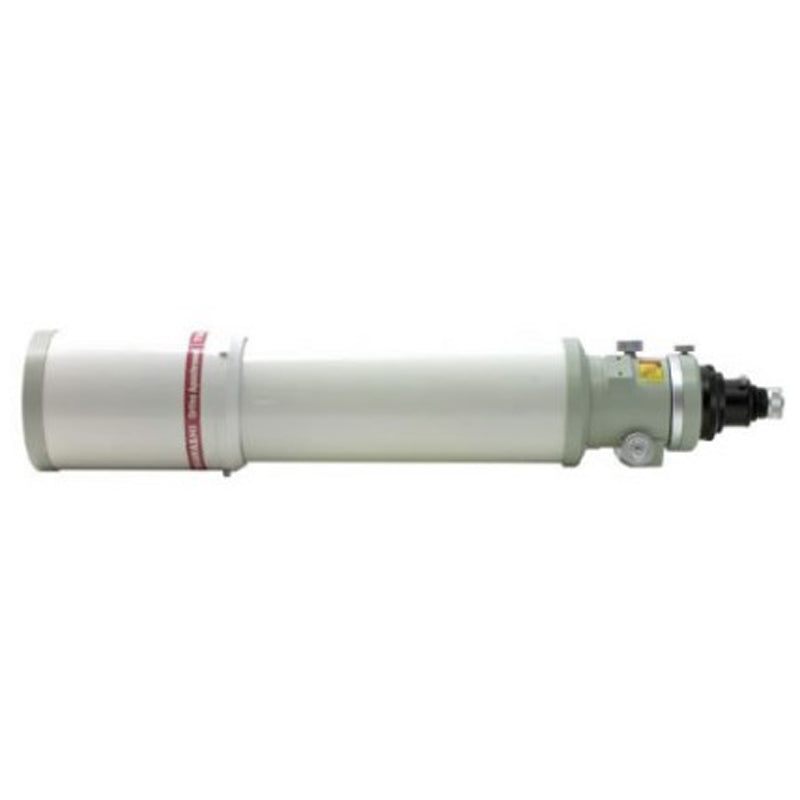


- Description
- Specifications
- Downloads
Product Overview
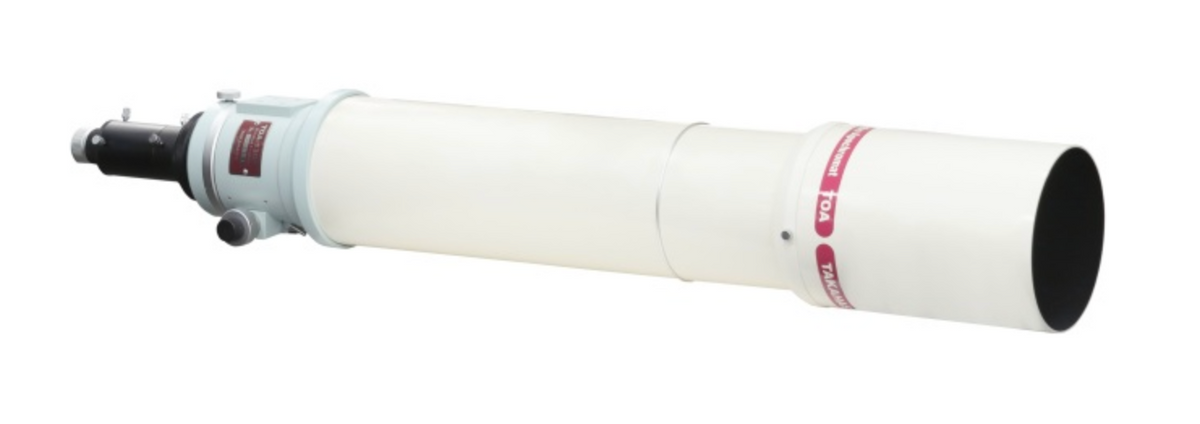
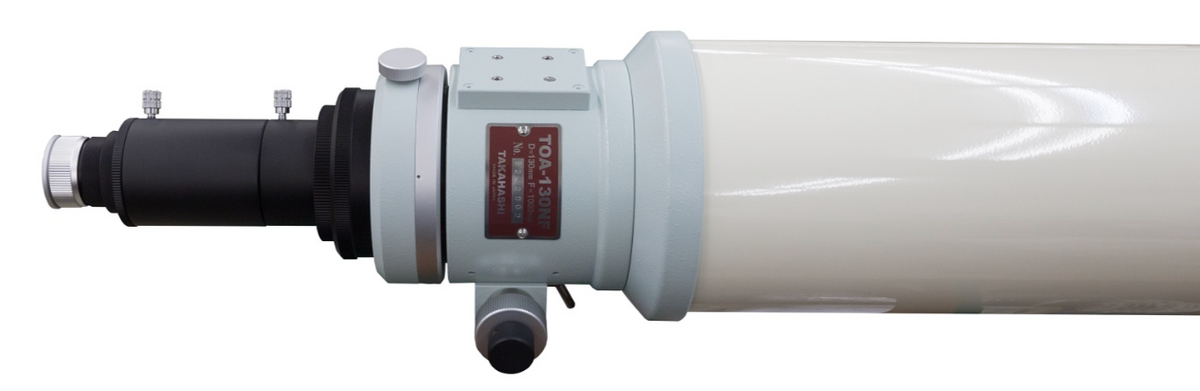
The TOA-130NFB shares its 130 mm ED apochromatic triplet objective with the TOA-130NS, but ships with Takahashi's larger Micro Edge Focuser MEF-4 — a 4-inch dual-speed rack-and-pinion unit with a built-in camera angle adjuster, sized for medium-format imaging trains. The native focal length is 1000 mm at f/7.7, published weight is 11.7 kg, and the back focus at prime focus runs 274.5 mm, noticeably longer than the NS variant's 222.5 mm because of the larger focuser body.
Who It's For
This is a good match if you are building a medium-format or heavier imaging train and want the longer back focus and larger focuser throat the MEF-4 provides — the built-in camera angle adjuster is aimed at photographers who need to rotate a bulkier camera body without disturbing the tube rings. At 11.7 kg published weight, it asks for a mount with real payload margin once accessories are attached.
Key Features & Design
- Highly air-spaced ED triplet, 3 elements in 3 groups: two S-FPL53 ED elements deliver Takahashi's highest published order of color correction at this aperture.
- 1000 mm focal length at f/7.7: strong native resolving power for planetary, lunar and tight deep-sky targets.
- Micro Edge Focuser MEF-4 included: a 4-inch dual-speed rack-and-pinion focuser with a built-in camera angle adjuster for medium-format photography.
- 274.5 mm back focus at prime focus: published by Takahashi, noticeably longer than the TOA-130NS's 222.5 mm.
- Retractable dew shield: tube length runs from 1022 mm to 1153 mm as it extends.
- Knife-edged internal baffles: reduce internal reflections and improve contrast.
Optical / Mechanical Design
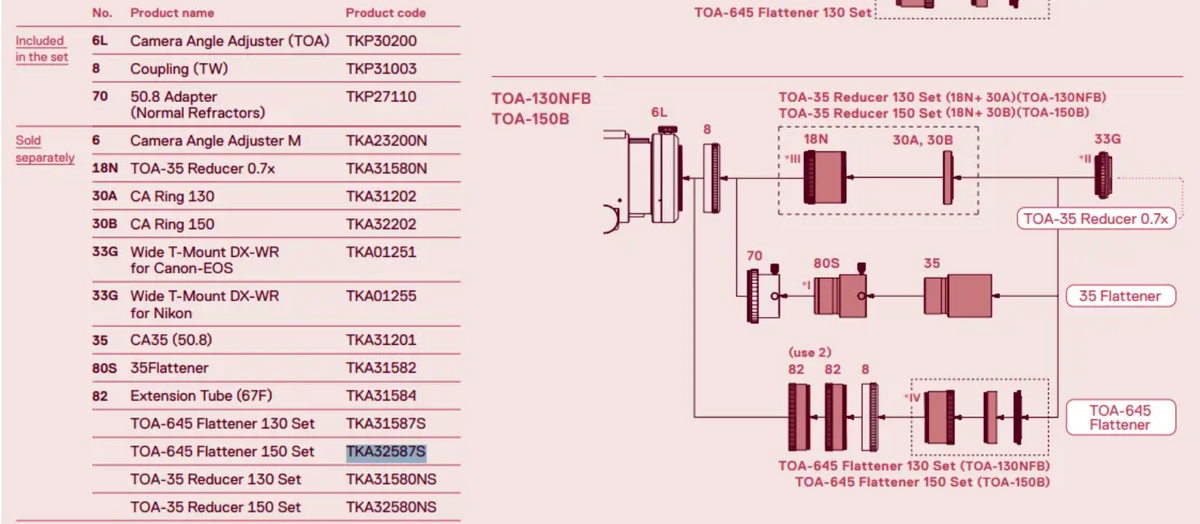
The TOA-130NFB uses the same highly air-spaced triplet objective as the TOA-130NS — two S-FPL53 ED elements for Takahashi's highest published order of color correction at this aperture — paired with the larger MEF-4 focuser instead of the MEF-2.7. That focuser change is what shifts the back focus from 222.5 mm to 274.5 mm and adds roughly 1.8 kg to the published tube weight. At f/7.7 and 1000 mm focal length, the optical performance is identical to the NS variant; the difference is entirely in what the focuser and its camera angle adjuster support downstream. The design accepts the same TOA-series correctors as the NS: the TOA-35FL field corrector runs 980 mm at f/7.5 with a 40 mm image circle, and the 67FL corrector holds the full 1000 mm focal length at f/7.7 with a substantially larger 92 mm image circle for medium-format sensors.
Recommended Uses
Medium-format and full-frame deep-sky astrophotography where the larger image circle and camera angle adjuster matter; high-resolution planetary and lunar visual observation; observatory setups on a mount rated well above the 11.7 kg tube weight.
Compatibility and Accessory Notes
At prime focus, back focus runs 274.5 mm — longer than most Takahashi refractors, which is worth checking against your existing adapter stack before ordering. Adding the TOA-35FL corrector changes that to a 40 mm image circle at 980 mm and f/7.5, while the 67FL corrector opens the image circle to 92 mm at the native 1000 mm focal length and f/7.7 for medium-format cameras. The Takahashi Back Focus Guide lists these figures in full, and we're glad to confirm a specific camera and filter setup against them before you order. Note that the closely related TOA-130NS carries a different published weight (9.9 kg) and a shorter back focus (222.5 mm) due to its smaller MEF-2.7 focuser; the two are separate products, not variants of one another.
Good to Know Before You Order
Mount, tripod, and finder are sold separately: this listing is the optical tube assembly with the MEF-4 focuser attached.
The longer back focus changes your adapter stack: at 274.5 mm, this tube needs more spacing than most Takahashi refractors reach natively — worth confirming against your camera train before ordering.
Frequently Asked Questions
Is it difficult to set up?
No — it is a fixed-mirror-free refractor with nothing to collimate in normal use. The MEF-4 focuser's camera angle adjuster is a built-in mechanical rotator, not a separate accessory to fit.
What is it best used for?
Medium-format and full-frame astrophotography, plus high-resolution planetary and lunar visual observation.
Does it need extra accessories for imaging?
For a flat field, yes — the TOA-35FL or 67FL corrector, matched to the image circle and back focus your camera needs.
What mounts is it suited to?
A mount rated comfortably above the 11.7 kg published tube weight once a full imaging accessory load is added.
How is this different from the TOA-130NS?
Both share the same 130 mm optical design, but the NS ships with the smaller MEF-2.7 focuser, weighs less at 9.9 kg, and has a shorter 222.5 mm back focus — the two are separate products, not interchangeable configurations of one tube.
Bottom Line
In short: the same 130 mm f/7.7 ED apochromatic triplet as the TOA-130NS, built around the larger MEF-4 focuser for a longer back focus and medium-format imaging support.
| Optical design | Highly air-spaced ED apochromatic triplet, 3 elements in 3 groups (2x S-FPL53 ED elements) |
|---|---|
| Aperture | 130 mm |
| Focal length | 1000 mm |
| Focal ratio | f/7.7 |
| Back focus (prime focus) | 274.5 mm |
| External tube diameter | 156 mm (179 mm at dew shield) |
| Tube length | 1022–1153 mm |
| Drawtube extension | 77 mm |
| Focuser | Micro Edge Focuser MEF-4, dual-speed rack-and-pinion with integrated camera angle adjuster, included |
| Weight | 11.7 kg |
| With TOA-35FL | 980 mm, f/7.5, 40 mm image circle |
| With 67FL | 1000 mm, f/7.7, 92 mm image circle |
Shopping Guide
- Takahashi English Catalog 2025 — PDF, 8.63 MB
System Charts, Diagrams and Adapter Guides
- Takahashi Telescope Backfocus Table — PDF, 71 kB
- TOA-130NFB System Chart (prime focus) — PDF
- TOA-130 System Chart (with TOA-35FL corrector) — PDF
- TOA-130NFB System Chart (with 67FL corrector) — PDF
- TOA-130 System Chart (with TOA-35RD reducer) — PDF
Manuals
You may also like
Recently viewed
Recent Blog Posts
View all
Your Guide Graph Is Lying to You
Read More

D-Size vs V-Size: A Complete Guide to Telescope Dovetail Systems
Read More

What Is Back Focus in Astrophotography? Telescope Reducers, Flatteners, and Spacing Explained
Read More