

- Description
- Specifications
- Downloads
Product Overview
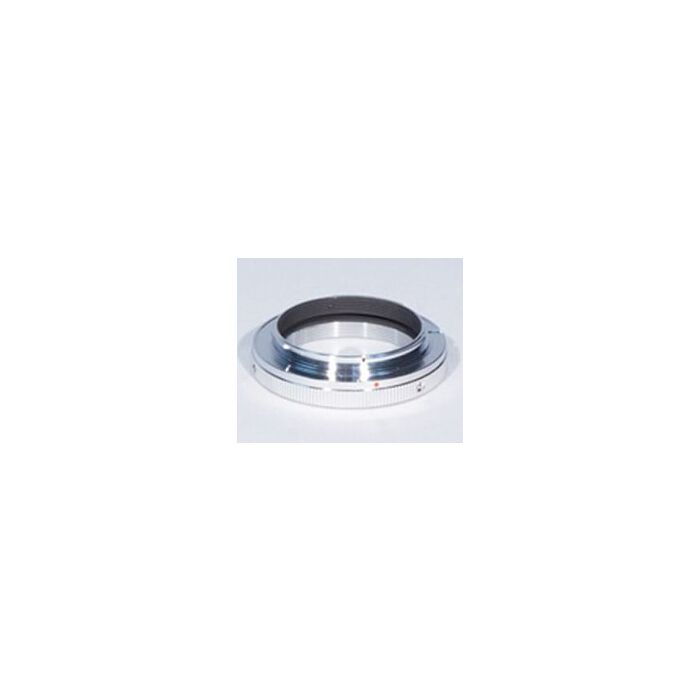
This Takahashi T-mount lets you put a Canon EOS body on a Takahashi telescope. It converts from a male wide mount thread to the EOS lens mount, so the camera sits on the telescope the same way a lens would sit on the camera — the telescope becomes the optic.
Who It's For
This is a good match if you shoot with a Canon EOS body and want to connect it to a Takahashi telescope or corrector that terminates in Takahashi's wide mount thread.
Key Features & Design
- Wide mount to Canon EOS: male wide mount thread on the telescope side, EOS bayonet on the camera side.
- Mechanical adapter only: no optical elements, and no electronic communication between camera and telescope.
- Takahashi-made: matched to Takahashi's own wide mount standard rather than a generic T-ring.
Recommended Uses
Prime-focus astrophotography with a Canon EOS DSLR on a Takahashi refractor or astrograph, usually behind a flattener, reducer or extender that presents the wide mount thread.
Compatibility and Accessory Notes
The telescope side is Takahashi's male wide mount thread — not the generic M42 T-thread, so a standard T-ring is not a substitute. The camera side is the Canon EOS bayonet, which covers EF and EF-S bodies; EOS R mirrorless bodies need Canon's own EF-to-RF adapter in addition. Takahashi also makes a DX-S version of the EOS T-mount, and a Nikon version of this one. If you are working out a full imaging train and its back-focus, send us the camera, corrector and telescope and we will map it with you.
Good to Know Before You Order
Mechanical only: there is no electrical contact through this adapter, so the camera has no aperture or lens data. Shooting is in manual with the telescope as the lens, which is normal for prime-focus work.
Wide mount, not T-thread: this is Takahashi's own thread standard. If the part of your train facing the camera is M42 or M48, this is not the adapter — tell us what you have and we will identify the right one.
Two EOS versions exist: the DX-60W here and the DX-S. They terminate differently on the telescope side; we stock both and can confirm which your train needs.
Frequently Asked Questions
Is it difficult to set up?
No — it threads onto the wide mount at one end and the camera clicks on at the other, exactly like mounting a lens.
Which cameras does it fit?
Canon EOS bodies with the EF/EF-S bayonet. EOS R bodies work with Canon's EF-to-RF adapter added.
Will autofocus or aperture control work?
No — it is a mechanical adapter with no electronic link. Focus is done at the telescope's focuser.
Can I use a standard T-ring instead?
Not on a wide mount thread. The wide mount is Takahashi's own standard and takes this adapter.
Bottom Line
The adapter that puts a Canon EOS body on Takahashi's wide mount thread — mechanical, direct, and matched to the Takahashi imaging train.
| Product name | T-Mount DX-60W (Canon EOS) |
|---|---|
| Product code | TKA20245 |
| Telescope side | Male wide mount thread |
| Camera side | Canon EOS lens mount |
| Optics | None — mechanical adapter only |
| Electronic communication | None |
Shopping Guide
- Takahashi English Catalog 2025 — PDF, 8.63 MB
You may also like
Recently viewed
Recent Blog Posts
View all
Your Guide Graph Is Lying to You
Read More

D-Size vs V-Size: A Complete Guide to Telescope Dovetail Systems
Read More

What Is Back Focus in Astrophotography? Telescope Reducers, Flatteners, and Spacing Explained
Read More