
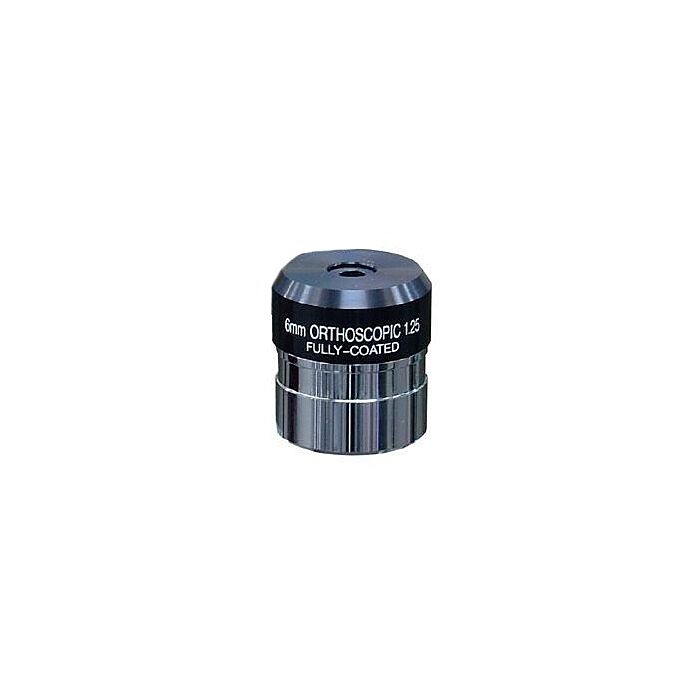
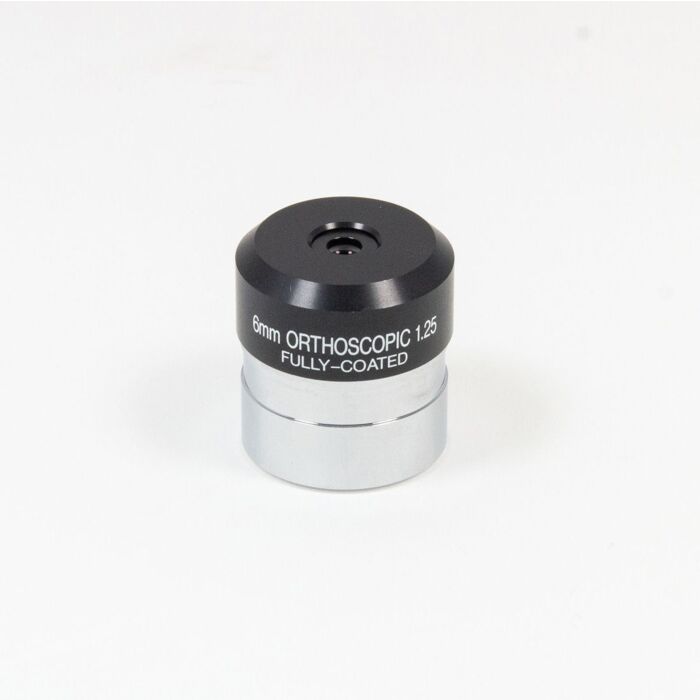


- Description
- Specifications
- Downloads
Product Overview
The Starbase OR-6mm is a 6mm orthoscopic eyepiece from Takahashi's Starbase accessory line, and the shortest, highest-power focal length in the series. It uses the same 4-elements-in-2-groups design as the rest of the OR range, with a 43° apparent field of view, 4mm of eye relief, and a 1.25” (31.7mm) barrel with fully multi-coated optics.
Who It's For
This is a good match if you want the highest practical magnification in a Starbase orthoscopic eyepiece — for planetary detail, close double stars, and lunar close-ups on nights when the atmosphere holds steady.
Key Features & Design
- Orthoscopic 4-element, 2-group design: low distortion at the center of the field, where high-power detail is formed.
- 43° apparent field of view: slightly narrower than the rest of the Starbase OR line, typical at this short a focal length.
- 4mm eye relief: tight — workable bare-eyed, demanding for eyeglass wearers.
- Fully multi-coated optics: keeps contrast up despite the high element count for the size.
- 1.25” (31.7mm) barrel: the Takahashi standard, fits existing focusers and diagonals.
Optical / Mechanical Design
Short-focal-length orthoscopic eyepieces put the most demand on the four-element, two-group design's center-field correction, since that is where all the magnification and detail is concentrated. The OR-6mm holds the same design language as the rest of the Starbase orthoscopic line at a scale built specifically for high power, which is also why the eye relief tightens up and the apparent field narrows slightly compared to its longer siblings.
Recommended Uses
On a Takahashi TSA-120 (900mm, f/7.5) the OR-6mm gives about 150x, useful for planetary detail and close double stars on a night of good seeing. On a Takahashi FS-60CB (355mm, f/5.9) the same eyepiece yields roughly 59x, a solid high-power option for a small travel refractor. Divide any Takahashi tube's focal length by 6mm for the magnification on your own setup — and remember that atmospheric seeing, not the eyepiece, usually sets the practical ceiling on a given night.
Compatibility and Accessory Notes
The 1.25” (31.7mm) barrel fits any Takahashi focuser, star diagonal, or 2″-to-1.25” adapter already in the current lineup, so it slots into an existing eyepiece case without extra hardware.
Good to Know Before You Order
Not parfocal: Takahashi lists this eyepiece as non-parfocal, so refocusing is needed when you switch to it from another eyepiece.
4mm eye relief is tight: comfortable without glasses; eyeglass wearers may prefer a longer-eye-relief eyepiece for this magnification range, or observing without glasses and adjusting focus to compensate.
Frequently Asked Questions
Is it difficult to set up?
No — it threads directly into a standard 1.25” focuser or diagonal. The tight eye relief takes a bit more care in positioning your eye than a longer-eye-relief eyepiece, but no tools or adjustment are involved.
What is it best used for?
High-power visual observing — planetary detail, lunar close-ups, and close double stars, on nights with steady seeing.
How does it compare to the OR-9mm?
Same 4-element orthoscopic design; the OR-6mm's shorter focal length gives higher magnification, a narrower field, and tighter eye relief.
What telescopes does it fit?
Any Takahashi refractor or reflector with a standard 1.25” focuser or diagonal.
Bottom Line
A 6mm orthoscopic eyepiece with a 43° field and a 1.25” barrel — the highest-power option in the Starbase orthoscopic line, built for planetary and lunar detail. If you're building a full eyepiece set and want help matching focal lengths to your telescope, send us your setup and we'll work it out with you.
| Optical design | Orthoscopic, 4 elements / 2 groups |
|---|---|
| Focal length | 6mm |
| Apparent field of view | 43° |
| Eye relief | 4mm |
| Barrel size | 1.25” (31.7mm) |
| Optical coatings | Fully multi-coated |
| Parfocal | No |
Shopping Guide
- Takahashi English Catalog 2025 — PDF, 8.63 MB
You may also like
Recently viewed
Recent Blog Posts
View all
Your Guide Graph Is Lying to You
Read More

D-Size vs V-Size: A Complete Guide to Telescope Dovetail Systems
Read More

What Is Back Focus in Astrophotography? Telescope Reducers, Flatteners, and Spacing Explained
Read More