
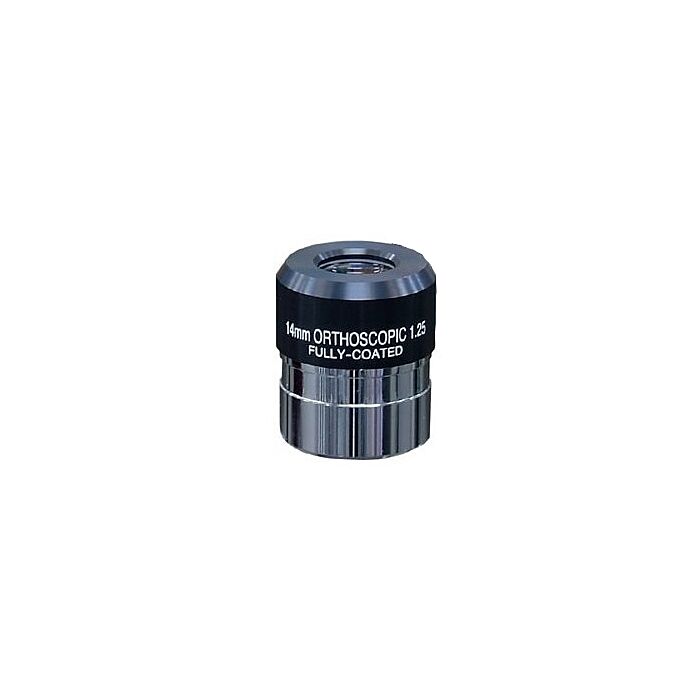

- Description
- Specifications
- Downloads
Product Overview
The Starbase OR-14mm is a 14mm orthoscopic eyepiece from Takahashi's Starbase accessory line, built on the series' 4-elements-in-2-groups design for low distortion toward the center of the field. It has a 45° apparent field of view, 12mm of eye relief, weighs 70g, and Takahashi lists an overall body size of 33mm x 38mm (diameter x length) for this model.
Who It's For
This is a good match if you want a mid-to-high power eyepiece for planetary detail, lunar craters, and splitting closer double stars, with the sharp, low-distortion correction orthoscopic designs are known for.
Key Features & Design
- Orthoscopic 4-element, 2-group design: low distortion, particularly at the center of the field.
- 45° apparent field of view: steady framing at moderate-to-high power.
- 12mm eye relief: workable for eyeglass wearers at this focal length.
- 70g weight: light enough not to unbalance a small refractor's focuser.
Optical / Mechanical Design
The four-element, two-group orthoscopic layout holds sharpness and low distortion from the center outward, the trait that has kept orthoscopic designs in regular use for lunar and planetary observing even as wide-field alternatives have become more common. At 14mm, the OR-14mm sits in the middle of the Starbase orthoscopic range — short enough for real planetary detail, long enough to stay easy on the eye.
Recommended Uses
On a Takahashi FS-60CB (355mm, f/5.9) the OR-14mm gives about 25x, useful for lunar overviews and brighter deep-sky targets. On a TSA-120 (900mm, f/7.5) the same eyepiece yields roughly 64x — enough for real planetary and lunar detail on a night of average seeing. Divide any Takahashi tube's focal length by 14mm for the magnification on your own setup.
Compatibility and Accessory Notes
Takahashi's product page for the OR-14mm gives a 33mm x 38mm overall body size rather than a separate barrel-diameter figure. The rest of the Starbase orthoscopic line uses the 1.25” (31.7mm) barrel standard that fits every current Takahashi focuser and diagonal.
Good to Know Before You Order
Not parfocal with the rest of the range: expect to refocus when you swap eyepieces.
Frequently Asked Questions
Is it difficult to set up?
No — it threads directly into a standard 1.25” focuser or diagonal.
What is it best used for?
Mid-to-high power visual observing — planetary detail, lunar craters, and closer double stars.
How does it compare to the OR-9mm?
Same 4-element orthoscopic design; the OR-14mm's longer focal length gives lower magnification and a larger, more forgiving exit pupil on the same telescope.
What telescopes does it fit?
Any Takahashi refractor or reflector with a standard 1.25” focuser or diagonal.
Bottom Line
A 14mm orthoscopic eyepiece with a 45° field, 12mm eye relief, and a 70g weight — a sharp mid-power choice for planetary and lunar detail. If you're building a full eyepiece set and want help matching focal lengths to your telescope, send us your setup and we'll work it out with you.
| Optical design | Orthoscopic, 4 elements / 2 groups |
|---|---|
| Focal length | 14mm |
| Apparent field of view | 45° |
| Eye relief | 12mm |
| Size (Φ x L) | 33mm x 38mm |
| Weight | 70g |
Shopping Guide
- Takahashi English Catalog 2025 — PDF, 8.63 MB
You may also like
Recently viewed
Recent Blog Posts
View all
Your Guide Graph Is Lying to You
Read More
D-Size vs V-Size: A Complete Guide to Telescope Dovetail Systems
Read More
What Is Back Focus in Astrophotography? Telescope Reducers, Flatteners, and Spacing Explained
Read More