
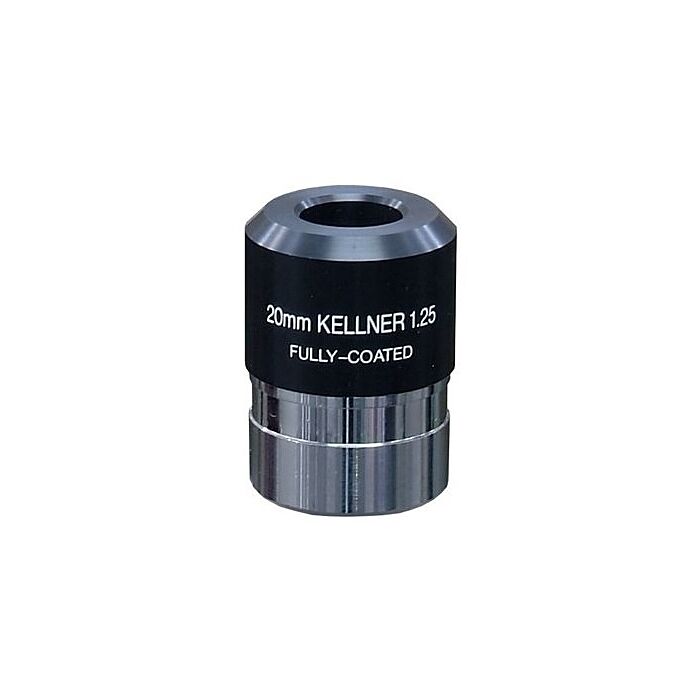

- Description
- Specifications
- Downloads
Product Overview
The Starbase KE-20mm is a 20mm Kellner eyepiece from Takahashi's Starbase accessory line, built around a straightforward 2-groups, 3-element optical design. It delivers a 45° apparent field of view and 14mm of eye relief, and weighs 77g. It threads into any standard 1.25” focuser, diagonal, or binoviewer using the same barrel convention as the rest of the Takahashi eyepiece range.
Who It's For
This is a good match if you want a low-power, wide-field eyepiece for a Takahashi refractor or reflector — for scanning star fields, framing open clusters, or getting a bright, comfortable finder-style view before switching to higher power. It also works as a second eyepiece alongside a shorter-focal-length Starbase or TPL for a two-eyepiece kit covering low and high power.
Key Features & Design
- Kellner optical design: 2 groups, 3 elements — a simple, well-corrected layout for the center and mid-field of the view.
- 45° apparent field of view: a generous window at 20mm focal length, wider than the eyepieces bundled with most starter refractors.
- 14mm eye relief: comfortable for observing without eyeglasses.
- 77g weight: light enough not to unbalance a small refractor's focuser.
Optical / Mechanical Design
The Kellner design pairs a plano-convex field lens with a cemented achromatic eye lens, a configuration that keeps cost down while holding up well at the center of the field — exactly where a low-power, wide-view eyepiece spends most of its time. At 20mm focal length and f-ratios typical of Takahashi apochromats, the KE-20mm stays undemanding on the eye and forgiving of minor eye placement, which is what the 14mm eye relief figure is doing for you.
Recommended Uses
On a Takahashi FS-60CB (355mm, f/5.9) the KE-20mm gives roughly 18x — a true wide-field, grab-and-go view of large open clusters and Milky Way star fields. On a TSA-120 (900mm, f/7.5) the same eyepiece yields about 45x, a comfortable low-power view for scanning before you move to a shorter focal length for detail. Divide any Takahashi tube's focal length by 20mm to get the magnification on your own setup.
Compatibility and Accessory Notes
Most of the Starbase and Takahashi eyepiece lines use the 1.25” (31.7mm) barrel standard, which fits every Takahashi focuser, star diagonal, and 2″-to-1.25” adapter in the current catalog.
Good to Know Before You Order
Not parfocal with the rest of the range: expect to refocus when you swap eyepieces.
Frequently Asked Questions
Is it difficult to set up?
No — it drops into any 1.25” focuser or diagonal and is ready to use immediately.
What is it best used for?
Low-power, wide-field visual observing — star fields, open clusters, and framing before you switch to a shorter eyepiece for detail.
Does it work for astrophotography?
It's built for visual use. For imaging, a dedicated camera train and adapter suited to your telescope's back focus is the better route — see our Takahashi Back Focus Guide if you're setting one up.
What telescopes does it fit?
Any Takahashi refractor or reflector with a standard 1.25” focuser or diagonal.
Bottom Line
A 20mm Kellner eyepiece with a 45° field and 14mm of eye relief — a wide, comfortable, low-power view for any Takahashi tube with a 1.25” focuser. If you're building out a full eyepiece set and want help matching focal lengths to your telescope, send us your setup and we'll work it out with you.
| Optical design | Kellner, 2 groups / 3 elements |
|---|---|
| Focal length | 20mm |
| Apparent field of view | 45° |
| Eye relief | 14mm |
| Weight | 77g |
| Parfocal | No |
Shopping Guide
- Takahashi English Catalog 2025 — PDF, 8.63 MB
You may also like
Recently viewed
Recent Blog Posts
View all
Your Guide Graph Is Lying to You
Read More

D-Size vs V-Size: A Complete Guide to Telescope Dovetail Systems
Read More

What Is Back Focus in Astrophotography? Telescope Reducers, Flatteners, and Spacing Explained
Read More