
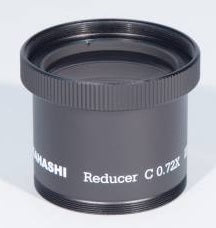

- Description
- Specifications
- Downloads
Product Overview
The Reducer-C 0.72x is Takahashi's wide-field reducer for the FS-60 platform, dedicated to the FS-60CB, FS-60Q, and the earlier FS-60 models. On the FS-60CB it takes the native 355mm f/5.9 down to roughly 255mm at f/4.2, correcting a 40mm image circle at a fixed 56.2mm back focus. It weighs 180 g and adds 48 mm of length ahead of the sensor.
Who It's For
This is a good match if you own an FS-60CB or FS-60Q and want a faster, wider field for extended deep-sky exposures — nebula and Milky Way framing where the native focal length is already narrower than most refractors but you want it faster still.
Key Features & Design
- 0.72x reduction: speeds up the FS-60CB from f/5.9 to roughly f/4.2 for wide-field imaging.
- 40mm corrected image circle at a fixed 56.2mm back focus.
- M56 x 0.75 input, M52 x 0.75 output: a compact 48mm-long in-line unit weighing 180 g.
- Direct camera mounting: supports direct DSLR attachment via a brand-specific T-ring, or CMOS/CCD cameras with a filter wheel.
Optical / Mechanical Design
The FS-60 platform's native 355mm f/5.9 (FS-60CB) is already a compact wide-field configuration; the Reducer-C 0.72x speeds it up further for shorter exposure times per unit of signal, at the cost of some focal length reach. Threaded between the drawtube's M56 x 0.75 female mount and an M52 x 0.75 camera-side output, the reducer holds a 40mm image circle and a fixed 56.2mm back focus, which is also published for the FS-60Q at its own native focal length.

Recommended Uses
Wide-field nebula and Milky Way imaging on the FS-60CB or FS-60Q, and extended-exposure deep-sky work where a faster focal ratio shortens total integration time.
Compatibility and Accessory Notes
Takahashi dedicates this reducer to the FS-60 platform.
| Telescope | Native | With Reducer-C 0.72x (calculated) | Image circle | Back focus |
|---|---|---|---|---|
| FS-60CB | 355mm f/5.9 | ~256mm f/4.2 | Φ40mm | 56.2mm |
| FS-60Q | 600mm f/10.0 | ~432mm f/7.2 | Φ40mm | 56.2mm |
The FS-60CB figures are Takahashi's own stated result (f/5.9 to f/4.2). The FS-60Q figure is calculated from that same published 0.72x factor applied to its native focal length. For thread and spacing detail across your full imaging train, see the Takahashi Back Focus Guide.
Good to Know Before You Order
A separate option from Takahashi's other FS-60CB reducer: Takahashi also publishes the RD NC0.85x for the same tube; the 0.72x here is the faster, wider-field alternative, not a replacement for it.
Built for imaging, not eyepiece use: the flattened, reduced field has no benefit for visual observing.
Frequently Asked Questions
Is it difficult to set up?
No — it threads onto the FS-60's M56 x 0.75 drawtube thread and presents a fixed M52 x 0.75 output, so the 56.2mm back focus is set by the part itself.
What is it best used for?
Wide-field, faster-ratio deep-sky imaging on the FS-60CB or FS-60Q.
Can I mount a DSLR directly?
Yes — a brand-specific T-ring threads to the M52 x 0.75 output, or a CMOS/CCD camera can be mounted with a filter wheel in between.
Does it also work on the FS-60Q?
Takahashi states it is dedicated to the FS-60CB, FS-60Q, and earlier FS-60 models; send us your exact tube and we will confirm the fit before you order.
Bottom Line
The Reducer-C 0.72x speeds the FS-60CB up to roughly f/4.2 with a corrected 40mm image circle and a fixed 56.2mm back focus, at a compact 180 g.
| Type | Focal reducer, Reducer-C 0.72x |
|---|---|
| FS-60CB | 355mm f/5.9 native → approx. 256mm f/4.2 (Takahashi states f/4.2), Φ40mm, back focus 56.2mm |
| FS-60Q | 600mm f/10.0 native → approx. 432mm f/7.2 (calculated from 0.72x), Φ40mm, back focus 56.2mm |
| Input interface | M56 x 0.75, female |
| Output interface | M52 x 0.75, male |
| Length | 48mm |
| Weight | 180g |
| Part number | TKA20580B |
Shopping Guide
- Takahashi English Catalog 2025 — PDF, 8.63 MB
- Takahashi Telescope Backfocus Table — PDF, 71 kB
You may also like
Recently viewed
Recent Blog Posts
View all
Your Guide Graph Is Lying to You
Read More

D-Size vs V-Size: A Complete Guide to Telescope Dovetail Systems
Read More

What Is Back Focus in Astrophotography? Telescope Reducers, Flatteners, and Spacing Explained
Read More