
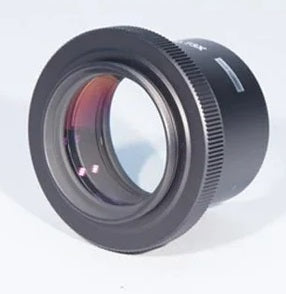

- Description
- Specifications
- Downloads
Product Overview
The Reducer-CR 0.73x is Takahashi's focal reducer for the CCA-250 and the Mewlon-250CRS and Mewlon-300CRS Cassegrains, trading some of each telescope's long native reach for a meaningfully faster, more deep-sky-friendly focal ratio. On the CCA-250 it brings the system down to f/3.6; on the Mewlon-250CRS and Mewlon-300CRS, to f/7.3 and f/7.2 respectively.
Who It's For
This is a good match if you own a CCA-250, Mewlon-250CRS, or Mewlon-300CRS and want a faster system for deep-sky imaging than the native long-focus Cassegrain configuration provides.
Key Features & Design
- Shared across three Cassegrains: one part, with the resulting focal length and ratio set by which telescope it is mounted on.
- Meaningful speed gain: the CCA-250 goes from f/5.0 native to f/3.6; the Mewlon CRS pair drop from roughly f/10 native into the f/7 range.
- 38–35mm image circle depending on host telescope, with a matched back focus for each.
Optical / Mechanical Design
The CCA-250, Mewlon-250CRS, and Mewlon-300CRS are Dall-Kirkham and related Cassegrain designs built natively for long-focus planetary and lunar work. The Reducer-CR 0.73x shortens the effective focal length on each by roughly the same 0.73x factor, but because their native ratios differ, the resulting speed gain is most dramatic on the CCA-250 (f/5.0 to f/3.6) and more moderate on the two Mewlon CRS models (f/9.9–f/10.0 down to roughly f/7.2–f/7.3).
Recommended Uses
Faster deep-sky imaging on the CCA-250, Mewlon-250CRS, or Mewlon-300CRS — galaxies, planetary nebulae, and globular clusters where the native long-focus configuration would otherwise demand long exposures.
Compatibility and Accessory Notes
Takahashi publishes this reducer for three telescopes, with a fourth pairing available through an additional adapter.
| Telescope | Native | With RD CR0.73x | Image circle | Back focus |
|---|---|---|---|---|
| CCA-250 | 1250mm f/5.0 | 910mm f/3.6 | Φ38mm | 56.2mm |
| Mewlon-250CRS | 2500mm f/10.0 | 1825mm f/7.3 | Φ35mm | 72.2mm |
| Mewlon-300CRS | 2960mm f/9.9 | 2160mm f/7.2 | Φ35mm | 72.2mm |
Takahashi also lists this reducer as compatible with the FSQ-106EDX4 when used with the separate CA35 (SKY90)-style adapter, part TKA35201. The same three Cassegrains also take the companion Mewlon CR Extender 1.5x, which Ontario Telescope carries separately, for the opposite trade-off. See the Takahashi Back Focus Guide for spacing detail.
Good to Know Before You Order
FSQ-106EDX4 use needs a separate adapter (TKA35201).
Frequently Asked Questions
Is it difficult to set up?
No — it threads to the rear cell with a fixed back focus on each host telescope, so there is no spacing to work out on the CCA-250 or Mewlon CRS pairings.
What is it best used for?
Faster deep-sky imaging on the CCA-250, Mewlon-250CRS, or Mewlon-300CRS.
Does the same part fit all three Cassegrains?
Yes — one reducer, with a different resulting focal length, ratio, and image circle depending on the host telescope.
Can I use it on my FSQ-106EDX4?
Takahashi notes compatibility with a separate adapter (TKA35201).
Bottom Line
The Reducer-CR 0.73x speeds up the CCA-250, Mewlon-250CRS, and Mewlon-300CRS for deep-sky imaging — down to f/3.6 on the CCA-250 and into the f/7 range on the Mewlon CRS pair — and extends to the FSQ-106EDX4 with an additional adapter.
| Type | Focal reducer (RD CR0.73x) |
|---|---|
| CCA-250 | 1250mm f/5.0 native → 910mm f/3.6, Φ38mm, back focus 56.2mm |
| Mewlon-250CRS | 2500mm f/10.0 native → 1825mm f/7.3, Φ35mm, back focus 72.2mm |
| Mewlon-300CRS | 2960mm f/9.9 native → 2160mm f/7.2, Φ35mm, back focus 72.2mm |
| FSQ-106EDX4 | Compatible with separate CA35-style adapter TKA35201 |
| Part number | TKA82580 |
Shopping Guide
- Takahashi English Catalog 2025 — PDF, 8.63 MB
- Takahashi Telescope Backfocus Table — PDF, 71 kB
You may also like
Recently viewed
Recent Blog Posts
View all
Your Guide Graph Is Lying to You
Read More

D-Size vs V-Size: A Complete Guide to Telescope Dovetail Systems
Read More

What Is Back Focus in Astrophotography? Telescope Reducers, Flatteners, and Spacing Explained
Read More