


- Description
- Specifications
- Downloads
Product Overview
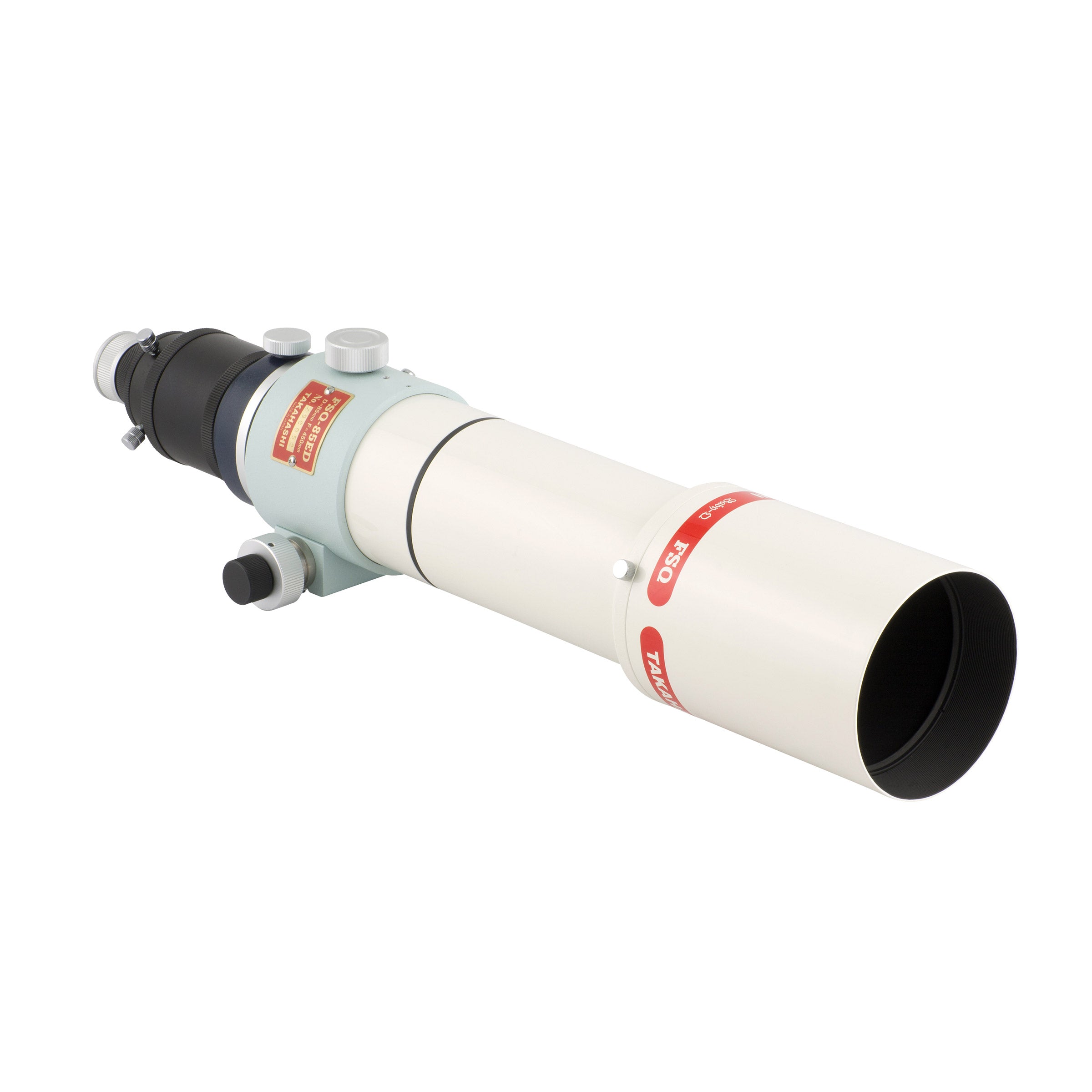
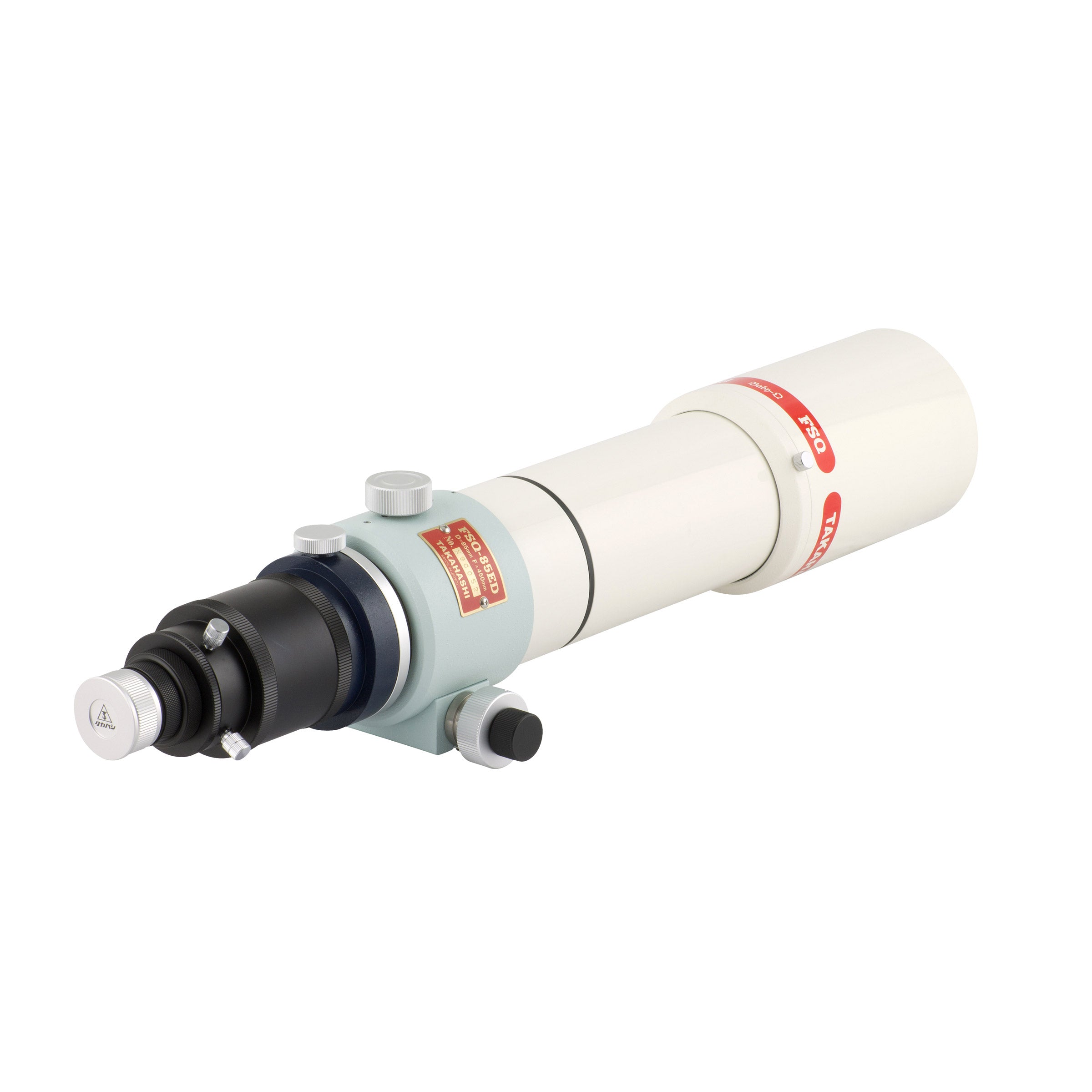
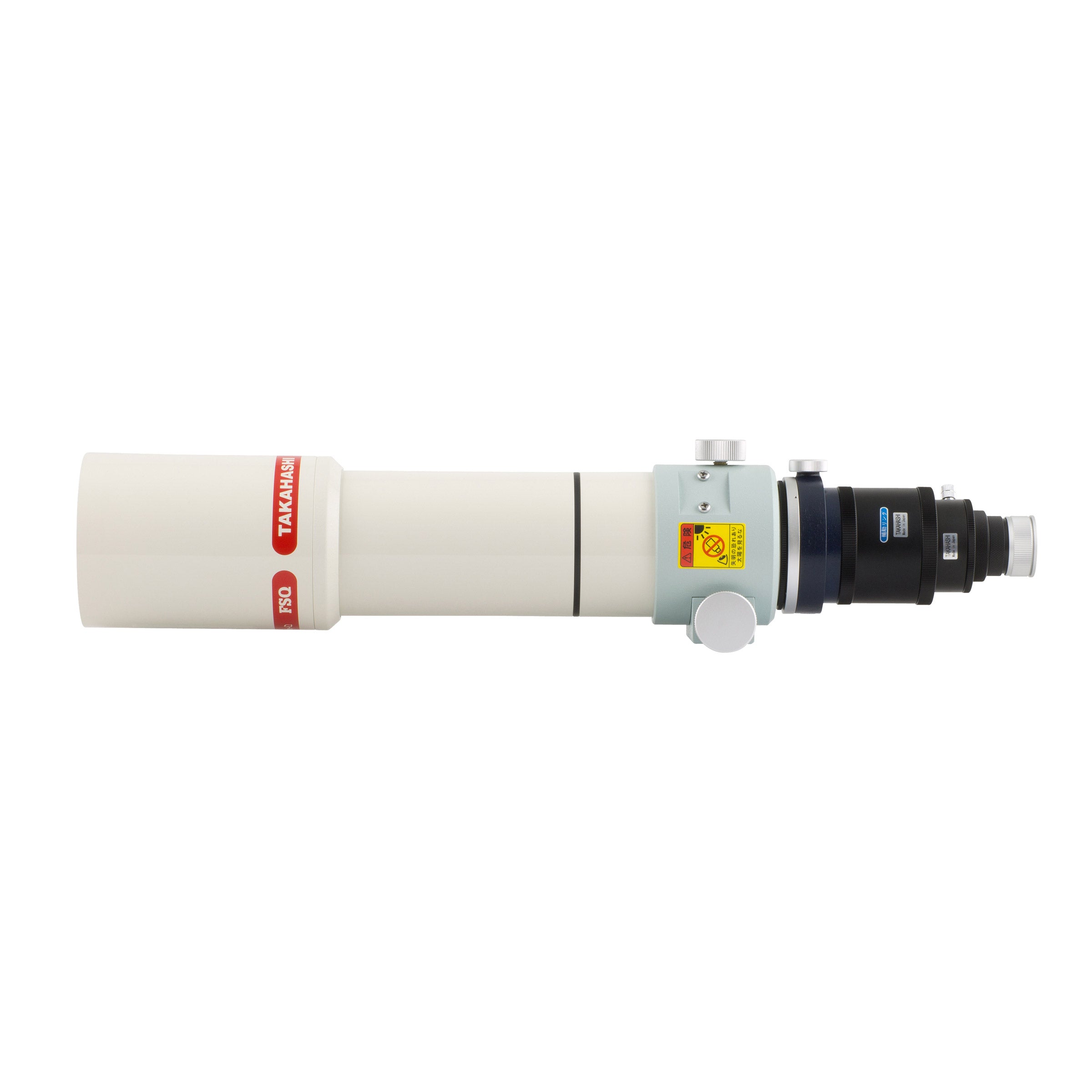
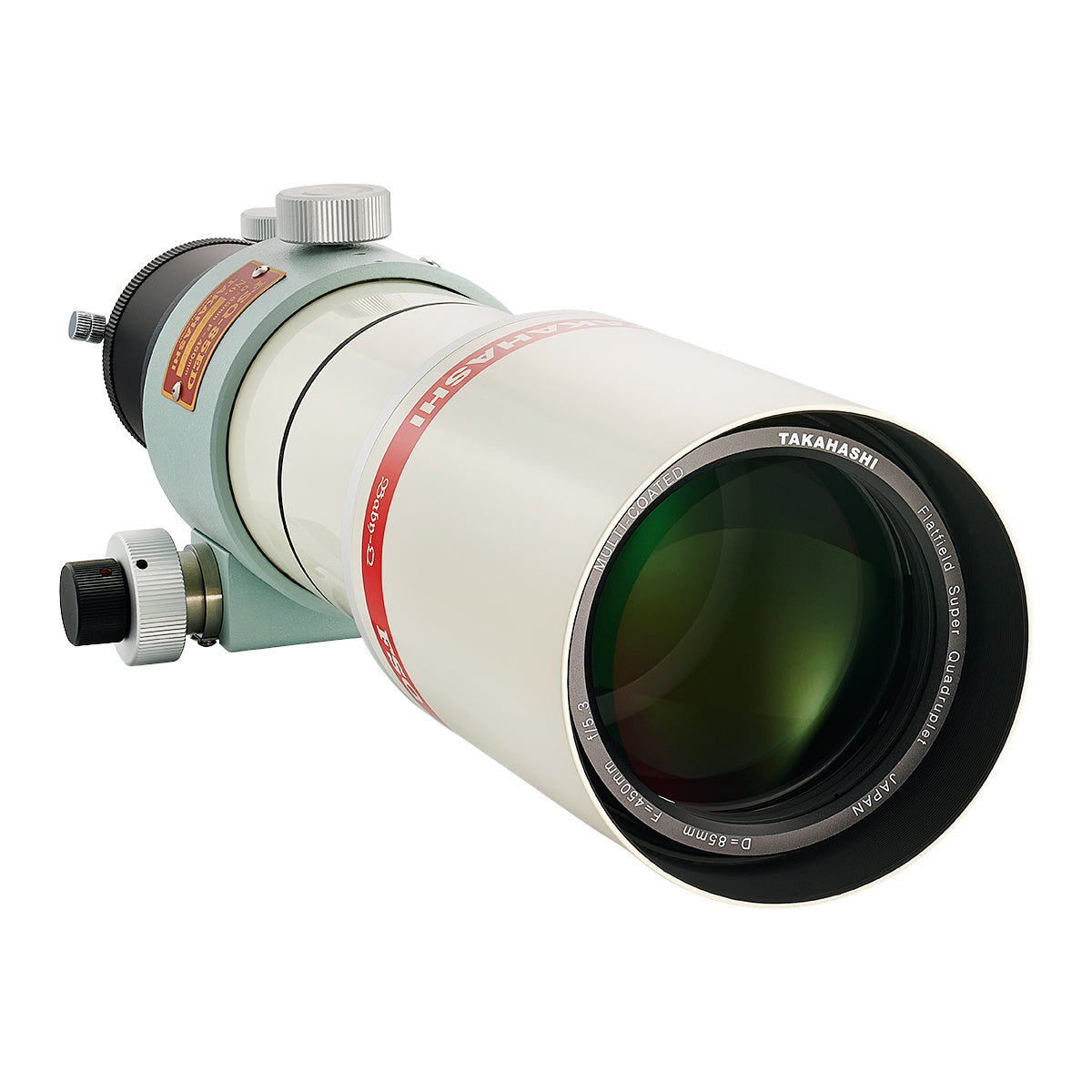
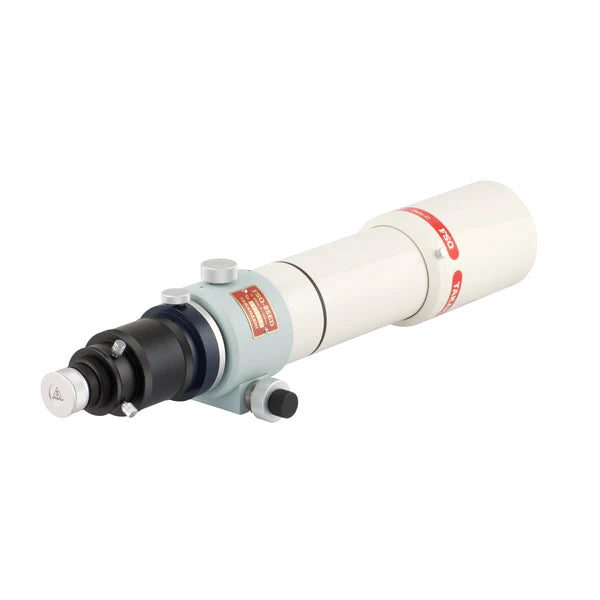
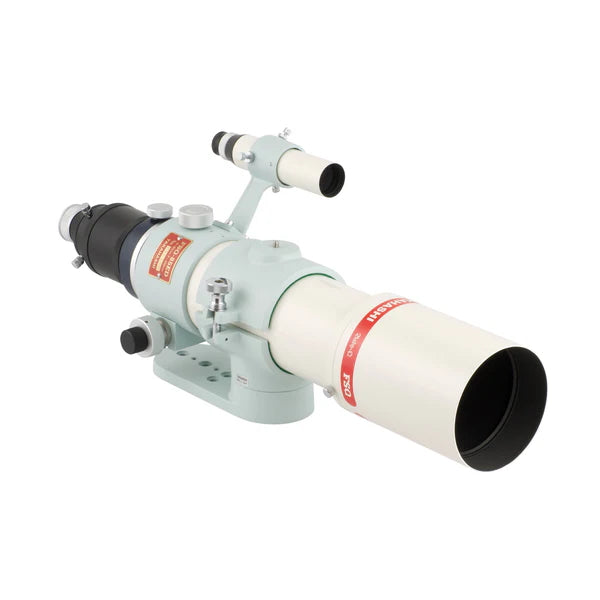
The FSQ-85EDX — known as the BabyQ — is Takahashi's 85 mm Petzval quadruplet astrograph, sold here as an optical tube assembly bundled with the 1.01x flattener. At 450 mm focal length and f/5.3 in a 535–613 mm tube, it weighs 3.6 kg and covers a 44 mm image circle. With the included flattener fitted the system runs 455 mm at f/5.4 with just 56.2 mm of back focus, which is what makes the flattener worth bundling rather than buying separately.
Who It's For
This is a good match if you want a small, genuinely flat-field quadruplet for wide-field deep-sky imaging — four elements in four groups control field curvature and colour across the full 44 mm circle without the compromises a doublet or triplet design makes at this speed. Its 3.6 kg weight and 535 mm collapsed length make it a strong travel astrograph, and the 50 mm drawtube extension gives the focuser room to work with different camera and filter-wheel combinations.
Visual observers get a genuine apochromat at prime focus with a diagonal and eyepiece, though the FSQ-85EDX is built and priced around imaging. Tell us your camera and filter setup and we will confirm the flattener spacing works for your train.
Key Features & Design
- Petzval quadruplet: four elements in four groups, an ED apochromat design built to control field curvature and colour across a flat field.
- 450 mm at f/5.3: in a 535–613 mm retractable tube, 95 mm across (114 mm dew shield).
- 1.01x flattener included: 455 mm at f/5.4, 44 mm corrected circle, 56.2 mm back focus — the configuration this kit is built around.
- 3.6 kg: light enough for portable and travel mounts once a full imaging train is attached.
- 50 mm of drawtube extension for focus travel across different camera setups.
- 197.5 mm of back focus at prime — before the flattener is fitted, ample room for accessories.
Optical / Mechanical Design
The FSQ-85EDX objective is a four-element, four-group Petzval quadruplet built around ED glass — a design that inherently controls field curvature better than a doublet or triplet at the same speed, because the rear element group does the flattening work a separate corrector would otherwise need to do. The bundled 1.01x flattener refines that further, correcting the field to 44 mm at 455 mm and f/5.4 with 56.2 mm of back focus — tight enough that camera spacing needs to be accurate, and generous enough that most imaging trains reach it without extension tubes.
Other conversion options exist for the FSQ-85EDX platform — the RD QB 0.73x reducer brings it to 330 mm at f/3.9, and the EX ED 1.5x extender to 680 mm at f/8.0, both with the same 44 mm circle — though this kit is built and priced around the OTA-plus-flattener configuration.
Recommended Uses
- Wide-field deep-sky imaging: at 455 mm and f/5.4 with the included flattener, a 44 mm corrected circle across the frame.
- Travel astrophotography: a 535 mm collapsed tube and 3.6 kg weight suit portable rigs and checked baggage.
- Faster, wider framing: with the RD QB 0.73x reducer (sold separately) at 330 mm and f/3.9.
- Tighter framing: with the EX ED 1.5x extender (sold separately) at 680 mm and f/8.0.
Compatibility and Accessory Notes
Back focus is 197.5 mm at prime, dropping to 56.2 mm once the included 1.01x flattener is fitted — the figure your imaging train needs to hit. Takahashi's system charts for the base configuration, the RD QE 0.73x reducer and the EX ED 1.5x extender are in the Downloads tab, with the exact parts and distances for each. Our Takahashi Back Focus Guide collects the same figures for the whole range in one table.
- Flattener: 1.01x, included in this kit — 455 mm at f/5.4, 44 mm circle, 56.2 mm back focus.
- Reducer: RD QB 0.73x (sold separately), 330 mm at f/3.9, 44 mm circle, 72.2 mm back focus.
- Extender: EX ED 1.5x (sold separately), 680 mm at f/8.0, 44 mm circle, 117.5 mm back focus.
- Mount: sold as an OTA with flattener — no mount, rings, dovetail, diagonal or eyepiece included. At 3.6 kg plus a full imaging train, most travel and mid-payload mounts handle it.
If you are not sure your camera and filter thickness will reach 56.2 mm exactly, send us your imaging train and we will work out the spacing with you.
Good to Know Before You Order
- This is an optical tube assembly with the flattener included. Mount, rings, dovetail, diagonal and eyepiece are sold separately.
- Back focus with the flattener is tight. 56.2 mm is generous by imaging-train standards but still worth checking against your camera and filter wheel stack.
- The reducer and extender are sold separately. This kit bundles only the OTA and the 1.01x flattener; the RD QB 0.73x and EX ED 1.5x are additional purchases.
- Tube length varies with the dew shield position. 535 mm retracted, 613 mm extended — worth accounting for in a case.
Frequently Asked Questions
Is it difficult to set up?
No. The flattener is included and matched to the tube, so reaching the 56.2 mm back focus is mostly a matter of using the standard adapter stack. The published system chart in the Downloads tab confirms the exact parts, and we can check your specific camera train against it.
What is it best used for?
Wide-field deep-sky imaging — nebulae, star fields and Milky Way regions — at 455 mm and f/5.4 across a flat 44 mm circle.
Does the kit include everything I need to image?
It includes the OTA and the 1.01x flattener. A mount, camera, and any filter wheel or guider are separate purchases.
Can I use it visually?
Yes, at prime focus with a diagonal and eyepiece, though the telescope and this kit are built and priced around imaging use.
What is the difference between this and the reducer or extender configurations?
This kit is built around the 1.01x flattener at 455 mm and f/5.4. The RD QB 0.73x reducer (330 mm, f/3.9) and EX ED 1.5x extender (680 mm, f/8.0) are separate accessories for wider or tighter framing.
When should this not be the choice?
If you need faster than f/5.4 without buying the reducer separately, or a longer native focal length than 450 mm offers before adding the extender.
Bottom Line
In short: an 85 mm Petzval quadruplet astrograph and its matched 1.01x flattener, together giving 455 mm at f/5.4 with a 44 mm corrected circle and 56.2 mm of back focus. It weighs 3.6 kg, collapses to 535 mm for travel, and is built for wide-field deep-sky imaging.
Optical Diagram Reports
Takahashi publishes a spot diagram for the FSQ-85EDX with the 1.01x flattener fitted — the configuration this kit ships in — showing star images across the field at the design wavelengths.

| Optical design | 4 elements in 4 groups, Petzval ED apochromat |
|---|---|
| Aperture | 85 mm |
| Focal length (prime focus) | 450 mm |
| Focal ratio (prime focus) | f/5.3 |
| Image circle (prime focus) | Φ44 mm |
| Back focus (prime focus) | 197.5 mm |
| With 1.01x flattener (included) | 455 mm, f/5.4, Φ44 mm image circle, 56.2 mm back focus |
| With RD QB 0.73x reducer (sold separately) | 330 mm, f/3.9, Φ44 mm image circle, 72.2 mm back focus |
| With EX ED 1.5x extender (sold separately) | 680 mm, f/8.0, Φ44 mm image circle, 117.5 mm back focus |
| Tube length | 535–613 mm |
| External diameter | 95 mm |
| Dew shield diameter | 114 mm |
| Drawtube extension | 50 mm |
| Weight | 3.6 kg |
| Included | 1.01x flattener |
| Case included | No |
Shopping Guide
- Takahashi English Catalog 2025 — PDF, 8.63 MB
System Charts, Diagrams and Adapter Guides
- FSQ-85EDX System Chart — PDF, 482.7 kB
- FSQ-85EDX RD QE 0.73x Reducer System Chart — PDF, 47.6 kB
- FSQ-85EDX EX ED 1.5x Extender System Chart — PDF, 465.3 kB
- Takahashi Telescope Backfocus Table — PDF, 71 kB
Manuals
- FSQ-85EDX Instruction Manual (English) — PDF, 891.0 kB
You may also like
Recently viewed
Recent Blog Posts
View all
Your Guide Graph Is Lying to You
Read More

D-Size vs V-Size: A Complete Guide to Telescope Dovetail Systems
Read More

What Is Back Focus in Astrophotography? Telescope Reducers, Flatteners, and Spacing Explained
Read More