
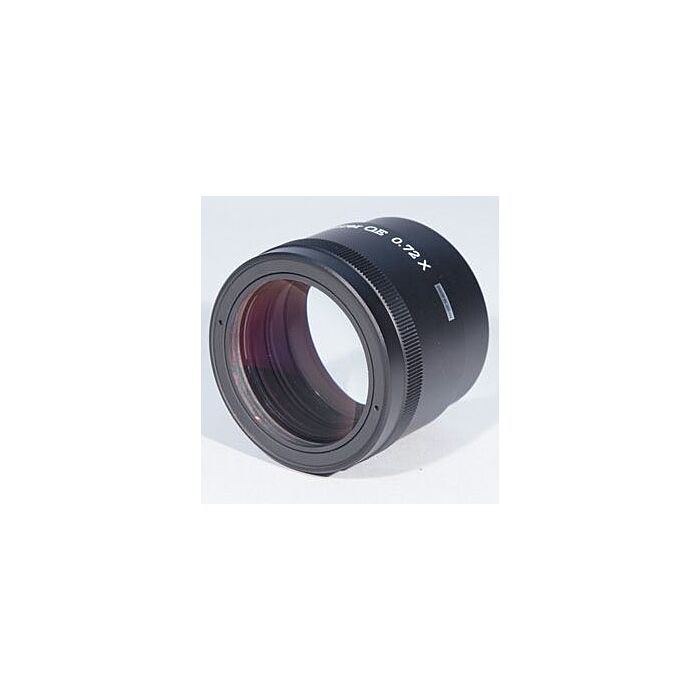
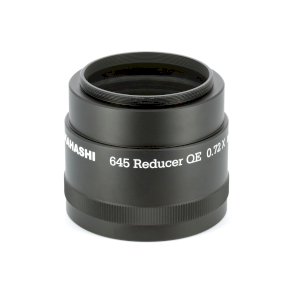


- Description
- Specifications
- Downloads
Product Overview
The 645RD QE 0.72x Reducer is Takahashi's medium-format focal reducer for the FSQ-106EDX4, cutting its focal length by 0.72x to reach 380mm at f/3.6. Four large-diameter lenses deliver a Φ60mm image circle with Takahashi's published figures putting relative illumination above 70% at the periphery and above 90% across a full-frame sensor.
Who It's For
This reducer suits FSQ-106EDX4 owners shooting with medium-format or large full-frame cameras who want a faster focal ratio for wide, deep-sky fields — large nebula complexes, galaxy clusters, and Milky Way mosaics.
Key Features & Design
- 4 lenses in 4 groups: large-diameter elements sized for a 60mm image circle.
- 0.72x reduction: takes the FSQ-106EDX4 to 380mm at f/3.6.
- Broad-spectrum multilayer coatings: minimize reflections and ghosting while maximizing transmission across visible wavelengths.
- M72x0.75 male input thread: installs directly on the FSQ-106EDX4's camera train.
Optical / Mechanical Design
The reducer measures 74.2mm in total length and sets a back focus of 56.2mm, matching the metal back distance published for this configuration. See the Takahashi Back Focus Guide for the full spacing chain.
Recommended Uses
Wide-field deep-sky imaging on the FSQ-106EDX4 with medium-format or large full-frame sensors; nebula and galaxy field imaging where the full Φ60mm circle is put to use; general astrophotography where f/3.6 shortens exposure times against the FSQ-106EDX4's native configuration.
Compatibility and Accessory Notes
| Telescope | Resulting focal length | Resulting focal ratio | Image circle | Back focus |
|---|---|---|---|---|
| FSQ-106EDX4 | 380mm | f/3.6 | Φ60mm | 56.2mm |
This reducer is specific to the FSQ-106EDX4 — the similarly-named 645 Reducer-CA 0.72x serves the CCA-250 instead, and the two aren't interchangeable between telescopes.
Good to Know Before You Order
At 200g, it's a light addition to the imaging train, though it's worth accounting for once your camera and any filters are attached and the whole assembly is balanced on the focuser.
Frequently Asked Questions
Is it difficult to set up?
No — it threads directly onto the FSQ-106EDX4's M72x0.75 interface, and the 56.2mm back focus figure is fixed once it's installed.
What is it best used for?
Wide-field deep-sky astrophotography on the FSQ-106EDX4 with medium-format and large full-frame sensors.
Does it work for visual observing?
No — it's built to deliver a flat photographic image circle rather than a visual eyepiece path.
What else do I need with it?
Your camera's own adapter to complete the connection at the 56.2mm back focus figure.
Bottom Line
A medium-format 0.72x reducer that takes the FSQ-106EDX4 to 380mm at f/3.6 across a Φ60mm image circle, at a 56.2mm back focus and a published weight of 200g.
| Product type | 0.72x focal reducer |
|---|---|
| Compatible telescope | FSQ-106EDX4 |
| Optical design | 4 lenses in 4 groups |
| Reduction factor | 0.72x |
| Resulting focal length | 380mm |
| Resulting focal ratio | f/3.6 |
| Corrected image circle | Φ60mm |
| Back focus (metal back distance) | 56.2mm |
| Total length | 74.2mm |
| Input thread | M72x0.75 male |
| Weight | 200g |
Shopping Guide
- Takahashi English Catalog 2025 — PDF, 8.63 MB
- Takahashi Telescope Backfocus Table — PDF, 71 kB
You may also like
Recently viewed
Recent Blog Posts
View all
Your Guide Graph Is Lying to You
Read More

D-Size vs V-Size: A Complete Guide to Telescope Dovetail Systems
Read More

What Is Back Focus in Astrophotography? Telescope Reducers, Flatteners, and Spacing Explained
Read More