
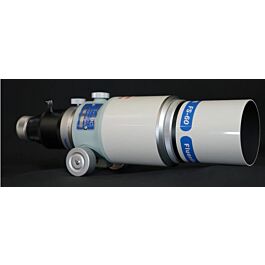

- Description
- Specifications
- Downloads
Product Overview
The FS-60CP is Takahashi's fixed-tube 60 mm fluorite doublet apochromat, built around the same objective as the FS-60CB but housed in a longer, 95 mm-diameter tube with a permanently mounted camera angle adjuster. At 355 mm focal length and f/5.9 it shares the CB's optical formula and most of its conversion-lens options, but the longer tube gives it 197.8 mm of back focus at prime focus — well over the CB's 162 mm — which is what lets it run Takahashi's newer FU-series reducer without running out of drawtube travel. Attach the 60CP FURD 0.65x reducer and it becomes a 230 mm f/3.8 astrograph.
Who It's For
This is a good match if you already know you want a wide-field imaging platform and would rather buy the longer-backfocus tube outright than add a spacer later. It suits imagers running the FU reducer for fast, flat fields, and anyone assembling a permanent imaging rig rather than a travel kit that gets reconfigured on site. It is less suited to observers who want the shortest, most collapsible package — the FS-60CB's retractable dew shield is the better fit there.
Key Features & Design
- Air-spaced fluorite doublet: the same two-element, two-group objective used in the FS-60CB — a genuine fluorite crystal element, not an ED-glass substitute.
- 355 mm at f/5.9: 60 mm aperture, native prime-focus figures identical to the CB.
- 197.8 mm of back focus: a fixed 95 mm tube gives substantially more rear clearance than the CB's 162 mm, built for reducer and flattener use.
- Camera angle adjuster: built into the rear cell, for rotating framing without disturbing focus.
- 63 mm drawtube extension on a rack-and-pinion focuser.
- 1.8 kg: heavier than the CB by the length of tube, still light for most imaging mounts.
Optical / Mechanical Design
The objective is the same two-element, air-spaced fluorite doublet used across the FS-60 line — fluorite's anomalous partial dispersion pulls the red, green and blue focal points close enough together that a two-element design performs like a more complex triplet at this aperture, without the violet fringing that limits ordinary short achromats. Hard multicoatings protect the fluorite surface and cut internal reflections.
What distinguishes the CP from the CB is the tube itself, not the glass. The 95 mm barrel is fixed rather than telescoping, and the extra length shifts the back focus out to 197.8 mm at prime focus — room enough for the 60CP FURD 0.65x reducer to reach focus, a part specified for this tube's back focus and not interchangeable with the CB's reducer. Takahashi notes that focus to infinity is not available in the base configuration without the correct diagonal or extension in the visual train, worth checking against the eyepiece setup you plan to use.
Recommended Uses
- Fast wide-field imaging: with the 60CP FURD 0.65x reducer at 230 mm and f/3.8, for large nebulae and wide star fields.
- Flat-field imaging at prime focus: with the FC/FS MFL 1.04x flattener at 370 mm and f/6.2, corrected across a 44 mm circle.
- Reduced-field imaging: with the 60C RD NC 0.85x reducer at 300 mm and f/5.0.
- Visual observing: lunar, double-star and wide-field work with a diagonal and eyepiece, keeping the infinity-focus note above in mind.
Compatibility and Accessory Notes
The FS-60CB and FS-60CP share the flattener and 0.85x reducer, but the 60CP FURD 0.65x reducer is built specifically for the CP's longer back focus and is a different part from the CB's reducer. Our Takahashi Back Focus Guide lists the figures for both tubes side by side, which is the fastest way to confirm a train before ordering.
- Back focus: 197.8 mm at prime focus.
- Field flattener: FC/FS MFL 1.04x — 370 mm, f/6.2, 44 mm circle, 87.5 mm back focus.
- Focal reducer: 60C RD NC 0.85x — 300 mm, f/5.0, 44 mm circle, 56.0 mm back focus.
- FU reducer: 60CP FURD 0.65x — 230 mm, f/3.8, 44 mm circle, 56.0 mm back focus measured from the rear of the adapter.
- Mount: sold as an OTA — no mount, rings or dovetail included.
If you are not sure which reducer or CA ring your camera needs, send us your camera and filter setup and we will work it out with you.
Good to Know Before You Order
- This is an optical tube assembly. Mount, tripod, rings, dovetail, diagonal, eyepiece and finder are sold separately.
- Focus to infinity needs the right visual train. Takahashi notes the base configuration does not reach infinity focus without the correct extension tube or diagonal in place — worth checking against the eyepiece or diagonal you plan to use.
- The CP's FU reducer is model-specific. The 60CP FURD 0.65x is built for this tube's back focus and is a different part from the CB's reducer.
- A flat field needs a corrector. At prime focus the field curves; the flattener or reducer corrects it.
Frequently Asked Questions
Is it difficult to set up?
No — at prime focus it is a diagonal and eyepiece, or a camera and the appropriate spacer. The one detail worth checking ahead of time is the visual train reaching infinity focus, which depends on the diagonal or extension used; tell us your setup and we will confirm it.
What is the difference between the FS-60CB and FS-60CP?
Same objective and focal length, different tube. The CP's fixed 95 mm barrel gives 197.8 mm of back focus against the CB's 162 mm, and that extra room is what the FU reducer needs to reach focus.
What is it best used for?
Wide-field imaging, particularly with the FU reducer at f/3.8, where the extra back focus over the CB matters most.
Does it need a flattener for astrophotography?
At prime focus, yes, for a flat field to the edge — the MFL 1.04x flattener or the 0.85x/0.65x reducers each correct it differently.
Can I use FS-60CB accessories on this tube?
The flattener and 0.85x reducer are shared. The FU reducer is specific to the CP's back focus and is a separate part from the CB's reducer.
Bottom Line
In short: a 60 mm fluorite apochromat at 355 mm and f/5.9, built into a fixed 95 mm tube with 197.8 mm of back focus for reducer and flattener work — and a 230 mm f/3.8 astrograph once the FU reducer is attached.
| Optical design | 2 elements in 2 groups, air-spaced fluorite apochromat |
|---|---|
| Aperture | 60 mm |
| Focal length (prime focus) | 355 mm |
| Focal ratio (prime focus) | f/5.9 |
| Back focus (prime focus) | 197.8 mm |
| With FC/FS MFL 1.04x flattener | 370 mm, f/6.2, Φ44 mm image circle, 87.5 mm back focus |
| With 60C RD NC 0.85x reducer | 300 mm, f/5.0, Φ44 mm image circle, 56.0 mm back focus |
| With 60CP FURD 0.65x reducer | 230 mm, f/3.8, Φ44 mm image circle, 56.0 mm back focus (from rear of adapter) |
| Tube length | 361 mm |
| External diameter | 95 mm |
| Dew shield diameter | 80 mm |
| Focuser | Rack-and-pinion, 63 mm drawtube extension |
| Weight | 1.8 kg |
| Supplied as | Optical tube assembly only — no mount, rings, diagonal or eyepiece |
Shopping Guide
- Takahashi English Catalog 2025 — PDF, 8.63 MB
System Charts, Diagrams and Adapter Guides
- Takahashi Telescope Backfocus Table — PDF, 71 kB
You may also like
Recently viewed
Recent Blog Posts
View all
Your Guide Graph Is Lying to You
Read More
D-Size vs V-Size: A Complete Guide to Telescope Dovetail Systems
Read More
What Is Back Focus in Astrophotography? Telescope Reducers, Flatteners, and Spacing Explained
Read More