
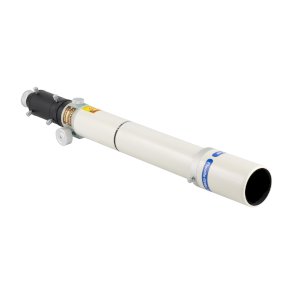
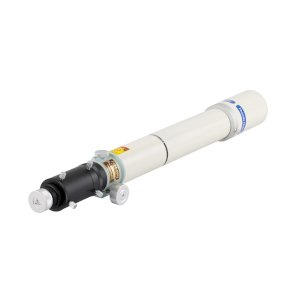
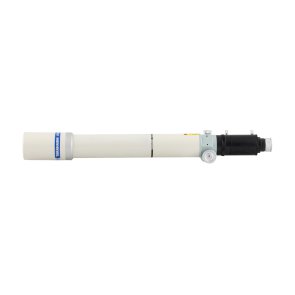


- Description
- Specifications
- Downloads
Product Overview
The FOA-60Q is the FOA-60's Ortho Apochromat objective with the 1.7x EX extender built permanently into the optical path — a 6-element, 4-group design running natively at 900 mm and f/15, with an 88 mm corrected image circle. Takahashi publishes a theoretical Strehl ratio of 99.8% for this configuration, a figure the company states exceeds its own TOA-130 and TOA-150 triplets. The tube weighs 2.1 kg and extends to 707 mm.
Who It's For
This is a good match if you want the FOA-60's correction quality at long focal length without assembling the extender yourself — planetary and lunar observers chasing fine detail at high power, and double-star observers splitting close, faint pairs where wavefront quality matters as much as aperture. It suits imagers doing high-resolution planetary and lunar work who want a compact, dedicated long-focal-length apochromat rather than a general-purpose wide-field tube.
Key Features & Design
- Ortho Apochromat with built-in extender: six elements in four groups — the FOA-60 doublet plus a permanently mounted 1.7x extender group.
- 900 mm at f/15: native focal length and ratio, with an 88 mm corrected image circle.
- 99.8% theoretical Strehl ratio, per Takahashi — correction Takahashi states exceeds its TOA-130 and TOA-150 triplets.
- 208.1 mm of back focus: ample room for a diagonal or imaging train.
- 84 mm drawtube extension on a rack-and-pinion focuser.
- 2.1 kg: compact for the focal length, in a tube that extends to 707 mm.
Optical / Mechanical Design
The front two elements are the FOA-60's Ortho Apochromat fluorite doublet — already specified for correction levels associated with Takahashi's TOA triplets — with a four-element 1.7x extender group permanently mated behind it, rather than sold as a separate accessory. The combination is what produces the published 99.8% theoretical Strehl ratio, and Takahashi's own comparison places that figure above the TOA-130 and TOA-150.
Hard multicoatings protect the fluorite surfaces, and the 208.1 mm of back focus — generous for a 60 mm-aperture tube — is what makes room for a diagonal, filter wheel or high-resolution planetary camera without running short on drawtube travel. Because the extender is integrated rather than an add-on, there is no shorter native configuration on this tube — removing the extender group returns it to a standard FOA-60.
Recommended Uses
- High-power planetary and lunar observing: at 900 mm and f/15, where the high Strehl ratio shows up as tighter, cleaner diffraction detail.
- Close double-star splitting: correction quality matters as much as aperture for faint, tight pairs.
- High-resolution planetary imaging: the long native focal length suits lucky-imaging style planetary cameras without an additional Barlow.
- Compact long-focal-length visual work: 900 mm in a tube that still travels, at 2.1 kg.
Compatibility and Accessory Notes
The FOA-60Q's system chart and extender-specific chart, both in the Downloads tab, list the adapters and distances Takahashi publishes for this configuration. Our Takahashi Back Focus Guide collects the same figures for the whole Takahashi range.
- Back focus: 208.1 mm.
- Image circle: 88 mm, corrected.
- Visual train: a 1.25-inch or 2-inch diagonal and eyepiece attach through the matching Takahashi visual adapter.
- Mount: sold as an OTA — no mount, rings, finder or dovetail included. At 2.1 kg it suits small to mid-sized equatorial mounts, though 900 mm of focal length asks more of tracking accuracy than a wide-field scope.
If you are planning a planetary imaging train and want to confirm your camera's back focus, send us the details and we will work it out with you.
Good to Know Before You Order
- This is an optical tube assembly. Mount, tripod, rings, dovetail, diagonal, eyepiece and finder are sold separately.
- The extender is built in, not removable as a separate accessory purchase. There is no shorter native configuration on this specific tube listing — for that, the FOA-60 without the extender is the base model.
- 60 mm still sets the light grasp. The Ortho design and extender improve correction and reach, not aperture — its strength is planetary and double-star detail rather than faint deep-sky targets.
Frequently Asked Questions
Is it difficult to set up?
No — at prime focus it is a diagonal and eyepiece and you are observing. The system chart in the Downloads tab lists the adapters and distances for imaging.
What is it best used for?
High-power lunar and planetary observing and imaging, and close double-star splitting, where the 99.8% theoretical Strehl ratio is most visible.
What is the difference between the FOA-60 and FOA-60Q?
The FOA-60Q has the 1.7x extender permanently built into the optical path — 900 mm at f/15 instead of the FOA-60's native 530 mm at f/8.8 — rather than being added as a separate accessory.
Does it need additional accessories for imaging?
The 88 mm image circle and 208.1 mm of back focus are already corrected for this configuration; a planetary or lunar camera attaches through the standard visual train without an additional flattener.
Will it work on a small mount?
At 2.1 kg the tube is light, but 900 mm of focal length benefits from steady tracking. Tell us which mount you are using and we will confirm the fit.
Bottom Line
In short: a 60 mm fluorite Ortho Apochromat running natively at 900 mm and f/15, with an 88 mm image circle, 208.1 mm of back focus, and a published 99.8% theoretical Strehl ratio built for high-resolution planetary and lunar work.
| Optical design | 6 elements in 4 groups, fluorite Ortho Apochromat (doublet objective + integrated 1.7x extender) |
|---|---|
| Aperture | 60 mm |
| Focal length | 900 mm |
| Focal ratio | f/15.0 |
| Image circle | Φ88 mm |
| Back focus | 208.1 mm |
| Strehl ratio | 99.8% theoretical, per Takahashi |
| Tube length | 647–707 mm (with drawtube extension) |
| External diameter | 68 mm |
| Dew shield diameter | 80 mm |
| Focuser | Rack-and-pinion, 84 mm drawtube extension |
| Weight | 2.1 kg |
| Supplied as | Optical tube assembly only — no mount, rings, diagonal or eyepiece |
Shopping Guide
- Takahashi English Catalog 2025 — PDF, 8.63 MB
System Charts, Diagrams and Adapter Guides
- FOA-60Q Photo & Visual System Chart — PDF
- FOA-60Q Extenders System Chart — PDF
- Takahashi Telescope Backfocus Table — PDF, 71 kB
Manuals
You may also like
Recently viewed
Recent Blog Posts
View all
Your Guide Graph Is Lying to You
Read More

D-Size vs V-Size: A Complete Guide to Telescope Dovetail Systems
Read More

What Is Back Focus in Astrophotography? Telescope Reducers, Flatteners, and Spacing Explained
Read More