

- Description
- Specifications
- Downloads
Product Overview
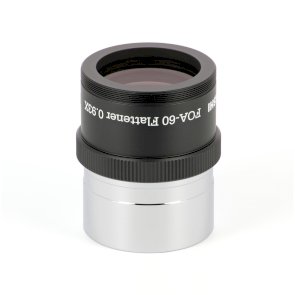
The FOA-60 0.93x Flattener is the field corrector built specifically for Takahashi's FOA-60 Ortho Apochromat. Threaded to the FOA-60's 2-inch drawtube and finishing in an M52 x 0.75 female output, it brings the focal length from 530 mm down to 495 mm at f/8.2 while flattening the field to within 10 microns across a 44 mm image circle. It weighs 205 g and adds 67 mm of length ahead of the sensor.
Who It's For
This is a good match if you already own the FOA-60 and want a flat, coma-free field for imaging — small-sensor deep-sky work, lunar mosaics, or solar eclipse photography where the corner stars matter as much as the center.
Key Features & Design
- Purpose-built for the FOA-60: not a universal flattener — matched specifically to this 60mm ortho-apochromat's native curvature.
- 44mm corrected image circle: covers full-frame sensors with the field flattened to within roughly 10 microns.
- 495mm f/8.2 result: a modest 0.93x reduction that trims the native 530mm f/8.8 slightly while correcting the field.
- Compact in-line design: 56mm diameter, 67mm long, 205g, threading directly between the 2-inch drawtube and an M52 x 0.75 camera train.
Optical / Mechanical Design
The corrector uses two lens elements in two groups to cancel the FOA-60's residual field curvature, the tradeoff Takahashi's ortho-apochromat design makes for its high on-axis Strehl ratio. The output back focus works out to 56.0 mm from the flattener, so spacing to the sensor is a fixed rather than adjustable figure once the M52 x 0.75 thread is engaged.
Recommended Uses
Deep-sky imaging where corner star shape matters, lunar mosaic photography, and solar eclipse imaging with a full-frame or APS-C sensor.
Compatibility and Accessory Notes
This flattener is matched to the FOA-60 only — the table below is Takahashi's published figure for that pairing.
| Telescope | Native | With FL 0.93x | Image circle | Back focus |
|---|---|---|---|---|
| FOA-60 | 530mm f/8.8 | 495mm f/8.2 | Φ44mm | 56.0mm |

Backfocus and thread spacing for the whole FOA-60 imaging train are covered in the Takahashi Back Focus Guide.
Good to Know Before You Order
Not combined with the FOA-60Q 1.7x extender: the flattener and the EX 1.7xR extender serve different configurations of the same tube and are not used together.
Built for imaging, not eyepiece use: the flattened field has no benefit for visual observing, where the FOA-60's native curvature is not a factor.
Frequently Asked Questions
Is it difficult to set up?
No — it threads onto the FOA-60's 2-inch drawtube on one side and presents an M52 x 0.75 female thread on the camera side, so the spacing is fixed by the part itself rather than something to measure out.
What is it best used for?
Flat-field imaging on the FOA-60 — deep-sky, lunar, and solar eclipse photography.
Does it work on other Takahashi refractors?
No — it is matched to the FOA-60's specific curvature. Other Takahashi models use their own matched flatteners; if you are unsure which one applies to your scope, send us your setup and we will confirm it.
Does it change the FOA-60 into the FOA-60Q?
No — that conversion uses the separate EX 1.7xR extender, which is not used together with this flattener.
Bottom Line
The FOA-60 0.93x Flattener is the matched corrector for Takahashi's FOA-60, turning it into a 495mm f/8.2 system with a flat 44mm image circle for imaging, at 205 g and a fixed 56.0mm back focus.
| Type | Field flattener, 2 lenses in 2 groups |
|---|---|
| For telescope | FOA-60 (530mm f/8.8 native) |
| Resulting focal length | 495mm |
| Resulting f-ratio | f/8.2 |
| Image circle | Φ44mm |
| Back focus | 56.0mm |
| Input interface | 2" (50.8mm) barrel |
| Output interface | M52 x 0.75, female |
| Mechanical diameter | 56mm |
| Total length | 67mm |
| Weight | 205g |
| Part number | TKA28582 |
Shopping Guide
- Takahashi English Catalog 2025 — PDF, 8.63 MB
- Takahashi Telescope Backfocus Table — PDF, 71 kB
You may also like
Recently viewed
Recent Blog Posts
View all
Your Guide Graph Is Lying to You
Read More

D-Size vs V-Size: A Complete Guide to Telescope Dovetail Systems
Read More

What Is Back Focus in Astrophotography? Telescope Reducers, Flatteners, and Spacing Explained
Read More