


- Description
- Specifications
- Downloads
Product Overview
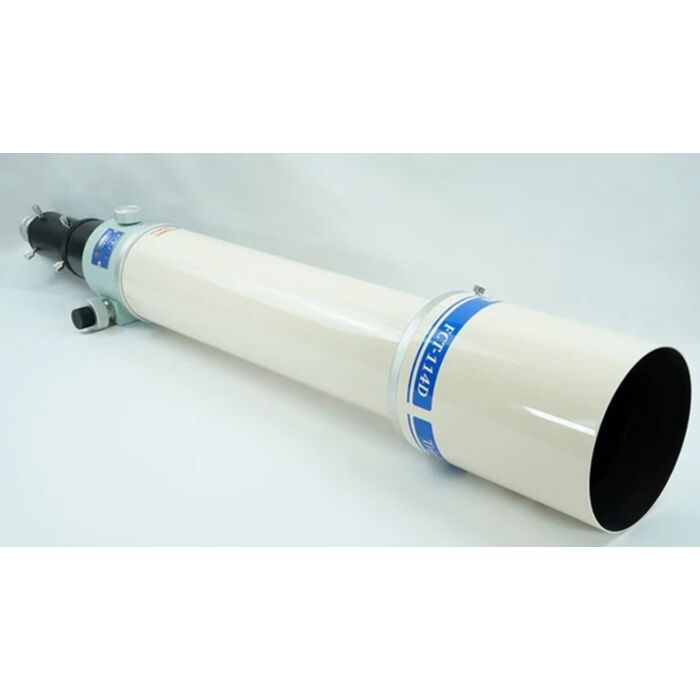
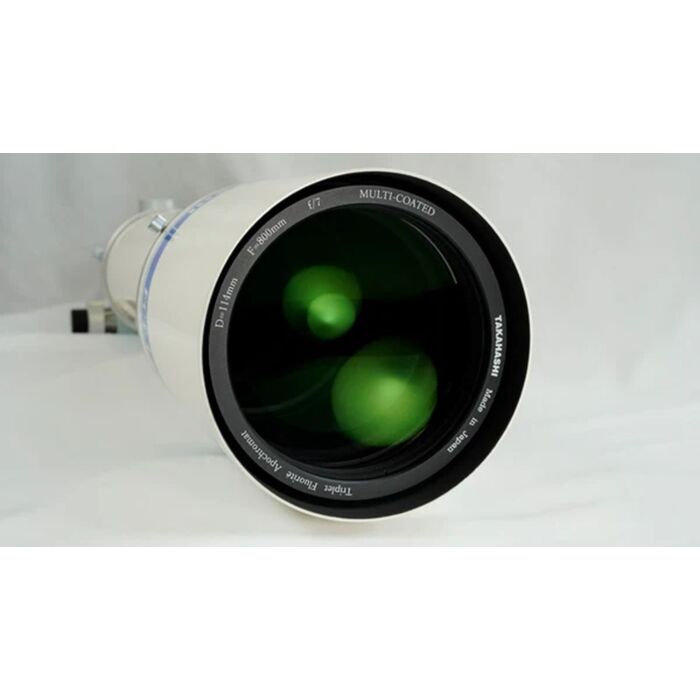
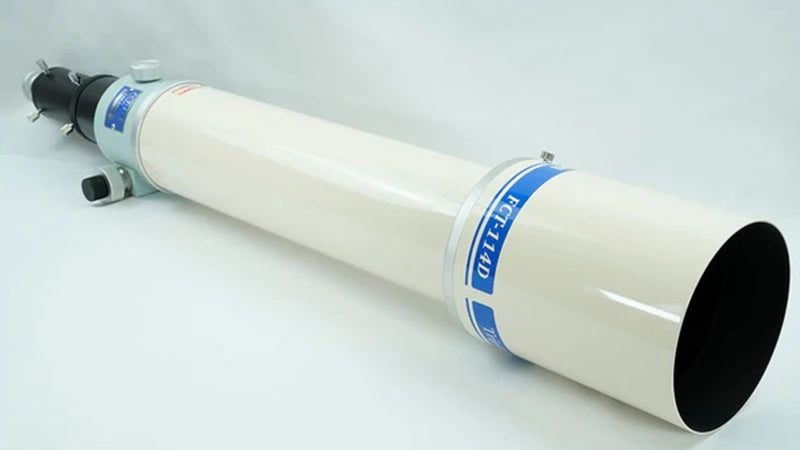
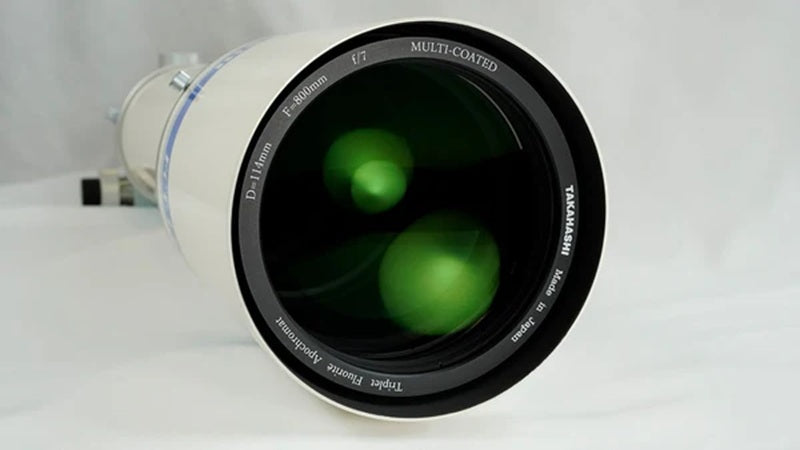
The FCT-114DF is Takahashi's 114 mm fluorite triplet apochromat, working at 800 mm and f/7. Takahashi publishes a 97.5% visual Strehl ratio for it — a figure that describes how close the focused image comes to theoretical perfection, and one very few refractors are specified against at all. It uses the same focuser assembly as the FSQ-85EDX, and the tube runs to approximately 5 kg.
Who It's For
This is a good match if you want a 114 mm apochromatic triplet for lunar, planetary and deep-sky observing, with the option of adding a flattener or reducer for imaging later. If you already own an FSQ-85EDX, the shared focuser means the accessories you have for one will carry across to the other.
At 114 mm it sits in useful territory — enough aperture to hold high magnification on a planet, still short enough at 800 mm to frame larger deep-sky objects without a reducer.
Key Features & Design
- Fluorite triplet apochromat: a fluorite element in a three-element objective, which is what buys the colour correction a doublet cannot reach at this aperture and speed.
- 800 mm at f/7: 114 mm of aperture at a moderate focal ratio — neither a fast astrograph nor a long planetary tube, but comfortable at both.
- 97.5% visual Strehl ratio: Takahashi's published figure for the optical quality of the finished instrument.
- Focuser shared with the FSQ-85EDX: the same assembly, so adapters and accessories transfer between the two.
- Approximately 5 kg: a manageable load for a mid-sized equatorial mount once a diagonal and eyepiece are attached.
Optical / Mechanical Design
A fluorite element in a triplet objective controls two problems at once. Chromatic error — the colour fringing that betrays a lesser refractor on a bright limb — comes down because fluorite's dispersion behaviour is something optical glass cannot imitate. Spherical aberration comes down because a third element gives the designer another surface to work with. Doing both at 114 mm and f/7 is what the 97.5% Strehl figure is measuring.
Strehl ratio is worth understanding when you see it quoted. It compares the light concentrated in the centre of a star image against what a theoretically perfect optic would deliver. Anything above 95% is generally regarded as excellent; 97.5% is a figure most manufacturers do not publish because most instruments cannot support the claim.
Recommended Uses
- Lunar and planetary observing at high magnification, where colour correction and contrast show most directly.
- Deep-sky visual observing — 114 mm gathers meaningfully more light than a 100 mm tube while staying transportable.
- Double star work, where clean star images matter more than field width.
- Astrophotography with a corrector, once the right flattener or reducer is matched to your camera.
Compatibility and Accessory Notes
- Focuser: the same assembly as the FSQ-85EDX, so 2-inch visual adapters and camera fittings for that telescope fit this one.
- Correctors: Takahashi offers flatteners and reducers for its refractor range, and the right one depends on your sensor. Send us your camera and we will match it for you.
- Mount: sold as an optical tube assembly. Rings, dovetail, diagonal and eyepiece are separate.
Good to Know Before You Order
- This is an optical tube assembly. Mount, rings, dovetail, diagonal and eyepiece are all sold separately. We can quote a complete setup if that is easier.
- No corrector is matched to this tube by name. Tell us how you plan to image with it and we will work out which flattener or reducer suits your sensor.
Frequently Asked Questions
Is it difficult to set up?
At prime focus, no — a diagonal and an eyepiece and you are observing. For imaging, send us your camera and we will work out the corrector and spacing with you.
What is it best used for?
Lunar, planetary and double-star observing, where the 97.5% Strehl ratio and the fluorite triplet's colour correction show most clearly. It handles deep-sky visual work comfortably too.
What does a 97.5% Strehl ratio actually mean?
It measures how much of a star's light lands where a perfect optic would put it. Above 95% is excellent. It is a demanding figure to publish, and most manufacturers do not quote one at all.
How is this different from the FCT-114DS?
They share aperture, focal length and focal ratio. The DF is the one Takahashi specifies as using the FSQ-85EDX focuser. If you are choosing between them, tell us how you plan to use the telescope and we will talk it through.
Can I use it for astrophotography?
Yes, with a corrector matched to your sensor. Send us your camera and we will work out the spacing with you before you order.
Will my FSQ-85EDX accessories fit?
The focuser is the same assembly, so accessories that thread or slide into that focuser will transfer.
Bottom Line
In short: a 114 mm fluorite triplet apochromat at 800 mm and f/7, published at 97.5% Strehl and sharing its focuser with the FSQ-85EDX at around 5 kg — built for lunar, planetary and double-star observers who want colour correction and contrast at a useful aperture, with room to add imaging later.
| Product name | FCT-114DF |
|---|---|
| Product code | TCK11420 |
| Optical design | Fluorite triplet apochromat, 3 elements in 3 groups |
| Aperture | 114 mm (4.5 in) |
| Focal length | 800 mm |
| Focal ratio | f/7 |
| Visual Strehl ratio | 97.5% |
| Focuser | Same assembly as the FSQ-85EDX (per Takahashi) |
| Weight | Approx. 5–5.5 kg (Takahashi publishes “just over 5 kg” in prose only, not as a spec-table figure) |
| Corrected performance with optional flattener | Spot sizes of 6 µm RMS or less on a full-frame sensor |
| Supplied as | Optical tube assembly only |
| Case included | No |
Shopping Guide
- Takahashi English Catalog 2025 — PDF, 8.63 MB (FCT-114DF is not in the 2025 specification chapter; catalog included for reference only)
System Charts, Diagrams and Adapter Guides
- Takahashi Telescope Backfocus Table — PDF, 71 kB (FCT-114DF is not listed in this table)
You may also like
Recently viewed
Recent Blog Posts
View all
Your Guide Graph Is Lying to You
Read More

D-Size vs V-Size: A Complete Guide to Telescope Dovetail Systems
Read More

What Is Back Focus in Astrophotography? Telescope Reducers, Flatteners, and Spacing Explained
Read More