
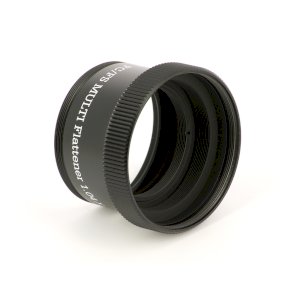


- Description
- Specifications
- Downloads
Product Overview
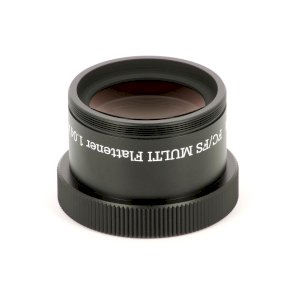
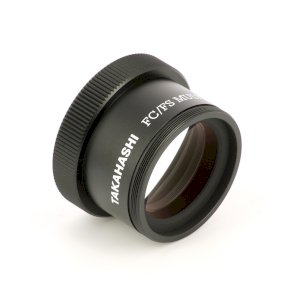
The FC/FS Multi-Flattener 1.04x is Takahashi's universal field flattener for the FC and FS doublet refractor families. It replaces the separate model-specific flatteners Takahashi previously sold: one optic now covers the whole range, with a telescope-specific CA ring setting the correct spacing for each tube.
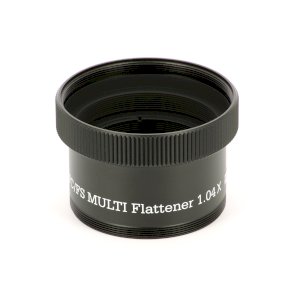
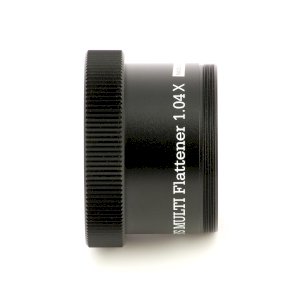
Two elements in one group, 40 mm long, 60 mm across and 110 g. It threads M56 x 0.75 female on the telescope side and presents M52 x 0.75 male to your camera adapter, with 40 mm of backfocus behind it. The 1.04x factor means focal length moves only slightly — a 355 mm FS-60CB becomes 370 mm — so this is a corrector, not a focal-length changer.
Who It's For
This is what you need if you image with an FC or FS doublet and your stars go elongated toward the corners of the frame. At prime focus these telescopes have a curved field; the flattener corrects it and gives a 44 mm flat circle on the shorter tubes — enough to cover APS-C completely and most of full frame.
If you observe visually with an eyepiece, this has no application in that train. It corrects a photographic field for a sensor.
Key Features & Design
- Two elements in one group: a cemented pair that corrects field curvature without adding measurable chromatic error of its own.
- 1.04x magnification factor: focal length and focal ratio shift only marginally — the point is the flat field, not a speed change.
- 44 mm corrected image circle on FS-60CB, FC-76D, FC-100D, FC-50, FC-65, FC-76 and FS-78; 40 mm on FC-100DL, FC-60, FC-100, FC-125, FS-102, FS-128 and FS-152.
- M56 x 0.75 female in, M52 x 0.75 male out: standard Takahashi interfaces on both faces.
- 40 mm backfocus: the distance from the rear thread to the sensor, which your camera adapter stack must total.
- 110 g and 40 mm long: adds almost nothing to focuser load or train length.
- One optic, whole family: replaces the older per-telescope flatteners; the CA ring does the model-specific work.
Optical Design
A doublet refractor focuses a curved surface, not a plane. Stars at the centre of the frame come to focus in front of the stars at the corners, so a flat sensor cannot record both sharply at once — which is why uncorrected short refractors show round stars in the middle and elongated ones at the edges.
The MFL 1.04x introduces the opposite curvature. Two elements in a single group bend the focal surface flat across the working circle while adding only 4% to the focal length. Because it is a corrector rather than a reducer, it does not compress the image or brighten the field — an FS-60CB goes from 355 mm at f/5.9 to 370 mm at f/6.2, and the corners come into line with the centre.
What makes it universal is that the optical correction is common to the FC and FS doublets while only the required spacing differs. Takahashi puts that difference in the CA ring rather than in the glass, so a single flattener covers telescopes from 50 mm to 152 mm of aperture.

Recommended Uses
- Deep-sky imaging with a DSLR, mirrorless or cooled astro camera on any current FC or FS doublet.
- APS-C and full-frame coverage: the 44 mm circle covers APS-C entirely and reaches most of a full-frame corner.
- Replacing an older model-specific flattener when you own more than one FC or FS tube and want one corrector for both.
- Wide-field mosaics where edge star shape has to match between panels.
Compatibility and Accessory Notes
The flattener and the CA ring are bought together — the ring is what sets the metal back distance for your particular telescope. Takahashi publishes the pairing:
| Takahashi part | CA ring | Telescope | Metal back distance |
|---|---|---|---|
| TKA20203 | CA-60C | FS-60CB | 87.5 mm |
| TKA18203 | CA-76 | FC-76D, FC-76, FS-78 | 75.0 mm |
| TKA19203 | CA-100 | FC-100D, FC-100 | 71.2 mm |
| TKA01203 | CA-50 | FC-50 | 84.0 mm |
| TKA03203 | CA-65 | FC-60, FC-65 | 78.0 mm |
| TKA07203 | CA-125 | FC-100DL, FS-102, FC-125 | 69.2 mm |
| TKA24203 | CA-128 | FS-128, FS-152 | 66.2 mm |
- Camera side: M52 x 0.75 male, with 40 mm of backfocus to the sensor. Your camera adapter, filter drawer and spacers together need to total that 40 mm.
- Filters count: a filter in the light path adds roughly one third of its thickness to the optical path. A 2 mm filter shifts focus by about 0.7 mm, which comes out of the spacer stack.
- Not compatible with the FOA-60 or SKY90. Both use different optical designs. The FOA-60 has its own 0.93x flattener; ask us and we will point you to the right part.
If you tell us your telescope, camera and any filters you use, we will work out the spacer stack with you and confirm the CA ring before you order.
Good to Know Before You Order
- The CA ring is a separate purchase. The flattener does not include one, and it will not reach correct spacing without the ring matched to your telescope. The table above names it; we stock the range.
- This is a photographic corrector. It has no application in a visual train with an eyepiece.
- Backfocus is 40 mm from the rear thread. The corner star shape follows how closely your adapter stack hits that figure, and the diagram above gives you the reference distances to measure against.
- The corrected circle depends on the telescope. 44 mm on the shorter tubes, 40 mm on the longer ones — the list above tells you which applies. A full-frame sensor has a 43.3 mm diagonal, so full-frame corners are covered on the 44 mm group and just short on the 40 mm group.
- It does not fit the FOA-60 or SKY90. Those telescopes take their own correctors.
Frequently Asked Questions
Is it difficult to set up?
It threads on directly — the CA ring goes on the telescope, the flattener onto the ring, and your camera adapter behind it. The work is in getting the 40 mm backfocus right on the camera side, and that is arithmetic rather than trial and error: add up your adapter, filter drawer and spacers to 40 mm. Send us your camera and filter setup and we will do the sum with you.
Does it change my focal length?
Slightly. The 1.04x factor takes a 355 mm FS-60CB to 370 mm and f/5.9 to f/6.2. It is a flattener, not a reducer.
Which CA ring do I need?
The table above pairs every FC and FS telescope with its ring and metal back distance. For an FS-60CB it is the CA-60C, Takahashi part TKA20203.
Will it cover a full-frame sensor?
On the 44 mm group — FS-60CB, FC-76D, FC-100D, FC-50, FC-65, FC-76, FS-78 — yes, a full-frame diagonal of 43.3 mm sits inside the corrected circle. On the 40 mm group the extreme corners fall outside it.
Can I use it with a filter in the train?
Yes. Allow for the focus shift a filter introduces — about a third of its thickness — when you build the spacer stack to 40 mm.
What is the difference between this and the older flatteners?
Takahashi previously sold a flattener per telescope. This one optic covers the whole FC and FS doublet range, with the CA ring handling the model-specific spacing.
Does it work on my FOA-60?
No — the FOA-60 and SKY90 use different optical designs. The FOA-60 takes the dedicated 0.93x flattener.
Bottom Line
In short: one 110 g corrector that flattens the field across the whole FC and FS doublet range, giving a 44 mm circle on the shorter tubes and 40 mm on the longer ones, at 40 mm of backfocus. Pair it with the CA ring for your telescope and it does its job — and we will confirm which ring and what spacing before you order.
| Type | Field flattener |
|---|---|
| Optical design | 2 lenses in 1 group |
| Magnification factor | 1.04x |
| Image circle | 44 mm (FS-60CB, FC-76D, FC-100D, FC-50, FC-65, FC-76, FS-78) / 40 mm (FC-100DL, FC-60, FC-100, FC-125, FS-102, FS-128, FS-152) |
| Mechanical interface (in) | M56 x 0.75 female |
| Mechanical interface (out) | M52 x 0.75 male |
| Backfocus | 40 mm |
| Mechanical diameter | 60 mm |
| Total length | 40 mm |
| Weight | 110 g |
| Required accessory | Telescope-specific CA ring (sold separately) |
| Not compatible with | FOA-60, SKY90 |
| In the box | FC/FS Multi-Flattener 1.04x |
Shopping Guide
- Takahashi English Catalog 2025 — PDF, 8.63 MB
System Charts, Diagrams and Adapter Guides
- FC/FS MFL 1.04x Dimensional Diagram — PNG
- Takahashi Telescope Backfocus Table — PDF, 71 kB
You may also like
Recently viewed
Recent Blog Posts
View all
Your Guide Graph Is Lying to You
Read More
D-Size vs V-Size: A Complete Guide to Telescope Dovetail Systems
Read More
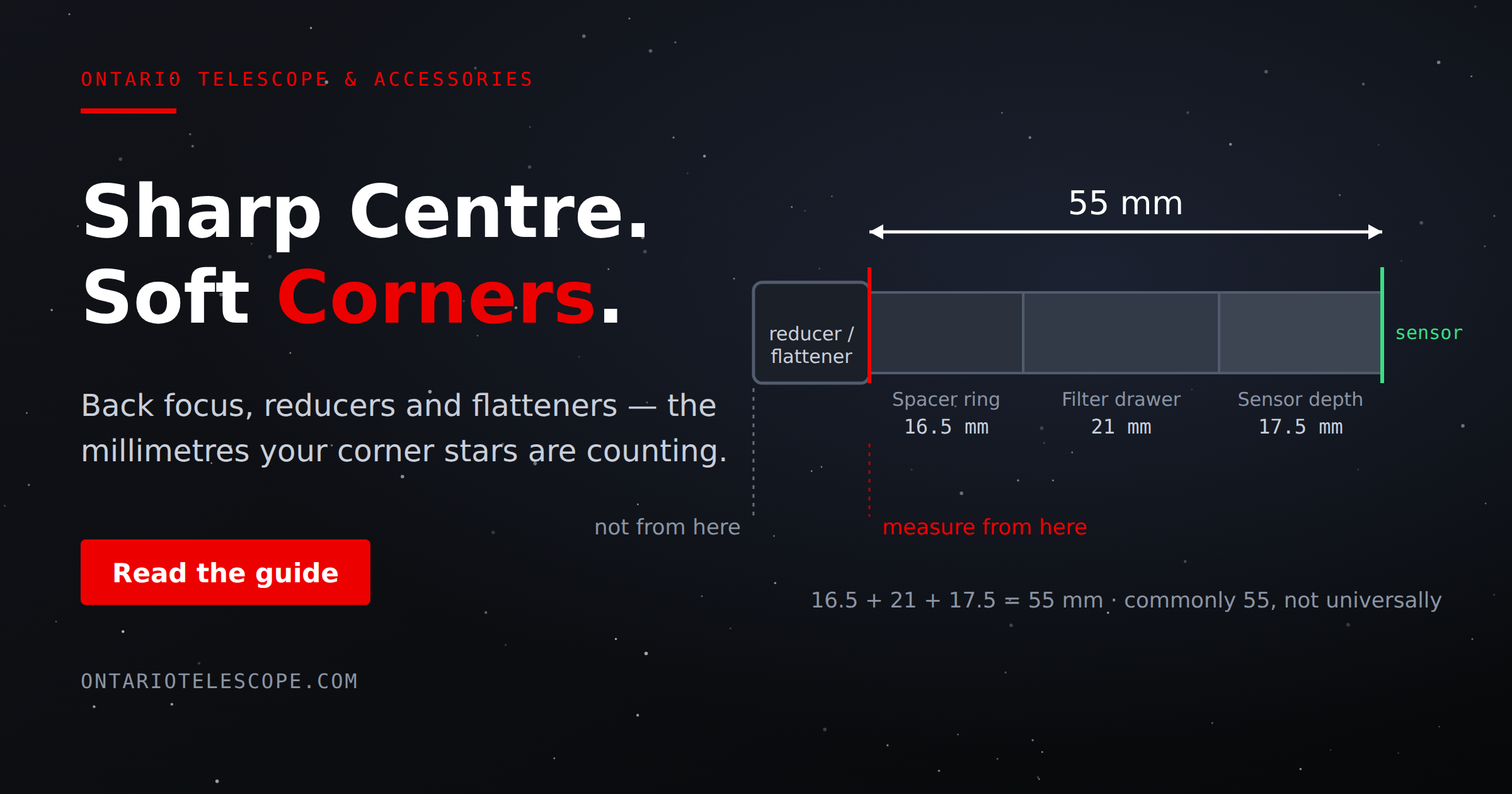
What Is Back Focus in Astrophotography? Telescope Reducers, Flatteners, and Spacing Explained
Read More