
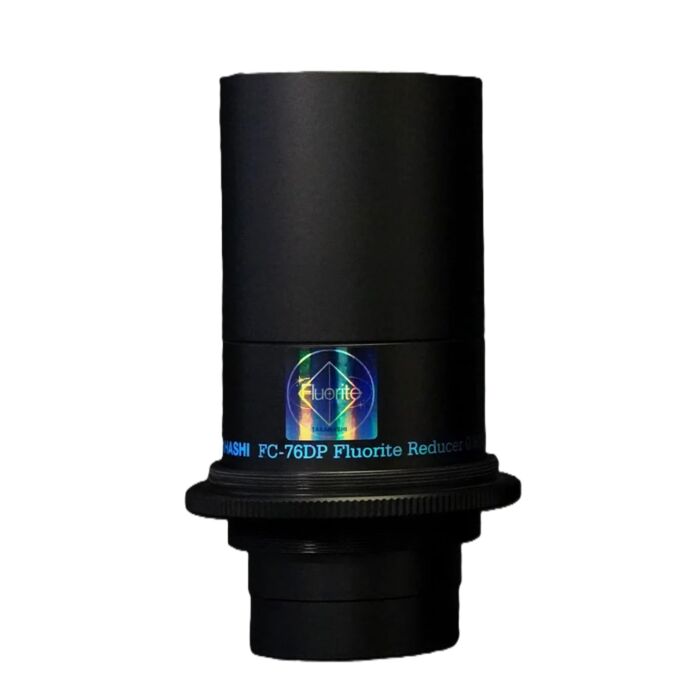

- Description
- Specifications
- Downloads
Product Overview
The FC-76DP 0.64x FU Reducer is Takahashi's dedicated fluorite focal reducer for the FC-76DP refractor. It takes the telescope's native 570mm f/7.5 down to a published 355mm at f/4.8, using a fluorite element to keep chromatic error under control at this level of reduction.
Who It's For
This reducer suits FC-76DP owners who image both wide fields and tighter deep-sky targets and want a faster focal ratio without giving up the telescope's sharp, high-contrast optics. Takahashi's own spot-radius figures for this combination run about 1.5 microns across APS-C and under 2 microns even at the edge of full frame.
Key Features & Design
- Four elements in four groups, one of them fluorite: Takahashi's published optical construction for this reducer.
- 0.64x reduction: Takahashi publishes the resulting FC-76DP figures as 355mm at f/4.8.
- Φ44mm corrected image circle: covers APS-C fully, with strong performance well into full-frame corners.
- M55.9 thread mount: installs directly into the FC-76DP drawtube system.
Optical / Mechanical Design
The reducer pairs with the included CA-35 (FURD) spacing ring, which sets a fixed back focus of 56.0mm measured from the rear of the adapter. That figure — not the telescope's native focal plane — is the one to build an imaging train from. See the Takahashi Back Focus Guide for the full spacing chain.
Recommended Uses
Deep-sky imaging of nebulae, clusters, and galaxies at a fast f/4.8; full-frame astrophotography where the wide, well-corrected image circle counts; general FC-76DP imaging where shorter exposures are worth the reduced focal length.
Compatibility and Accessory Notes
| Telescope | Resulting focal length | Resulting focal ratio | Image circle | Back focus |
|---|---|---|---|---|
| FC-76DP | 355mm | f/4.8 | Φ44mm | 56.0mm (from rear of adapter) |
The CA-35 (FURD) spacing ring ships with the reducer and fixes the 56.0mm figure above. Camera-side spacing from there follows your camera's own flange distance — full detail in the Takahashi Back Focus Guide.
Good to Know Before You Order
Built specifically for the FC-76DP: these figures don't carry over to the FC-76DCU or other FC siblings, which use their own reducers. If you want the resulting focal length confirmed for your own camera and spacing before you order, send us the train and we will work through it with you.
Frequently Asked Questions
Is it difficult to set up?
No — it threads into the FC-76DP drawtube with the included CA-35 spacing ring, and the 56.0mm back focus figure is fixed by that ring.
What is it best used for?
Deep-sky astrophotography on the FC-76DP at a fast f/4.8, across both APS-C and full-frame sensors.
Does it work for visual observing?
No — it's built for a flat photographic image circle rather than a visual eyepiece path.
What else do I need with it?
The CA-35 (FURD) spacing ring, included with the reducer, and your camera's own T-ring or adapter to complete the 56.0mm back focus.
Bottom Line
A dedicated fluorite reducer that takes the FC-76DP to Takahashi's published 355mm at f/4.8 with a flat Φ44mm image circle, set up with the included CA-35 ring at a fixed 56.0mm back focus.
| Product type | 0.64x FU (fluorite) focal reducer |
|---|---|
| Compatible telescope | FC-76DP |
| Optical construction | 4 elements in 4 groups, one of which is a fluorite lens |
| Reduction factor | 0.64x |
| Resulting focal length | 355mm (as printed in Takahashi's 2025 English catalogue) |
| Resulting focal ratio | f/4.8 |
| Corrected image circle | Φ44mm |
| Included accessory | CA-35 (FURD) spacing ring |
| Back focus | 56.0mm (measured from rear of adapter) |
| Mount thread | M55.9 |
| Part number | TKA18580F |
Shopping Guide
- Takahashi English Catalog 2025 — PDF, 8.63 MB
- Takahashi Telescope Backfocus Table — PDF, 71 kB
You may also like
Recently viewed
Recent Blog Posts
View all
Your Guide Graph Is Lying to You
Read More

D-Size vs V-Size: A Complete Guide to Telescope Dovetail Systems
Read More

What Is Back Focus in Astrophotography? Telescope Reducers, Flatteners, and Spacing Explained
Read More