


- Description
- Specifications
- Downloads
Product Overview
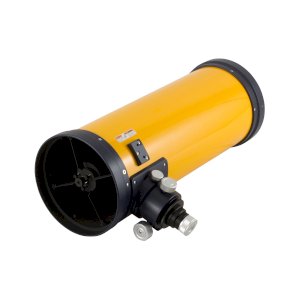
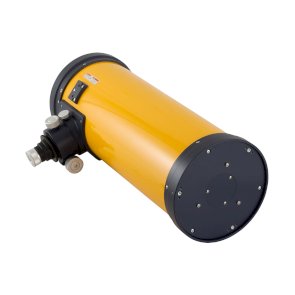
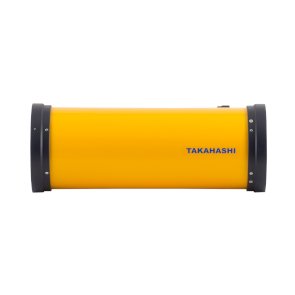
The Epsilon-160ED is a 160 mm hyperbolic Newtonian astrograph from Takahashi, built for deep-sky imaging at a native f/3.3. A hyperbolic primary mirror, flat secondary, and an integrated field-flattening corrector work together inside the tube, so there is no separate flattener to buy, align, or space out. The 530 mm focal length puts a flat 44 mm image circle 56.2 mm behind the focuser, and the published tube weight of 6.9 kg keeps it well inside the payload of a mid-size equatorial mount carrying a full imaging train.
Who It's For
This is a good match if you image deep-sky targets — nebulae, galaxies, and star clusters — and want the light-gathering speed of f/3.3 without the curved focal plane and flat-field-adapter fuss of a Schmidt camera design. It suits an imager already comfortable with reflector collimation, since a Newtonian-derived optical path benefits from periodic checking. It is not built for eyepiece observing — the fast mirror and integrated flattener are optimized for a sensor at a fixed backfocus, not a diagonal and eyepiece.
Key Features & Design
- Hyperbolic primary + flat secondary + integrated flattener: corrects coma and field curvature inside the tube, with no separate corrector lens to purchase or space.
- f/3.3 native speed: a 530 mm focal length gathers light quickly, shortening exposure times for faint targets compared with a conventional f/6–f/8 reflector.
- 44 mm image circle: covers full-frame and APS-C sensors, with the design holding spot size under roughly 3 micrometers at the field edge.
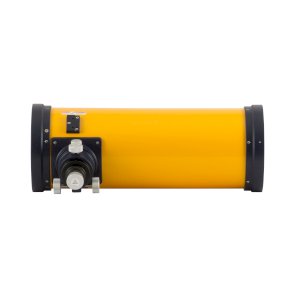
- Oversized rack-and-pinion focuser with integrated Camera Angle Adjuster: lets you rotate the imaging train to frame a target without loosening the tube rings.
- Removable central mirror cover: exposes the primary to ambient air for faster thermal acclimation before a session.
- Open spider-vane secondary support: reduces scattered light and diffraction spikes around bright stars.
Optical / Mechanical Design
The Epsilon-160ED's optical path combines a 160 mm hyperbolic primary mirror with a flat secondary and a built-in multi-element field flattener, a configuration Takahashi calls a modified hyperbolic Newtonian. Unlike a Schmidt camera, the focal plane is flat and the corrective elements live inside the tube rather than as a separate accessory train, which keeps the back focus fixed at 56.2 mm from the focuser's rear end. At f/3.3 the design cuts exposure times sharply against slower reflectors while holding the 44 mm image circle flat and coma-free. An optional Ɛ-EX 160ED extender changes the configuration to 800 mm at f/5.0, with the same 44 mm image circle and 56.2 mm back focus, for imagers who want tighter framing on the same optical tube.
Recommended Uses
Wide- to moderate-field deep-sky astrophotography of nebulae, galaxies and star clusters; narrowband and broadband imaging with a cooled CMOS or CCD camera; observatory or portable imaging rigs built around a fast reflector rather than a refractor.
Compatibility and Accessory Notes
The 56.2 mm back focus is measured from the rear end of the focuser to the focal plane and is fixed by the integrated flattener — there is no field-flattener spacing to calculate for prime focus imaging. Camera trains, filter drawers and off-axis guiders all need to fit inside that figure, so it is worth checking your full imaging stack against it before ordering. The Takahashi Back Focus Guide covers this and the Ɛ-EX 160ED extender configuration in detail. Because this is a Newtonian-derived design, periodic collimation is part of ownership — Takahashi's collimating tools work with this tube.
Good to Know Before You Order
Not built for eyepiece observing: the fast mirror and fixed-backfocus flattener are matched to a camera sensor, not a diagonal and eyepiece.
Collimation is periodic maintenance, not a one-time setup: like any fast Newtonian-derived optic, the mirrors benefit from a collimation check after transport, and Takahashi's own collimating eyepiece and telescope handle it directly.
Mount and tripod are not included: this listing is the optical tube assembly only.
Frequently Asked Questions
Is it difficult to set up?
The optical side is straightforward — the flattener is built in, so there is no separate corrector to space out. The part that takes practice is collimation, which any fast Newtonian-derived design needs checked periodically; Takahashi's collimating tools are built for this tube.
What is it best used for?
Deep-sky astrophotography at a fast focal ratio — nebulae, galaxies and clusters that benefit from short sub-exposures at f/3.3.
Can I use it for visual observing?
It has no real application in a visual eyepiece train; the flattener and back focus are set for a camera sensor.
What cameras does it fit?
Any cooled CMOS or CCD astronomy camera that can reach the 56.2 mm back focus with its own nosepiece, filter wheel or off-axis guider included in that figure — send us your camera and filter setup and we will work it out with you.
How is this different from the Epsilon-180ED?
The 180ED steps up to a 180 mm aperture and a faster f/2.8, with a larger, heavier tube; the 160ED is the lighter, more mount-friendly option at f/3.3.
Bottom Line
In short: a 160 mm f/3.3 hyperbolic astrograph with the flattener built in, delivering a flat 44 mm image circle at a fixed 56.2 mm back focus for fast deep-sky imaging.
| Optical design | Modified hyperbolic Newtonian astrograph (hyperbolic primary mirror, flat secondary, integrated field flattener) |
|---|---|
| Aperture | 160 mm |
| Focal length | 530 mm |
| Focal ratio | f/3.3 |
| Image circle | 44 mm |
| Back focus | 56.2 mm |
| External tube diameter | 204 mm (223 mm at front end) |
| Tube length | 580 mm |
| Drawtube extension | 23 mm |
| Focuser | Oversized rack-and-pinion with integrated Camera Angle Adjuster |
| Weight | 6.9 kg |
| With Ə-EX 160ED extender | 800 mm, f/5.0, 44 mm image circle, 56.2 mm back focus |
Shopping Guide
- Takahashi English Catalog 2025 — PDF, 8.63 MB
System Charts, Diagrams and Adapter Guides
- Takahashi Telescope Backfocus Table — PDF, 71 kB
- Epsilon-160ED System Chart — PDF
Manuals
You may also like
Recently viewed
Recent Blog Posts
View all
Your Guide Graph Is Lying to You
Read More

D-Size vs V-Size: A Complete Guide to Telescope Dovetail Systems
Read More

What Is Back Focus in Astrophotography? Telescope Reducers, Flatteners, and Spacing Explained
Read More