
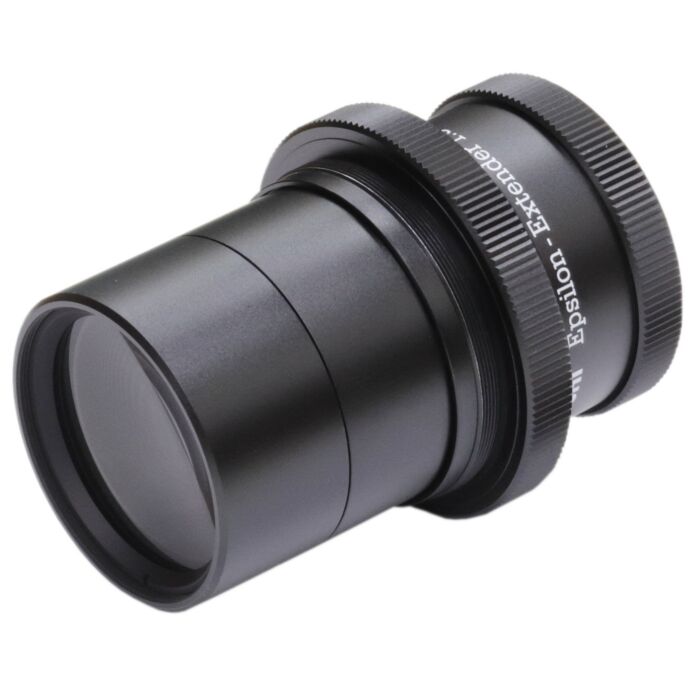

- Description
- Specifications
- Downloads
Product Overview
The Epsilon Extender 1.5x E-180ED extends the Epsilon-180ED astrograph's native 500mm f/2.8 to 780mm f/4.3, carrying the Epsilon series' coma correction through to the longer focal length. Seven elements in five groups magnify and re-correct the image together, holding the same fully-corrected Φ44mm circle the telescope delivers at prime focus.
Who It's For
This extender suits Epsilon-180ED owners who want more reach for tighter deep-sky targets — galaxies, planetary nebulae, compact clusters — while keeping the fast, coma-corrected imaging the Epsilon-180ED is built for.
Key Features & Design
- 7 elements in 5 groups: a complete optical assembly that maintains coma correction at the extended focal length.
- 1.5x extension: takes the Epsilon-180ED from 500mm f/2.8 to 780mm f/4.3.
- Φ44mm corrected image circle: fully corrected for coma, suited to full-frame sensors.
- M68 input / M54 output threads: installs between the Epsilon-180ED's camera angle adjuster and a standard camera adapter.
Optical / Mechanical Design
Back focus with the extender in place is 56.2mm, the same figure the Epsilon-180ED uses at prime focus, so an existing spacing setup carries over directly. See the Takahashi Back Focus Guide for the full spacing chain.
Recommended Uses
Imaging smaller deep-sky targets that are undersized in the Epsilon-180ED's native 500mm field; narrowband and high-resolution imaging where the extra reach helps frame a target tightly; general astrophotography where 780mm f/4.3 suits the target better than 500mm f/2.8.
Compatibility and Accessory Notes
| Telescope | Resulting focal length | Resulting focal ratio | Image circle | Back focus |
|---|---|---|---|---|
| Epsilon-180ED | 780mm | f/4.3 | Φ44mm | 56.2mm |
The extender is specific to the Epsilon-180ED — the Epsilon-130D and Epsilon-160ED each use their own dedicated 1.5x extender, sized for their own thread interfaces.
Good to Know Before You Order
Filters mount at the camera, not on the extender: Takahashi recommends against screw-in 2" filters here, so a filter wheel or camera-side filter mount is the way to add narrowband or broadband filtration.
At 550g, it's a modest addition to the imaging train — worth noting once your camera and filter wheel are attached, but not a figure that will drive your balance point on its own.
Frequently Asked Questions
Is it difficult to set up?
No — it installs between the Epsilon-180ED's camera angle adjuster and your camera on M68 and M54 threads, and the 56.2mm back focus matches the telescope's native prime-focus figure.
What is it best used for?
Imaging deep-sky targets that need more reach than the Epsilon-180ED's native 500mm provides, while keeping the coma correction the Epsilon series is known for.
Does it work for visual observing?
It's built as an imaging accessory — the corrected image circle and mechanical interfaces are designed around camera sensors rather than eyepieces.
What else do I need with it?
Your camera's own T-ring or M54 adapter to complete the connection at the 56.2mm back focus figure.
Bottom Line
A coma-corrected 1.5x extender that takes the Epsilon-180ED to 780mm at f/4.3 across a Φ44mm image circle, at the same 56.2mm back focus the telescope already uses at prime focus.
| Product type | 1.5x coma-corrected extender |
|---|---|
| Compatible telescope | Epsilon-180ED |
| Optical design | 7 elements in 5 groups |
| Extension factor | 1.5x |
| Resulting focal length | 780mm |
| Resulting focal ratio | f/4.3 |
| Corrected image circle | Φ44mm |
| Back focus | 56.2mm |
| Input thread | M68x0.75 male |
| Output thread | M54x0.75 female |
| Weight | 550g |
Shopping Guide
- Takahashi English Catalog 2025 — PDF, 8.63 MB
- Takahashi Telescope Backfocus Table — PDF, 71 kB
- Epsilon Extender 1.5x E-180ED Dimensional Diagram — PNG
You may also like
Recently viewed
Recent Blog Posts
View all
Your Guide Graph Is Lying to You
Read More
D-Size vs V-Size: A Complete Guide to Telescope Dovetail Systems
Read More
What Is Back Focus in Astrophotography? Telescope Reducers, Flatteners, and Spacing Explained
Read More