

- Description
- Specifications
- Downloads
Product Overview
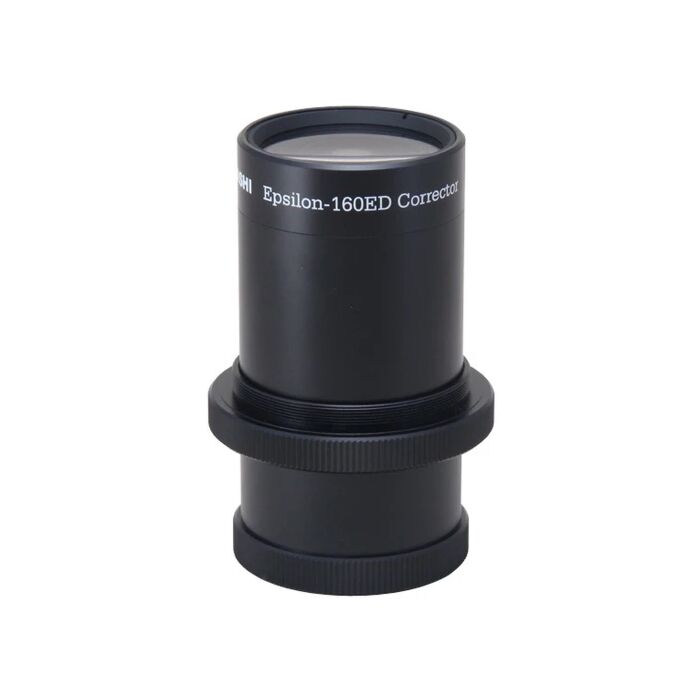
The Epsilon Extender 1.5x E-160ED extends the Epsilon-160ED astrograph's native 530mm f/3.3 to 800mm f/5.0, carrying the coma correction the Epsilon series is built around through to the longer focal length. Seven elements in five groups do the magnifying and the correcting together, rather than adding pure magnification on top of an uncorrected image.
Who It's For
This extender suits Epsilon-160ED owners who want more reach for tighter deep-sky targets — galaxies, planetary nebulae, compact clusters — while keeping the fast, coma-corrected imaging the Epsilon-160ED is built for. Takahashi rates the native Epsilon-160ED at an RMS spot radius within 1.3 microns across a full-frame field; the extender is built to preserve that standard at 800mm.
Key Features & Design
- 7 elements in 5 groups: a complete optical assembly that maintains coma correction at the extended focal length.
- 1.5x extension: takes the Epsilon-160ED from 530mm f/3.3 to 800mm f/5.0.
- Φ44mm corrected image circle: diffraction-limited performance, roughly 2 microns at center and up to 8 microns at the edge of a full-frame sensor.
- Matched thread interfaces: installs between the Epsilon-160ED's camera angle adjuster and a standard camera adapter.
Optical / Mechanical Design
Back focus with the extender in place is 56.2mm — the same figure the Epsilon-160ED uses at prime focus — so an existing spacing setup carries over directly. See the Takahashi Back Focus Guide for the full spacing chain.
Recommended Uses
Imaging smaller deep-sky targets that are undersized in the Epsilon-160ED's native 530mm field; narrowband and high-resolution work where the extra reach helps frame a target tightly; general astrophotography where 800mm f/5.0 suits the target better than 530mm f/3.3.
Compatibility and Accessory Notes
| Telescope | Resulting focal length | Resulting focal ratio | Image circle | Back focus |
|---|---|---|---|---|
| Epsilon-160ED | 800mm | f/5.0 | Φ44mm | 56.2mm |
The extender is specific to the Epsilon-160ED — the Epsilon-130D and Epsilon-180ED each use their own dedicated 1.5x extender, sized for their own thread interfaces.
Good to Know Before You Order
Screw-in 2" filters aren't recommended with this extender, as Takahashi notes they can introduce reflections at this focal ratio — a filter wheel or camera-side filter mounting avoids the issue.
Frequently Asked Questions
Is it difficult to set up?
No — it installs between the Epsilon-160ED's camera angle adjuster and your camera, and the 56.2mm back focus matches the telescope's native prime-focus figure.
What is it best used for?
Imaging deep-sky targets that need more reach than the Epsilon-160ED's native 530mm provides, while keeping the coma correction the Epsilon series is known for.
Does it work for visual observing?
It's built as an imaging accessory — the corrected image circle and mechanical interfaces are designed around camera sensors rather than eyepieces.
What else do I need with it?
Your camera's own T-ring or adapter to complete the connection at the 56.2mm back focus figure.
Bottom Line
A coma-corrected 1.5x extender that takes the Epsilon-160ED to 800mm at f/5.0 across a Φ44mm image circle, at the same 56.2mm back focus the telescope already uses at prime focus.
| Product type | 1.5x coma-corrected extender |
|---|---|
| Compatible telescope | Epsilon-160ED |
| Optical design | 7 elements in 5 groups |
| Extension factor | 1.5x |
| Resulting focal length | 800mm |
| Resulting focal ratio | f/5.0 |
| Corrected image circle | Φ44mm |
| Back focus | 56.2mm |
Shopping Guide
- Takahashi English Catalog 2025 — PDF, 8.63 MB
- Takahashi Telescope Backfocus Table — PDF, 71 kB
You may also like
Recently viewed
Recent Blog Posts
View all
Your Guide Graph Is Lying to You
Read More

D-Size vs V-Size: A Complete Guide to Telescope Dovetail Systems
Read More

What Is Back Focus in Astrophotography? Telescope Reducers, Flatteners, and Spacing Explained
Read More