
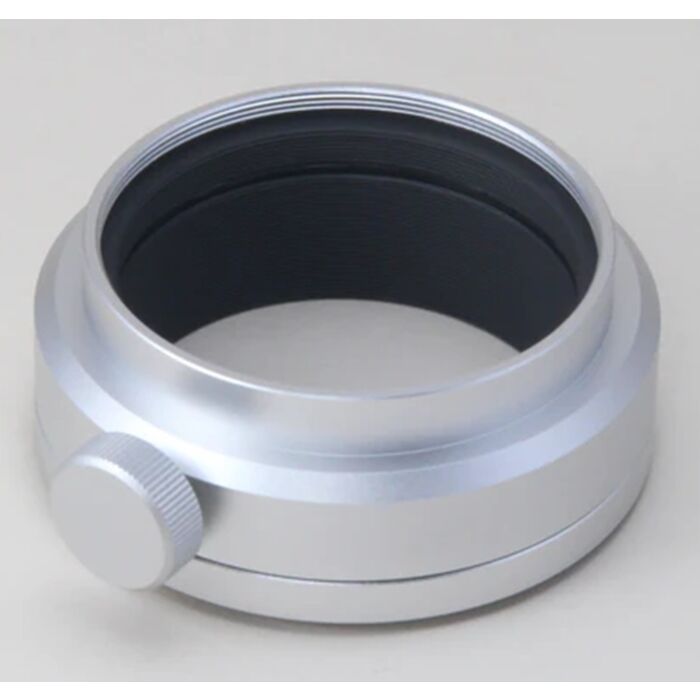


- Description
- Specifications
- Downloads
Product Overview
The Camera Angle Adjuster CAA-M rotates your camera to any angle around the optical axis and locks it there for the exposure, without disturbing the spacing already set in your imaging train. It threads in with an M72 x 1 male thread on one end and an M72 x 1 female thread on the other, adding 35 mm of light path — a figure to include in your backfocus total. It's the current version of what Takahashi previously sold as the CAA (TSA-102), and the two are interchangeable.
Who It's For
This is a good match if you image through a TSA-120, FC-100 series refractor, or a corrected Mewlon, and want to frame a target at any rotation without breaking your imaging train apart to do it.
Key Features & Design
- M72 x 1 threaded both ends: male on one side, female on the other, matching Takahashi's standard M72 imaging-train interface.
- Full rotation, then lock: turn the camera to the framing you want and lock it in place for the exposure.
- Fixed 35 mm light path: a known, published figure to build into your backfocus total rather than something to measure yourself.
- Compatible with the earlier CAA (TSA-102): a direct match if you're adding to or replacing a part in an existing Takahashi imaging train.
Recommended Uses
Framing adjustments on TSA-120 and FC-100 series refractors and corrected Mewlon telescopes; rotating a one-shot-colour or mono camera to align a target without loosening the whole imaging train; observatories reframing between multiple targets a night.
Compatibility and Accessory Notes
Threads with M72 x 1 on both ends — male into the telescope side, female to accept the next M72 adapter or T-ring in your train. Adds 35 mm of light path; the Takahashi Back Focus Guide lists this figure alongside every other Takahashi adapter so you can total your imaging train accurately. Compatible with the TSA-120, FC-100 series and corrected Mewlon optical tubes, and interchangeable with the earlier CAA (TSA-102).
Good to Know Before You Order
It adds 35 mm to your light path. On a spacing-critical imaging train, that's a figure worth building into your backfocus total from the start — the Takahashi Back Focus Guide has it listed, and we're glad to help you total the rest of the train.
Frequently Asked Questions
Is it difficult to set up?
No — it threads in like any M72 adapter, and rotation is a simple loosen-turn-lock motion.
What is it best used for?
Rotating a camera to frame a target on a TSA-120, FC-100 series refractor, or corrected Mewlon, without rebuilding the imaging train.
Does it affect my backfocus?
It adds 35 mm of light path, published in the Back Focus Guide alongside the rest of the Takahashi adapter range.
Is it the same as the old CAA (TSA-102)?
Yes — Takahashi treats the two as compatible and interchangeable.
Bottom Line
An M72-threaded camera rotator that adds a fixed, published 35 mm to your light path and locks your framing in place for the exposure.
| Product code | TKA23200N |
|---|---|
| Also sold as | CAA (TSA-102), interchangeable |
| Attachment | M72 x 1 male (one end), M72 x 1 female (other end) |
| Light path length | 35 mm |
| Compatibility | TSA-120, FC-100 series, corrected Mewlon optical tubes |
Shopping Guide
- Takahashi English Catalog 2025 — PDF, 8.63 MB
System Charts, Diagrams and Adapter Guides
- Takahashi Telescope Backfocus Table — PDF, 71 kB
You may also like
Recently viewed
Recent Blog Posts
View all
Your Guide Graph Is Lying to You
Read More

D-Size vs V-Size: A Complete Guide to Telescope Dovetail Systems
Read More

What Is Back Focus in Astrophotography? Telescope Reducers, Flatteners, and Spacing Explained
Read More