


- Description
- Specifications
- Downloads
Product Overview
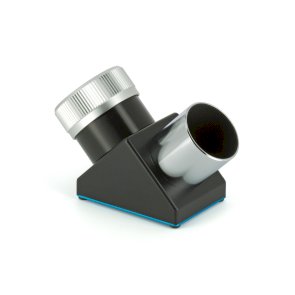
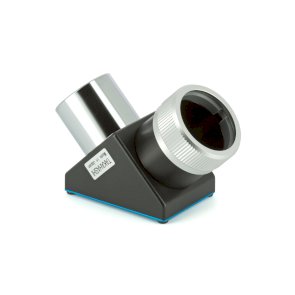
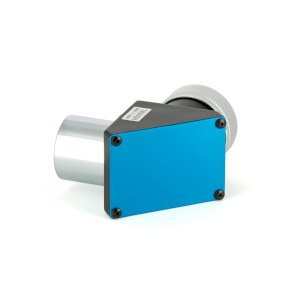
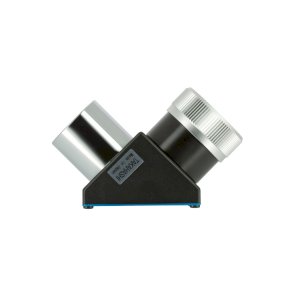
A 1.25-inch star diagonal built to Takahashi's mechanical standard, using a prism rather than a mirror. It takes a 1.25-inch male barrel into your focuser and presents a 1.25-inch female barrel with a clamp ring for the eyepiece, bending the light path 90° so you look down into a telescope pointed up.
The optical path through it measures 63.5 mm — the figure your focuser needs to accommodate, and the one to use when you are calculating whether an eyepiece will still reach focus. It weighs 135 g and measures 60 x 43 x 40 mm.
Who It's For
This is the part that makes visual observing comfortable. Without a diagonal, a refractor pointed near the zenith puts the eyepiece near the ground. With one, you look down at a natural angle.
It suits refractors, Schmidt-Cassegrains and Maksutovs — anything with a 1.25-inch focuser or a visual back that accepts a 1.25-inch barrel. If you are already using Takahashi eyepieces, the mechanical fit is exact.
It is a visual component. Imaging trains connect a camera straight through and do not use a diagonal.
Key Features & Design
- Prism, not a mirror: total internal reflection at the prism face, so there is no reflective coating to age, tarnish or degrade.
- Multicoated surfaces: applied to the entry and exit faces to cut reflection losses and internal ghosting.
- Non-marring compression ring: clamps the eyepiece barrel evenly instead of driving a set screw into it, so barrels stay unmarked and the eyepiece sits square.
- 1.25-inch male in, 1.25-inch female out: standard 31.75 mm fittings on both sides.
- 63.5 mm metal backfocus length: the optical path the diagonal adds to your train.
- 60 x 43 x 40 mm, 135 g: compact enough that focuser balance barely changes.
- Five-year manufacturer warranty.
Optical Design
A prism diagonal turns the light path using total internal reflection at the hypotenuse face of a glass prism, rather than bouncing it off an aluminised mirror surface. Total internal reflection is a property of the glass-air boundary itself, so nothing is lost to coating efficiency and nothing degrades with age — an aluminised mirror slowly dulls, a prism does not.
The trade is that light passes through glass, so the entry and exit faces are multicoated to hold down surface reflections and the scatter that would otherwise reduce contrast on planetary detail. At f/6 and slower, which covers most of the Takahashi refractor range in visual use, a prism of this quality introduces no aberration that the eye can separate from the telescope's own.
The compression ring is the mechanical half of the design. A single set screw pushes an eyepiece barrel off-axis and leaves a dimple; the ring here spreads the clamping force around the barrel, which keeps the eyepiece square to the optical axis and the barrel unmarked.
Recommended Uses
- Visual observing with a refractor — lunar detail, planets, double stars, open clusters at a comfortable viewing angle.
- Schmidt-Cassegrain and Maksutov visual backs that accept a 1.25-inch barrel.
- Zenith observing, where a straight-through eyepiece position would be unusable.
- Terrestrial and daytime use with a spotting eyepiece, noting that a star diagonal gives a mirror-reversed image.
Compatibility and Accessory Notes
- Focuser side: 1.25-inch (31.75 mm) male barrel — fits any 1.25-inch focuser or visual back directly.
- Eyepiece side: 1.25-inch (31.75 mm) female with clamp ring, so any 1.25-inch eyepiece seats in it.
- Optical path: 63.5 mm. Add this to your train when checking that an eyepiece reaches focus — short-focus refractors with limited inward travel are where it matters.
- 2-inch focusers: use a 2-inch to 1.25-inch reducing adapter, or move to a 2-inch diagonal if you plan to use 2-inch eyepieces. We stock both.
- Takahashi visual adapters: the FS-60CB and the FC/FS range each have a matching visual adapter that presents the correct barrel to this diagonal. Ask us which one your tube takes.
- Image orientation: a star diagonal produces a right-side-up but mirror-reversed image. That is normal for astronomical use; for terrestrial viewing an erecting prism gives a correctly oriented image.
Good to Know Before You Order
- It adds 63.5 mm to the optical path. Most refractors have ample travel for that, and Takahashi publishes a backfocus table — included in the Downloads tab — covering the range if you want to check before ordering.
- 1.25-inch only. It will not take 2-inch eyepieces. If you own or plan to own 2-inch wide-field eyepieces, a 2-inch diagonal is the better starting point.
- This is a visual component. Camera trains connect straight through and do not use a diagonal.
- The view is mirror-reversed. Standard for astronomical diagonals and of no consequence at the eyepiece; worth knowing if you also plan to use the telescope for daytime viewing.
- Published weight differs between Takahashi sources — 135 g on the European specification sheet, 3 oz (85 g) in the North American listing. Either way it is light enough not to affect focuser balance.
Frequently Asked Questions
Is it difficult to set up?
No. The barrel slides into your focuser, the eyepiece goes into the clamp ring, and the ring tightens by hand. There is nothing to align or adjust.
Prism or mirror — which is better?
A prism uses total internal reflection, so there is no coating to degrade over the years, and it tends to hold contrast well on planetary detail at moderate focal ratios. Mirror diagonals are usually preferred at very fast focal ratios and in 2-inch formats. For visual work on a Takahashi refractor, a prism of this quality is a sound match.
Will it fit my telescope?
It fits any 1.25-inch focuser or visual back directly. On a 2-inch focuser you need a reducing adapter; on a Takahashi tube with a proprietary rear thread you need the matching visual adapter. Tell us your telescope and we will confirm the part.
Will my eyepieces still reach focus?
The diagonal adds 63.5 mm of optical path. Most refractors have enough travel to absorb it. The Takahashi backfocus table below covers the range, and we are happy to check a specific combination for you.
Can I use it for astrophotography?
No — imaging trains connect the camera directly to the corrector or telescope. This is for eyepiece observing.
Does it mark my eyepiece barrels?
No. The compression ring clamps evenly around the barrel rather than pressing a screw point into it.
What is in the box?
The diagonal itself. Eyepieces and any focuser adapters are separate.
Bottom Line
In short: a 135 g multicoated prism diagonal that adds 63.5 mm to a 1.25-inch visual train, clamps eyepieces without marking them, and has no reflective coating to age. It is the piece that makes a refractor comfortable to observe with.
| Type | Star diagonal, prism |
|---|---|
| Deviation | 90° |
| Coatings | Multicoated prism surfaces |
| Mechanical interface (in) | 1.25" (31.75 mm) male barrel |
| Mechanical interface (out) | 1.25" (31.75 mm) female barrel with clamp ring |
| Eyepiece retention | Non-marring compression ring |
| Metal backfocus length | 63.5 mm |
| Dimensions | 60 mm x 43 mm x 40 mm |
| Weight | 135 g |
| Warranty | Five years |
| In the box | Takahashi 1.25" prism star diagonal |
Shopping Guide
- Takahashi English Catalog 2025 — PDF, 8.63 MB
System Charts, Diagrams and Adapter Guides
- 1.25" Prism Diagonal Dimensional Diagram — PNG
- Takahashi Telescope Backfocus Table — PDF, 71 kB
You may also like
Recently viewed
Recent Blog Posts
View all
Your Guide Graph Is Lying to You
Read More

D-Size vs V-Size: A Complete Guide to Telescope Dovetail Systems
Read More

What Is Back Focus in Astrophotography? Telescope Reducers, Flatteners, and Spacing Explained
Read More