


- Description
- Specifications
- Downloads
Product Overview
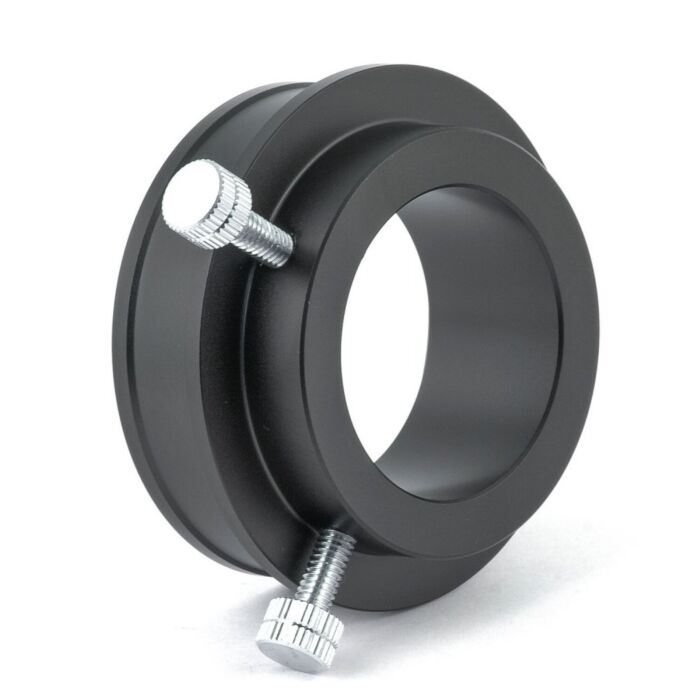
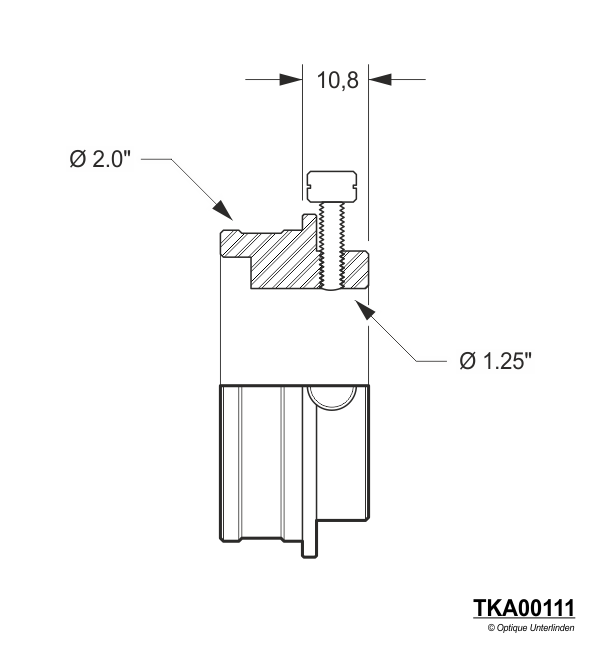
The 1.25″ Adapter for 2″ Diagonal converts any Takahashi 2″ (50.8 mm) diagonal or focuser drawtube down to a standard 1.25″ (31.75 mm) eyepiece barrel. It's a simple mechanical sleeve: 50.8 mm male on the telescope side, 31.75 mm female on the eyepiece side, with two knurled thumbscrews to lock the eyepiece in place. At 50 g and adding just 11 mm of light path, it lets you run 1.25″ eyepieces, Barlows and cameras through 2″ fittings without swapping the diagonal itself.
Who It's For
This is a good match if you own a Takahashi 2″ diagonal or 2″ focuser and also use 1.25″ eyepieces, a Barlow, or a compact accessory built on the smaller barrel.
Key Features & Design
- 50.8 mm male sleeve: fits directly into any 2″ diagonal, focuser drawtube, or visual back.
- 31.75 mm female barrel: accepts standard 1.25″ eyepieces, Barlows and accessories.
- Two knurled thumbscrews: lock the inserted accessory in place without tools.
- Minimal light path: adds 11 mm to your optical path — a figure worth accounting for against your back focus target. See the Takahashi Back Focus Guide for how it compares to other Takahashi adapters.
Recommended Uses
Switching between 1.25″ and 2″ eyepieces on the same 2″ diagonal; mounting a 1.25″ Barlow or compact eyepiece-based camera behind a 2″ visual back; running 1.25″ accessories on any Takahashi telescope drawtube fitted for 2″.
Compatibility and Accessory Notes
Fits the 2″ barrel on Takahashi diagonals, including the 2″ Mirror Diagonal, which ships with this exact adapter included as standard. Adds 11 mm of light path — worth checking against your backfocus target in the Takahashi Back Focus Guide.
Good to Know Before You Order
It's mechanical only. There's no optical element inside — it changes barrel size and nothing else.
It adds 11 mm to your light path. On a spacing-critical imaging train, that's worth accounting for; the Takahashi Back Focus Guide lists it alongside every other Takahashi adapter, and we're glad to help you check the total.
Frequently Asked Questions
Is it difficult to set up?
No — it drops into the 2″ fitting and the two thumbscrews lock the eyepiece in place by hand.
What is it best used for?
Running 1.25″ eyepieces and accessories through a 2″ diagonal or focuser.
Does it come with the 2″ Mirror Diagonal?
Takahashi ships one with the 2″ Mirror Diagonal as standard; this listing is for the adapter sold on its own, for use on other 2″ fittings.
Does it affect imaging spacing?
It adds 11 mm of light path, which the Back Focus Guide accounts for alongside the rest of your imaging train.
Bottom Line
A 50 g mechanical sleeve that steps a 2″ (50.8 mm) diagonal or focuser down to a 1.25″ (31.75 mm) eyepiece barrel, adding 11 mm of light path along the way.
| Product code | TKA00111 |
|---|---|
| Takahashi name | Adapter (DM) (31.7 mm) |
| System chart item | no. 75 |
| Input | 2" (50.8 mm) male sleeve |
| Output | 1.25" (31.75 mm) female barrel |
| Light path length | 11 mm |
| Dimensions | 56 mm diameter x 24 mm height |
| Weight | 50 g |
| Attachment | Two knurled thumbscrews |
Shopping Guide
- Takahashi English Catalog 2025 — PDF, 8.63 MB
System Charts, Diagrams and Adapter Guides
- Takahashi Telescope Backfocus Table — PDF, 71 kB
You may also like
Recently viewed
Recent Blog Posts
View all
Your Guide Graph Is Lying to You
Read More

D-Size vs V-Size: A Complete Guide to Telescope Dovetail Systems
Read More

What Is Back Focus in Astrophotography? Telescope Reducers, Flatteners, and Spacing Explained
Read More