




- Description
- Specifications

Product Overview
The SVBONY SV605MC is a cooled monochrome astronomy camera built on the Sony IMX533 back-illuminated sensor. The square 1″-class chip (15.968 mm diagonal, 11.31 x 11.31 mm image area) records 3008 x 3008 pixels at 3.76 µm, with a 0.91 QE peak, 50 ke⁻ full well, read noise of 1.0–3.3 e⁻ and a 14-bit ADC. A two-stage TEC cooler and a sealed, independent sensor cavity keep the sensor cold and the window free of condensation, and a 256 MB DDR3 buffer supports up to 20 fps over USB 3.0.
Who It's For
This is a good match if you image nebulae, galaxies and clusters through narrowband (H-alpha, OIII, SII) or LRGB filters and want a cooled mono sensor for full resolution in every filter. The square format suits round targets and makes framing less dependent on camera rotation, and the camera can also image the Moon, planets and — with a proper solar filter — the Sun.
Key Features & Design
- Two-stage TEC cooling with independent cavity: the sensor sits in its own chamber, protecting the CMOS and window glass from condensation as it cools.
- Amp glow control: a dedicated circuit suppresses the faint corner glow that otherwise appears in long exposures.
- HCG mode: lowers read noise to as little as 1.0 e⁻ while keeping dynamic range.
- 14-bit ADC: Mono8/Mono16 output, 9 MP at 20 fps.
- USB 3.0 with 256 MB DDR3 buffer: fast, reliable frame transfer.
- ROI and BIN1–BIN4 binning; gain range 0–500.
- AR-coated sensor window.


Camera Design
Without a Bayer matrix, every pixel of the IMX533 records light at full resolution, so narrowband filters use the whole sensor and colour images are built from separate filtered exposures. The 3.76 µm pixels give balanced sampling across common imaging focal lengths, the 0.91 peak QE makes good use of short narrowband exposures, and cooling holds dark current steady for clean calibration.

Recommended Uses
- Narrowband deep-sky imaging: H-alpha, OIII and SII for SHO or HOO palettes, including from light-polluted skies.
- LRGB imaging: galaxies and clusters with a filter wheel or drawer.
- Lunar, planetary and solar imaging: solar only with a dedicated solar filter.

Compatibility and Accessory Notes
- Filters: a mono camera needs filters for colour; SVBONY offers the SV605MC with 1.25″ and 2″ filter wheels or an SV226 filter drawer as separate styles.
- Cable: a USB 3.0/2.0 cable is listed in SVBONY's feature list.
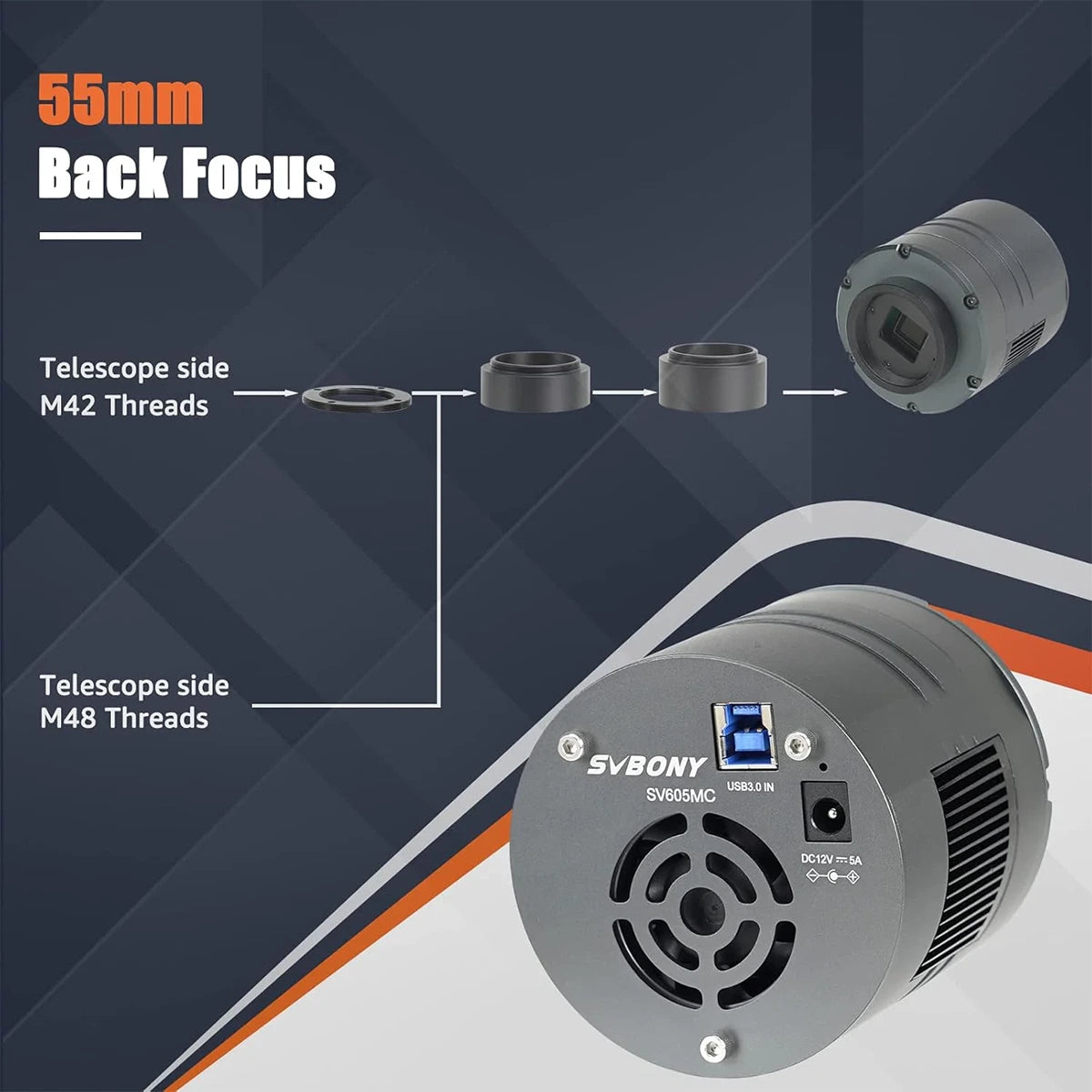
- Back focus and spacing: if you use a flattener or reducer, send us your telescope, corrector and filter setup and we will work out the spacer stack with you.
Good to Know Before You Order
- Camera only: this listing is the SV605MC on its own; filters, filter wheels and drawers are separate.
- Computer required: the camera runs from capture software over USB 3.0.
- Imaging only: no application in visual observing.
- Weight: SVBONY does not publish a weight for this camera.
Frequently Asked Questions
Is it difficult to set up?
No. Install the driver and capture software, connect USB 3.0 and power, set the cooler temperature, and add your filters ahead of the camera. Working out the spacing for a flattener is the one step that takes measuring, and we are happy to help.
Why choose mono over the colour SV605CC?
The SV605MC uses every pixel in each filter, which gives higher resolution and sensitivity in narrowband. The colour SV605CC captures a full-colour image in one exposure without filters.
Does it suffer from amp glow?
SVBONY builds in an amp-glow control circuit to suppress corner glow in long exposures.
Can it image planets too?
Yes. SVBONY lists the Moon, planets and the Sun (with a solar filter) as suitable targets alongside deep sky.
Bottom Line
In short: a cooled monochrome IMX533 camera with 3.76 µm pixels, 1.0 e⁻ read noise, 14-bit output and a sealed TEC-cooled sensor cavity, built for narrowband and LRGB deep-sky imaging.
| Brand | SVBONY |
|---|---|
| Model | SV605MC |
| Sensor | Sony IMX533, monochrome |
| Sensor size | 15.469 mm (H) x 16.375 mm (V) |
| Diagonal | 15.968 mm |
| Image area | 11.31 mm x 11.31 mm |
| Maximum resolution | 3008 x 3008 |
| Effective pixels | 9 MP |
| Maximum frame rate | 20 fps |
| Pixel size | 3.76 µm (H) x 3.76 µm (V) |
| Shutter type | Rolling shutter |
| Exposure time | 32ms–2000S (as listed by SVBONY) |
| Read noise | 1.0–3.3 e⁻ |
| Buffer memory | DDR3 256 MB |
| ROI | Yes |
| QE | 0.91 |
| Full well charge | 50 ke⁻ |
| ADC | 14 bit |
| Output image format | Mono8/Mono16 |
| Pixel binning | BIN1, BIN2, BIN3, BIN4 |
| Gain range | 0–500 |
| USB type | USB 3.0 |
| Cooling | 2-stage TEC, independent sensor cavity |
| Weight | Not published by vendor |
| Recommended use | Narrowband and LRGB deep-sky imaging |
You may also like
Recently viewed
Recent Blog Posts
View all
Your Guide Graph Is Lying to You
Read More

D-Size vs V-Size: A Complete Guide to Telescope Dovetail Systems
Read More

What Is Back Focus in Astrophotography? Telescope Reducers, Flatteners, and Spacing Explained
Read More