





- Description
- Specifications

Product Overview
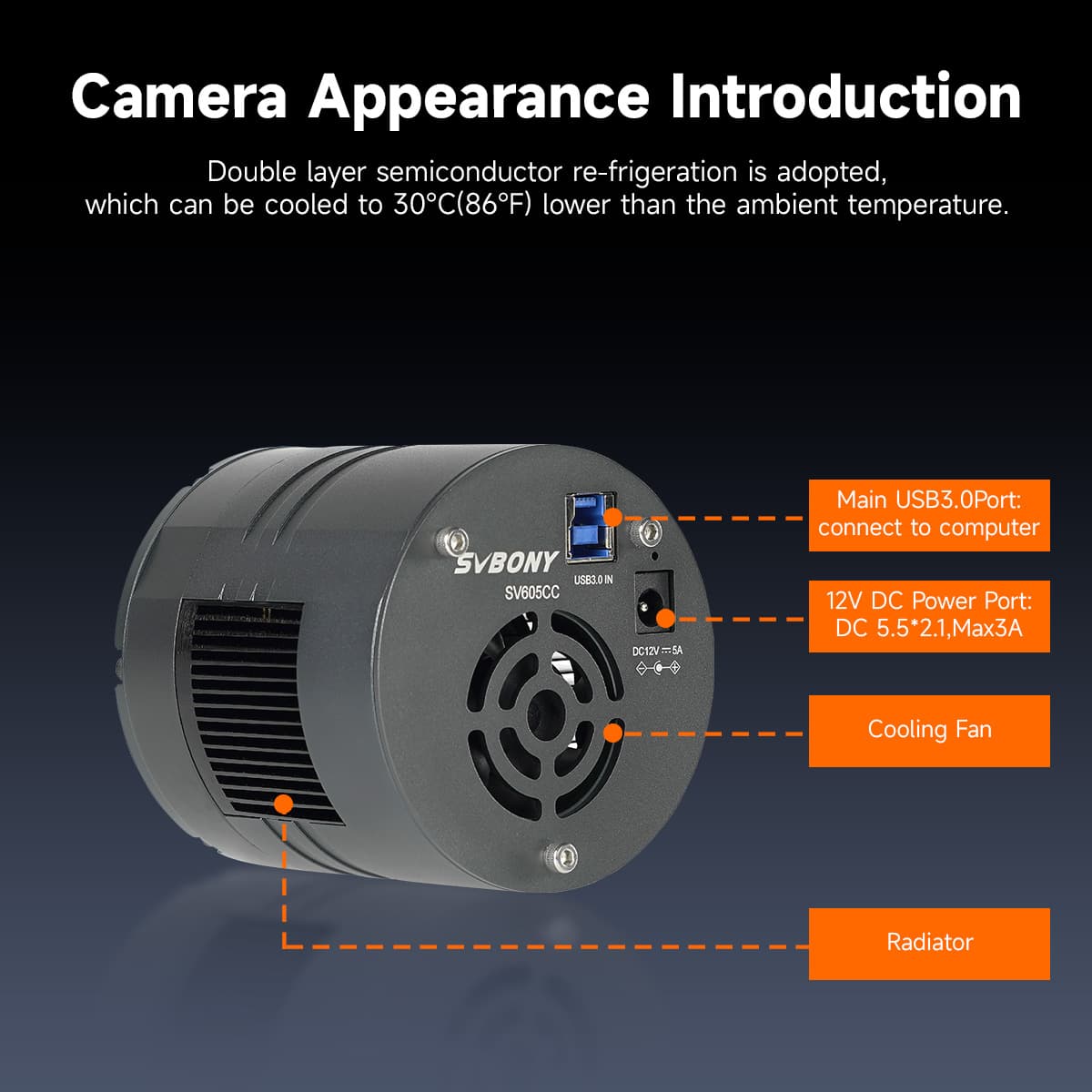
The SVBONY SV605CC is a cooled one-shot-colour astronomy camera built around the Sony IMX533 sensor. The square 1″-format chip (15.968 mm diagonal) records 3008 x 3008 pixels at 3.76 µm, with a 50 ke⁻ full well, 0.91 peak QE and 14-bit output. A two-stage TEC cooler takes the sensor down to 30 °C below ambient for long deep-sky exposures, and a 256 MB DDR3 buffer sits behind the USB 3.0 interface.


Who It's For
This is a good match if you image nebulae, galaxies and star clusters with a small to mid-sized refractor or reflector and want a cooled colour camera with a square field, so framing works without rotating the camera. It also suits imaging from suburban or city skies with a dual-band narrowband filter, where the cooled sensor keeps noise down across long integrations.
Key Features & Design
- Sony IMX533 colour CMOS: 9.0 MP, 3008 x 3008, 3.76 µm pixels on a square 1″ sensor.
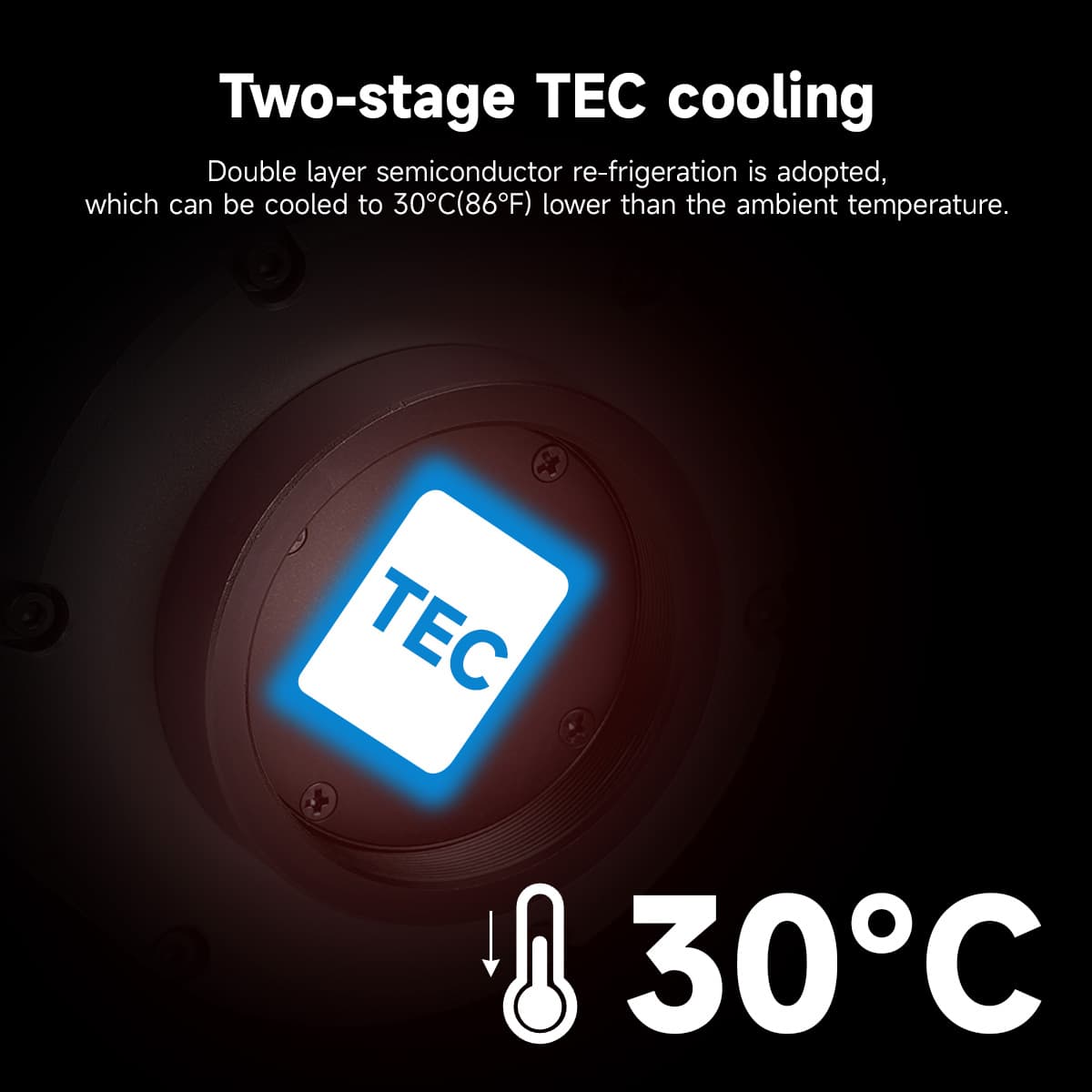
- Two-stage TEC cooling: sensor cooled to 30 °C below ambient, with temperature shown in the capture software.
- Amp-glow suppression: SVBONY designs the camera to suppress residual sensor glow that otherwise costs signal-to-noise in long exposures.
- 14-bit ADC, 50 ke⁻ full well: wide tonal range for bright star cores and faint nebulosity in the same frame.
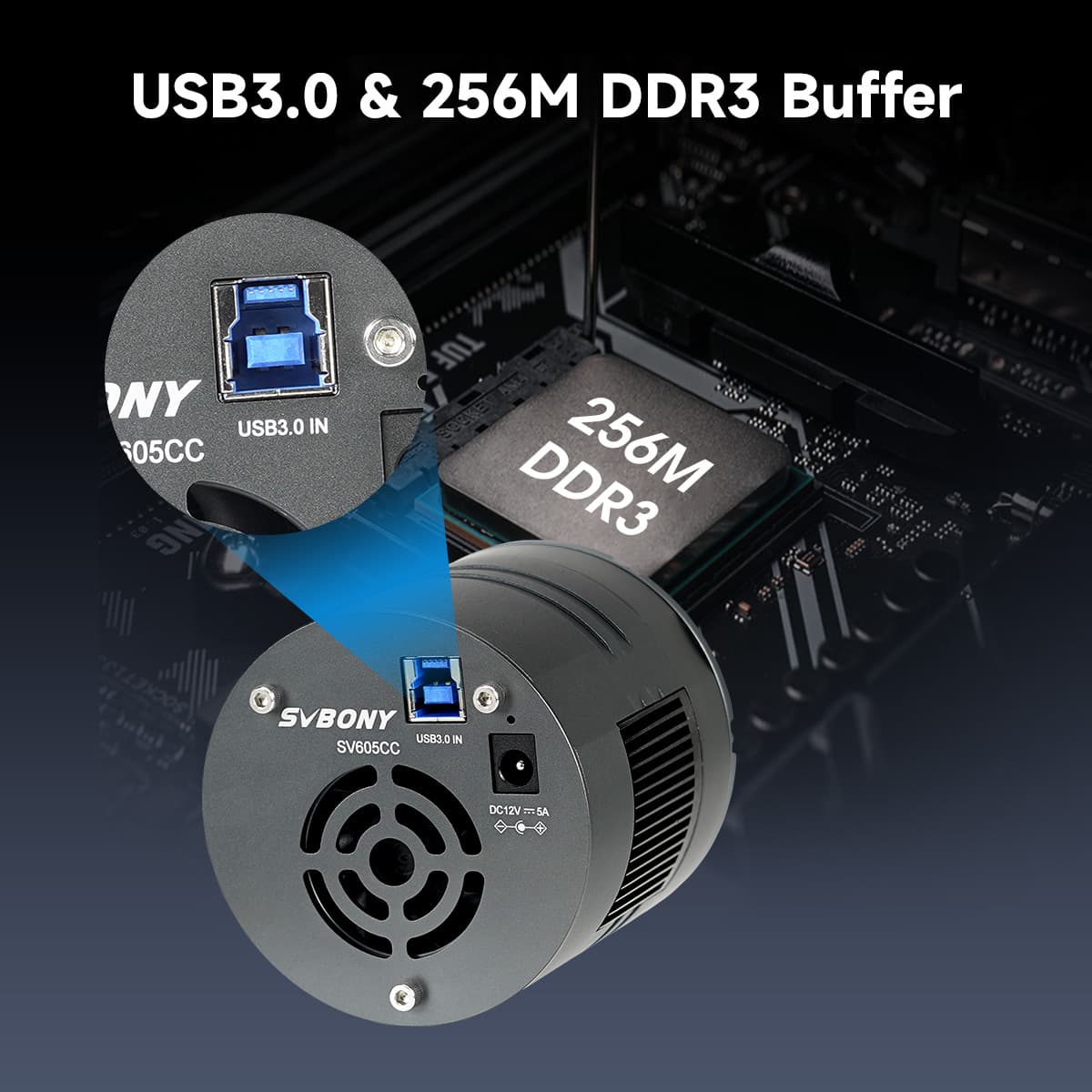
- 256 MB DDR3 buffer and USB 3.0 Type-B: up to 20 fps at full resolution.
- Exposure range: 0.05 ms to 2000 s, with ROI and binning from BIN1 to BIN4.
- AR-coated optical glass window in front of the sensor.


Camera Design
The IMX533 is a rolling-shutter colour sensor with a 1:1 aspect ratio. Its 3.76 µm pixels give a balanced image scale on common imaging focal lengths of roughly 400–1000 mm, and the 15.968 mm diagonal is small enough for most flatteners and reducers to cover cleanly. SVBONY lists read noise at 1.0–3.3 e⁻, with lower noise in high-conversion-gain mode. The cooler lowers dark current for consistent calibration frames, and the 14-bit ADC records 16,384 levels per pixel.


Recommended Uses
- Deep-sky imaging: emission nebulae, galaxies and clusters in colour.
- Dual-band narrowband imaging: H-alpha and OIII with a dual-band filter from light-polluted skies.
- Electronically assisted astronomy: live stacking in SharpCap and similar software.


Compatibility and Accessory Notes
- Front interface: SVBONY lists 2″, 1.25″ and M42 x 0.75 connection options.
- Back focus: SVBONY publishes the back focus as “6.5mm/17.5”. With a flattener or reducer that needs 55 mm, the remaining distance is made up with M42 spacers — send us your telescope, corrector and filter setup and we will work out the spacer stack with you.
- Software and platforms: Windows, Linux, macOS, Chrome OS and Raspberry Pi; SharpCap, N.I.N.A. and AstroDMx Capture are supported.
- Filters: a UV/IR cut filter or a dual-band filter such as the SVBONY SV220 can sit in the imaging train ahead of the camera.


Good to Know Before You Order
- Computer or controller required: the camera runs from capture software over USB 3.0.
- Power: SVBONY lists operating current under 300 mA and standby current under 30 mA.
- Rolling shutter, colour sensor: designed for imaging, with no application in visual observing.
- Weight: SVBONY does not publish a weight for this camera.
- This listing is the camera only; the filter and adapter bundles SVBONY offers are separate.
Frequently Asked Questions
Is it difficult to set up?
No. Install the driver and capture software, connect USB 3.0 and power, then thread or slide the camera into your imaging train. Setting the back-focus distance for a flattener is the one step that takes measuring, and we are happy to help with it.
How cold does it get?
SVBONY specifies cooling to 30 °C below ambient with its two-stage TEC.
Can I use it with a dual-band filter in the city?
Yes. SVBONY designs the SV605CC for use with dual narrowband filters under urban skies.
Why a square sensor?
A 1:1 frame fits round and compact targets well and gives the same field in both axes, so camera rotation matters less when framing.
Does it work on a Raspberry Pi?
Yes. SVBONY lists Raspberry Pi and Linux support alongside Windows, macOS and Chrome OS.
Bottom Line
In short: a cooled colour deep-sky camera with a square Sony IMX533 sensor, 3.76 µm pixels, 50 ke⁻ full well and 14-bit output, cooled to 30 °C below ambient for long, low-noise integrations.
| Model | SV605CC |
|---|---|
| Sensor | Sony IMX533 colour CMOS |
| Sensor size | 1″ |
| Diagonal | 15.968 mm |
| Resolution | 3008 x 3008 (9.0 MP) |
| Pixel size | 3.76 µm x 3.76 µm |
| Max frame rate | 20 fps |
| Shutter | Rolling shutter |
| Interface | USB 3.0 Type-B |
| Buffer | 256 MB DDR3 |
| Exposure | 0.05 ms – 2000 s |
| Read noise | 1.0–3.3 e⁻ |
| QE peak | 0.91 |
| Full well | 50 ke⁻ |
| ADC | 14-bit |
| Cooling | Two-stage TEC, 30 °C below ambient |
| Temperature display | In software |
| Digital noise reduction | Supported |
| ROI | Supported |
| Binning | BIN1, BIN2, BIN3, BIN4 |
| Protective window | Optical glass, AR coated |
| Camera interface | 2″ / 1.25″ / M42 x 0.75 |
| Back focus | 6.5mm/17.5 (as published by SVBONY) |
| Operating current | < 300 mA |
| Standby current | < 30 mA |
| Operating systems | Windows, Linux, macOS, Raspberry Pi, Chrome OS |
| Weight | Not published by vendor |
| Recommended use | Deep-sky and narrowband colour imaging, EAA |
You may also like
Recently viewed
Recent Blog Posts
View all
Your Guide Graph Is Lying to You
Read More

D-Size vs V-Size: A Complete Guide to Telescope Dovetail Systems
Read More

What Is Back Focus in Astrophotography? Telescope Reducers, Flatteners, and Spacing Explained
Read More