


- Description
- Specifications

Product Overview
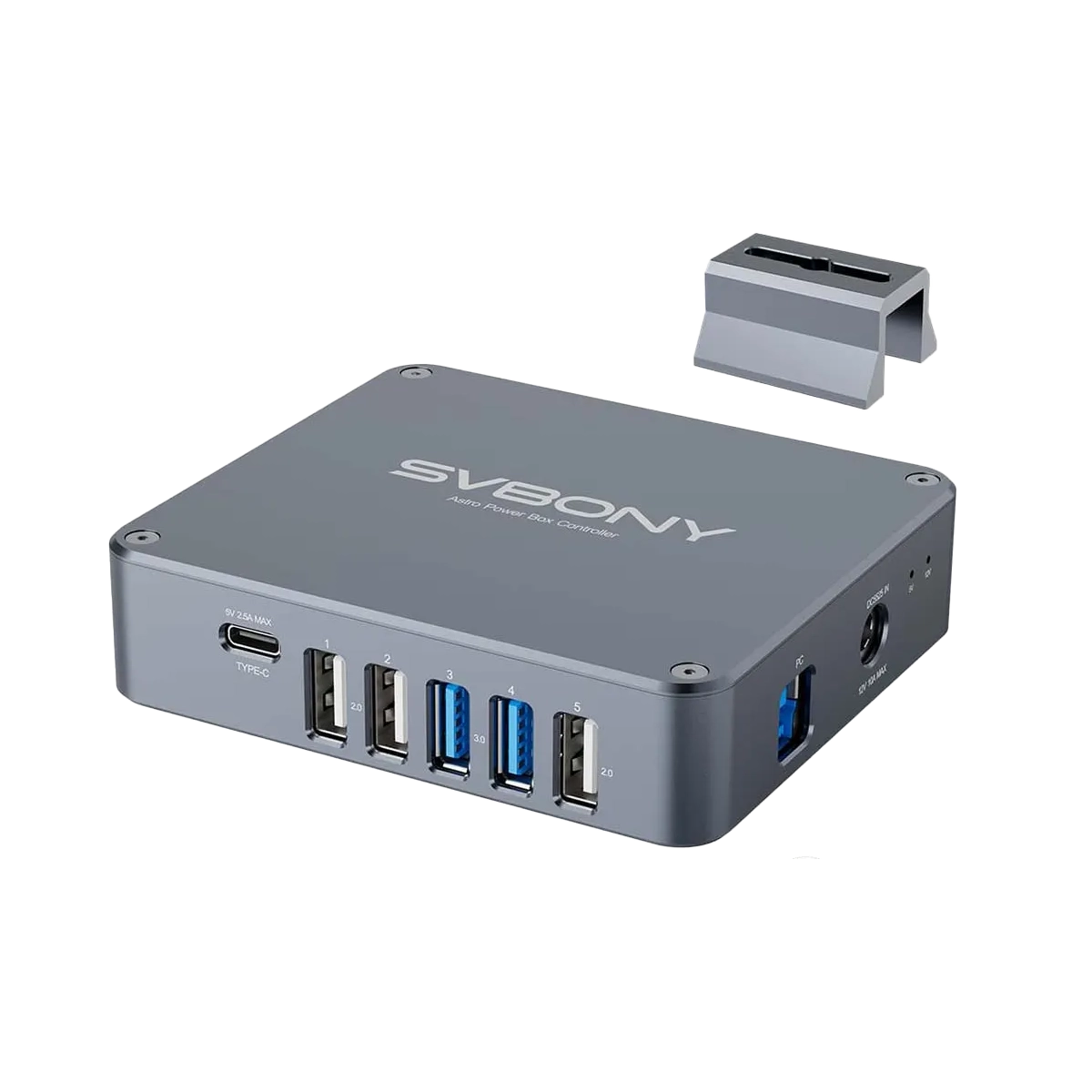
The SVBONY SV241 Pro is a compact power and USB distribution box for a telescope imaging rig. From a single 12V DC input (10A max) it supplies one always-on 12V output, five individually switchable 12V outputs (6A max each), a regulated 0–15V adjustable output (3A max), two PWM-controlled RCA dew heater ports, and a USB hub with two USB 3.0 and four USB 2.0 ports. It connects to your computer over USB 3.0 Type-B, runs under ASCOM with NINA integration, and reports voltage, current, temperature and humidity. The housing measures 100.5 x 87.5 x 24.5 mm and weighs approximately 210 g.


Who It's For
This is a good match if you run a computer-controlled imaging setup — cooled camera, mount, focuser, filter wheel, guide camera and dew heaters — and want power, USB and dew control in one box on the telescope, switched and monitored from your capture software. It suits portable rigs and permanent observatory setups alike.
Key Features & Design
- Seven 12V DC outputs: one always-on port plus five switchable ports, each rated to 6A, for cameras, mounts and motorized accessories.
- Adjustable 0–15V output: a regulated, switchable port rated to 3A for devices that need a voltage other than 12V.
- Two PWM dew heater ports: RCA outputs at 12V 6A, controlled independently, so the main scope and guide scope heaters can run at different levels.
- Automatic dew control: an SHT40 temperature and humidity sensor (5–85% RH) and a separate temperature probe feed dew-point difference, constant-temperature or manual heating modes.
- Built-in USB hub: two USB 3.0 and four USB 2.0 ports, each supplying 5V 2.5A with 2.75A overcurrent protection.
- Voltage and current monitoring: readouts available in software.
- Protection circuitry: ESD, reverse polarity, backflow, filtering, fusible link, under- and over-voltage, over-current and short-circuit protection, with automatic restart after an overload.
- Settings retention: custom settings are kept through power-off.
- Mounting: M4 and 1/4″-20 UNC screw holes for fixing the box to a dovetail, tube ring or pier plate.
- Status LED: lights steadily when the unit is ready.


Recommended Uses
- Deep-sky imaging rigs: power a cooled camera, mount, focuser and filter wheel from one 12V supply while routing their USB connections through a single cable to the computer.
- Dew management: drive dew heaters on the main telescope and the guide scope with automatic dew-point control.
- Remote and observatory operation: switch devices on and off and watch power draw from NINA or another ASCOM client.
- Cable management: mounting the box on the telescope shortens cable runs and reduces snag points as the mount slews.


Compatibility and Accessory Notes
- Power supply: takes 12V DC up to 10A through a 5.5 x 2.5 mm barrel connector; the supply is sold separately.
- Dew heaters: the two heater outputs are RCA connectors, so heaters with a matching RCA plug connect directly.
- Software: ASCOM drivers with NINA integration; SVBONY also lists INDI availability.
- USB: the hub uplinks to your computer over USB 3.0 Type-B. USB 3.0 ports suit imaging cameras; USB 2.0 ports suit guide cameras, focusers and filter wheels.
- Total load: the 10A input rating is the ceiling for everything connected at once — worth adding up when a cooled camera and two dew heaters run together.


Good to Know Before You Order
- Power supply not listed: SVBONY does not list a power supply or cables in the package; a 12V DC supply sized to your total load is needed.
- Environment: rated for -10°C to 50°C and 5–85% RH non-condensing.
- This listing is the single SV241 Pro. SVBONY also offers two-unit and SV241 Pro plus SV241 bundles on its page; get in touch if you need more than one unit.
Frequently Asked Questions
Is it difficult to set up?
No. Mount the box on the telescope, connect a 12V supply and the USB 3.0 cable to your computer, install the ASCOM driver, and connect it in NINA or your preferred ASCOM software. Devices then plug into the DC, USB and RCA ports.
Can it control two dew heaters at different levels?
Yes. The two RCA outputs are independent, each with PWM control and dew-point, constant-temperature or manual modes.
Can it power a cooled camera?
Yes. Each 12V output is rated to 6A, within the 10A total input.
Does it remember my settings?
Yes. Custom settings are retained after the box is powered off.
Does it work outside NINA?
It uses ASCOM drivers, so ASCOM-compatible software can control it, and SVBONY lists INDI availability.
Bottom Line
In short: a 210 g power, USB and dew control hub that puts seven 12V outputs, an adjustable 0–15V port, two PWM dew heater channels and a six-port USB hub on the telescope, all switched and monitored from ASCOM software.
| Model | SV241 Pro |
|---|---|
| Power input | 12V DC, 10A max, DC 5.5 x 2.5 mm |
| PC connection | USB 3.0 Type-B |
| Always-on DC output | 1 x 12V, 6A max (not switchable) |
| Switchable DC outputs | 5 x 12V, 6A max |
| Adjustable output | 1 x 0–15V regulated, 3A max, switchable |
| Dew heater outputs | 2 x RCA, 12V 6A, switchable, PWM control |
| USB ports | 2 x USB 3.0, 4 x USB 2.0; 5V 2.5A per port, 2.75A overcurrent protection |
| Monitoring | Voltage and current |
| Environment sensor port | 2.5 mm 4-pole TRRS, SHT40 temperature and humidity sensor |
| Temperature probe port | 2.5 mm 4-pole TRRS, temperature probe |
| Dew control modes | Dew-point difference, constant temperature, manual; two independent heaters |
| Software | ASCOM; NINA integration; INDI listed by SVBONY |
| Protection | ESD, reverse polarity, backflow, filtering, fusible link, under-voltage, over-voltage, over-current, short circuit, power detection, smart restart |
| Operating temperature | -10°C to 50°C |
| Operating humidity | 5% to 85% RH, non-condensing |
| Mounting | M4 and 1/4″-20 UNC screw holes |
| Dimensions | 100.5 x 87.5 x 24.5 mm |
| Weight | Approx. 210 g |
You may also like
Recently viewed
Recent Blog Posts
View all
Your Guide Graph Is Lying to You
Read More

D-Size vs V-Size: A Complete Guide to Telescope Dovetail Systems
Read More

What Is Back Focus in Astrophotography? Telescope Reducers, Flatteners, and Spacing Explained
Read More