




- Description
- Specifications

Product Overview
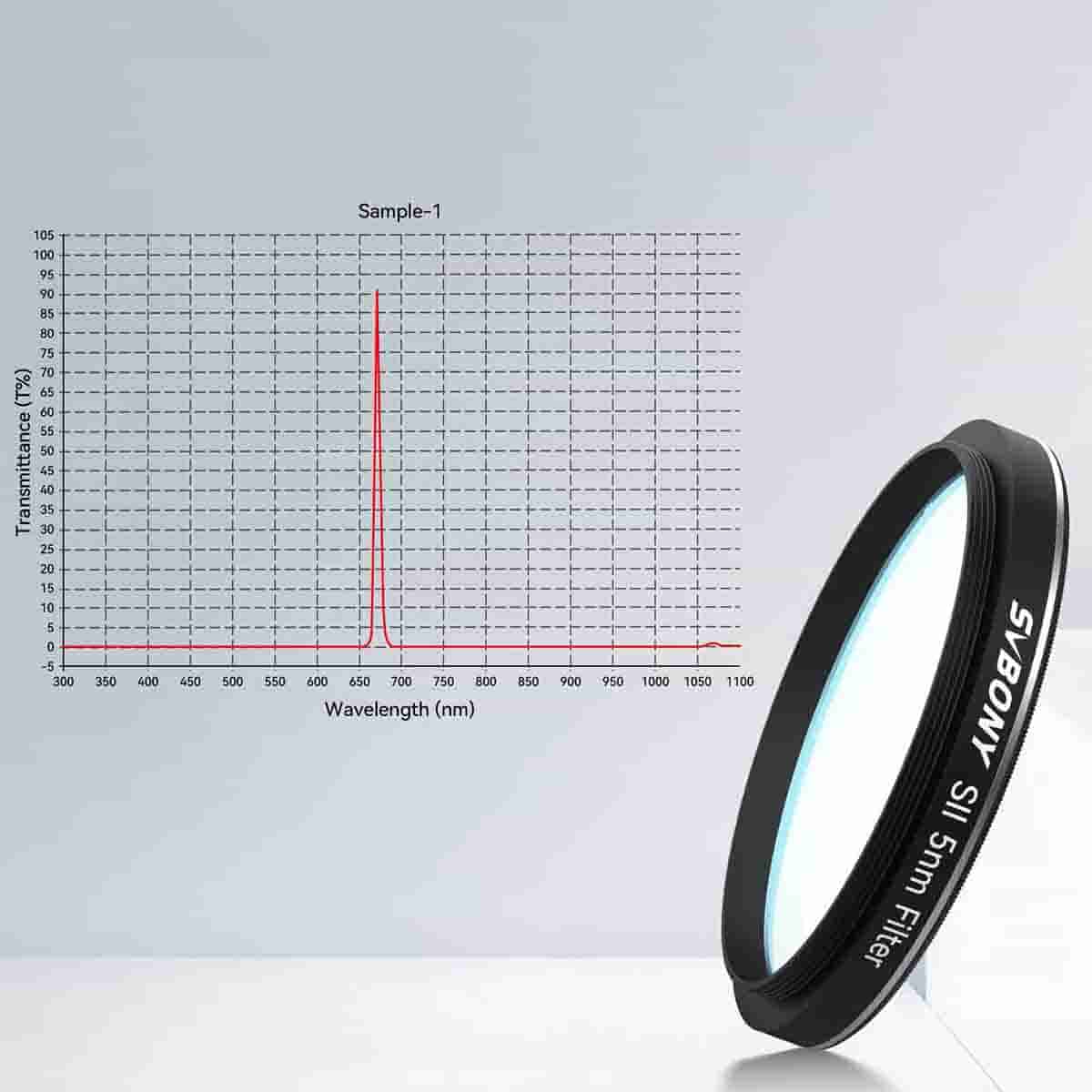
The SVBONY SV227 SII is a 2″ narrowband imaging filter with a 5 nm passband centred on the 672 nm sulfur II emission line. Peak transmission is at least 90%, blocking is ≥OD5 across 300–1000 nm, and the clear aperture is 44 mm. The 1.85 mm substrate sits in a CNC-machined, black-anodised cell with an M48 x 0.75 thread, and SVBONY lists the net weight as 12.5 g.

Who It's For
This is a good match if you image emission nebulae with a monochrome camera and are building SHO (Hubble palette) data, using a 2″ filter wheel or drawer to cover a larger sensor.
Key Features & Design
- 5 nm at 672 nm: isolates sulfur II emission from light pollution and moonlight.
- ≥90% peak transmission and ≥OD5 blocking from 300 to 1000 nm.
- Coatings: multi-layer anti-reflection coatings applied by electron-beam evaporation with ion-assisted deposition.
- Optical glass: SVBONY specifies German optical glass, 60/40 surface quality, 1/4λ surface parallelism and 30″ parallelism.
- Metal cell: CNC-machined, black-anodised and laser-engraved.


Optical Design
SII is usually the faintest of the three SHO lines, so a narrow 5 nm passband and deep blocking are what keep the background dark enough to record it. The interference coating passes the 672 nm line at ≥90% while rejecting the rest of the 300–1000 nm range at ≥OD5, which also blocks the near infrared that a separate IR-cut filter would otherwise handle.


Recommended Uses
- SHO imaging of emission nebulae and supernova remnants alongside H-alpha and OIII.
- Imaging from light-polluted skies or with the Moon up.
Compatibility and Accessory Notes
- Thread: M48 x 0.75, single thread, standard 2″ size.
- Holders: 2″ filter wheels, filter drawer sliders and 2″ nosepieces.
- Matching filters: SVBONY makes the SV227 2″ H-alpha and OIII 5 nm filters and a 2″ SHO set.


Good to Know Before You Order
- Focal ratio: SVBONY lists it as unsuitable for telescopes faster than f/4.
- Not for solar use.
- This listing is the filter only; SVBONY also offers it with a 2″ holder.
Frequently Asked Questions
Is it difficult to set up?
No. It threads into a 2″ filter wheel position, drawer slider or nosepiece like any standard M48 filter.
Can I use it on an f/3.6 astrograph?
SVBONY rates it for f/4 and slower.
Do I still need an IR-cut filter?
No. The ≥OD5 blocking covers the near infrared.
Bottom Line
In short: a 2″, 5 nm SII filter at 672 nm with ≥90% peak transmission and ≥OD5 blocking, for SHO imaging at f/4 and slower.
| Brand | SVBONY |
|---|---|
| Model | SV227 |
| Type | SII filter |
| Size | 2″ |
| Wavelength range | 300–1000 nm |
| CWL | 672 nm |
| FWHM | 5 nm |
| Peak transmittance | ≥90% |
| Substrate thickness | 1.85 mm |
| Blocking | ≥OD5 |
| Clear aperture | 44 mm |
| Surface quality | 60/40 |
| Surface parallelism | 1/4λ |
| Parallelism | 30″ |
| Thread | M48 x 0.75, single thread |
| Net weight | 12.5 g / 0.44 oz / 0.027 lb |
You may also like
Recently viewed
Recent Blog Posts
View all
Your Guide Graph Is Lying to You
Read More

D-Size vs V-Size: A Complete Guide to Telescope Dovetail Systems
Read More

What Is Back Focus in Astrophotography? Telescope Reducers, Flatteners, and Spacing Explained
Read More