




- Description
- Specifications

Product Overview
The SVBONY SV216 2x is a 1.25″ Barlow lens with a four-element optical design that doubles the effective focal length of your telescope, and therefore the magnification of any eyepiece placed behind it. All four elements are fully multi-coated and edge-blackened. The upper body is 59.5 mm long, the barrel inserts 39.5 mm into the focuser, the stainless steel barrel carries an M28.5 x 0.6 filter thread, and the whole unit weighs 219 g (7.72 oz).

Who It's For
This is a good match if you observe or image the Moon and planets and want more magnification from the eyepieces you already own, or if you are building a 1.25″ eyepiece set and want each eyepiece to cover two magnifications.
Key Features & Design
- 2x magnification factor: a 20 mm eyepiece behaves like a 10 mm.
- Four-element design: SVBONY specifies good control of chromatic and spherical aberration and a flatter field than standard Barlows.
- Fully multi-coated, edge-blackened lenses: reduce internal reflections and scattered light for contrast.
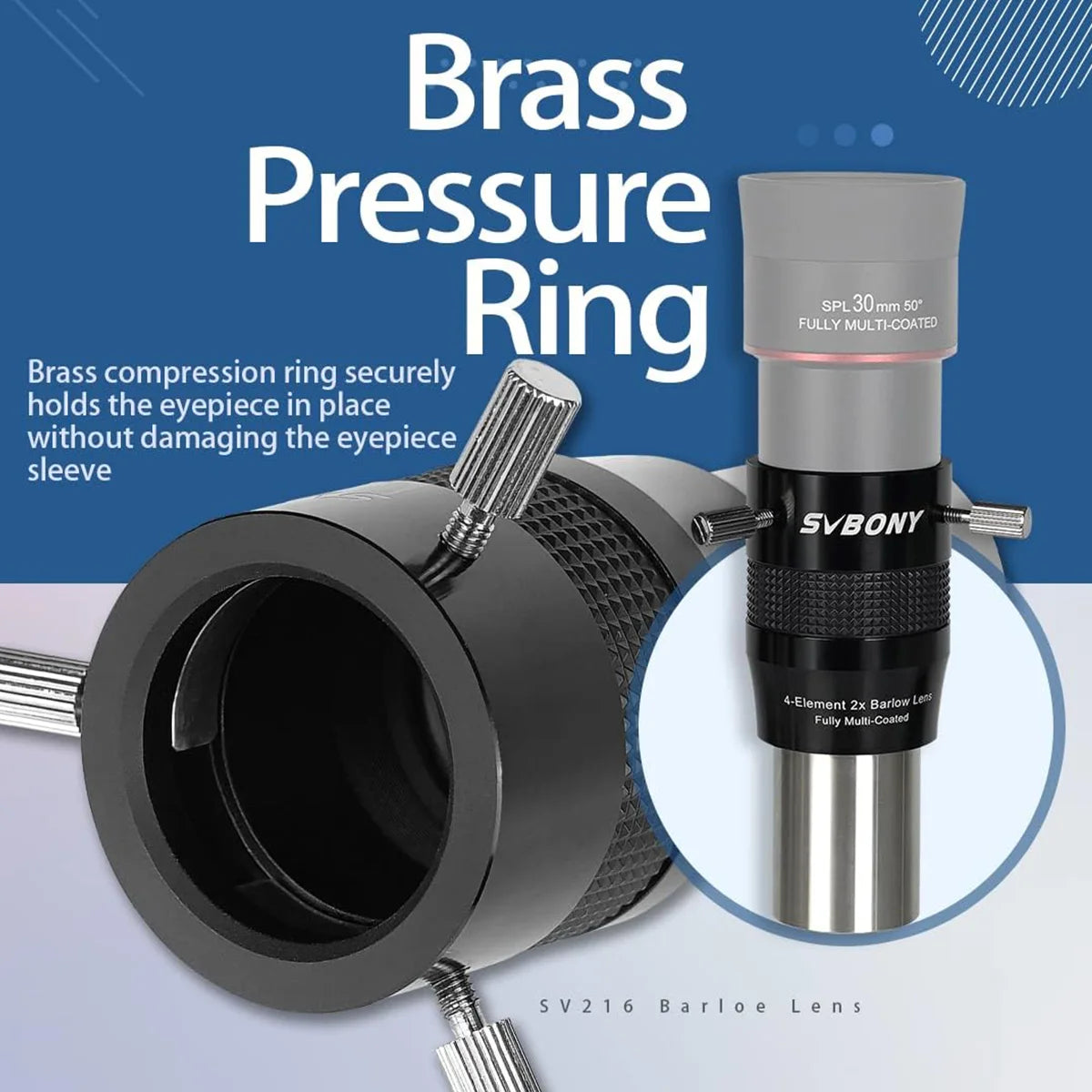
- Three-screw lock with compression ring: three M3 x 10 thumbscrews and a compression band hold the eyepiece centred without marking the barrel.
- Stainless steel straight barrel: 1.25″, with M28.5 x 0.6 filter threads.


Optical Design
A Barlow is a negative lens group placed ahead of the focal plane that lengthens the converging light cone, increasing the effective focal length. The SV216 uses four elements rather than the two found in basic Barlows, which gives the designer room to correct colour and spherical error and to keep the field flatter. SVBONY also notes that the eyepiece's eye relief is preserved when used with the Barlow, so short-focus magnifications stay comfortable to view through.


Recommended Uses
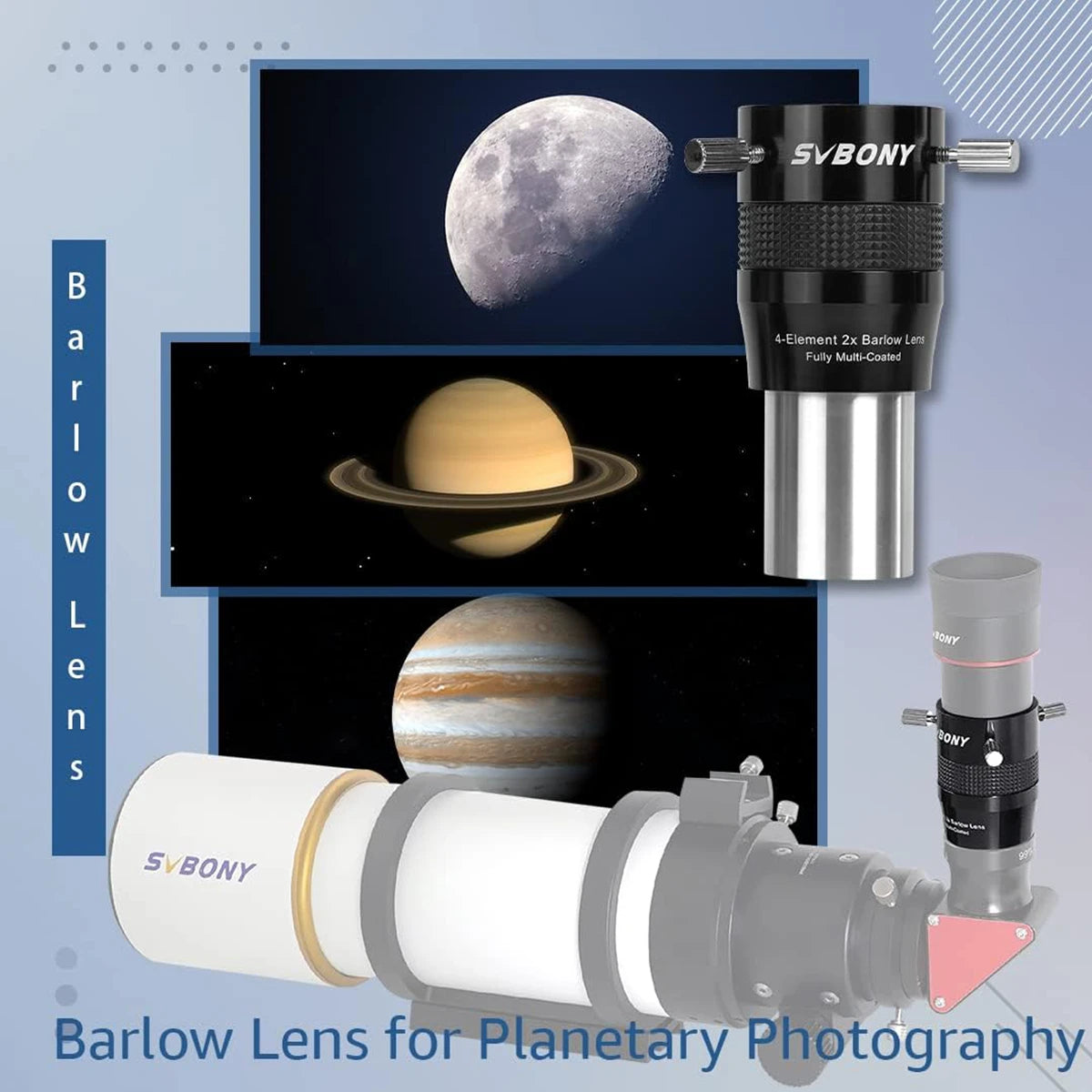
- Lunar and planetary observing: doubles magnification for craters, Jupiter's belts and Saturn's rings.
- Planetary imaging: lengthens focal length ahead of a small-pixel planetary camera.
- Double stars: higher image scale for splitting close pairs.
- Extending an eyepiece set: each 1.25″ eyepiece gains a second magnification.

Compatibility and Accessory Notes
- Focuser: fits any 1.25″ focuser or diagonal; insertion depth 39.5 mm, maximum diameter 44 mm excluding thumbscrew.
- Eyepieces and cameras: accepts 1.25″ eyepieces or 1.25″-nosepiece cameras; SVBONY notes it can sit anywhere between the eyepiece and the camera.
- Filters: M28.5 x 0.6 thread for standard 1.25″ filters.


What's in the Box
- 1 x SV216 4-element 2x 1.25″ Barlow lens
- 1 x Bolt Cases storage box
- 3 x M3 screws
- 1 x dust plug
- 1 x end cap


Good to Know Before You Order
- 1.25″ only: the barrel and eyepiece holder are 1.25″. 2″ eyepieces need a 2″ Barlow.
- Magnification and seeing: doubling magnification also doubles the effect of atmospheric turbulence, so the highest powers are best kept for steady nights.
Frequently Asked Questions
Is it difficult to set up?
No. It slides into the focuser or diagonal like an eyepiece, and the eyepiece then slides into the Barlow and locks with the three thumbscrews.
Can I use it with a camera?
Yes. A camera with a 1.25″ nosepiece fits the eyepiece holder, which is a common setup for planetary imaging.
Does it take filters?
Yes. The barrel has an M28.5 x 0.6 thread for standard 1.25″ filters.
How is it different from the SV216 3x?
The 2x doubles magnification and has a stainless steel barrel at 219 g. The 3x triples it and has an aluminium barrel at 173 g.
Bottom Line
In short: a four-element, fully multi-coated 1.25″ 2x Barlow with a three-screw lock and filter threads that doubles the magnification of your eyepieces for Moon, planets and double stars.
| Brand | SVBONY |
|---|---|
| Model | SV216 |
| Barrel size | 1.25″ |
| Magnification factor | 2x |
| Number of lens elements | 4 |
| Lens coatings | Fully multicoated |
| Outside length of upper body | 2.34″ / 59.5 mm |
| Insertion depth | 1.55″ / 39.5 mm |
| Max diameter excluding thumbscrew | 1.73″ / 44 mm |
| Filter threads | M28.5 x 0.6 |
| Barrel type | Straight barrel |
| Barrel material | Stainless steel |
| Thumbscrews | 3, M3 x 10 |
| Compression ring in eyepiece holder | Yes |
| Net weight | 7.72 oz / 219 g |
You may also like
Recently viewed
Recent Blog Posts
View all
Your Guide Graph Is Lying to You
Read More

D-Size vs V-Size: A Complete Guide to Telescope Dovetail Systems
Read More

What Is Back Focus in Astrophotography? Telescope Reducers, Flatteners, and Spacing Explained
Read More