



- Description
- Specifications

Product Overview
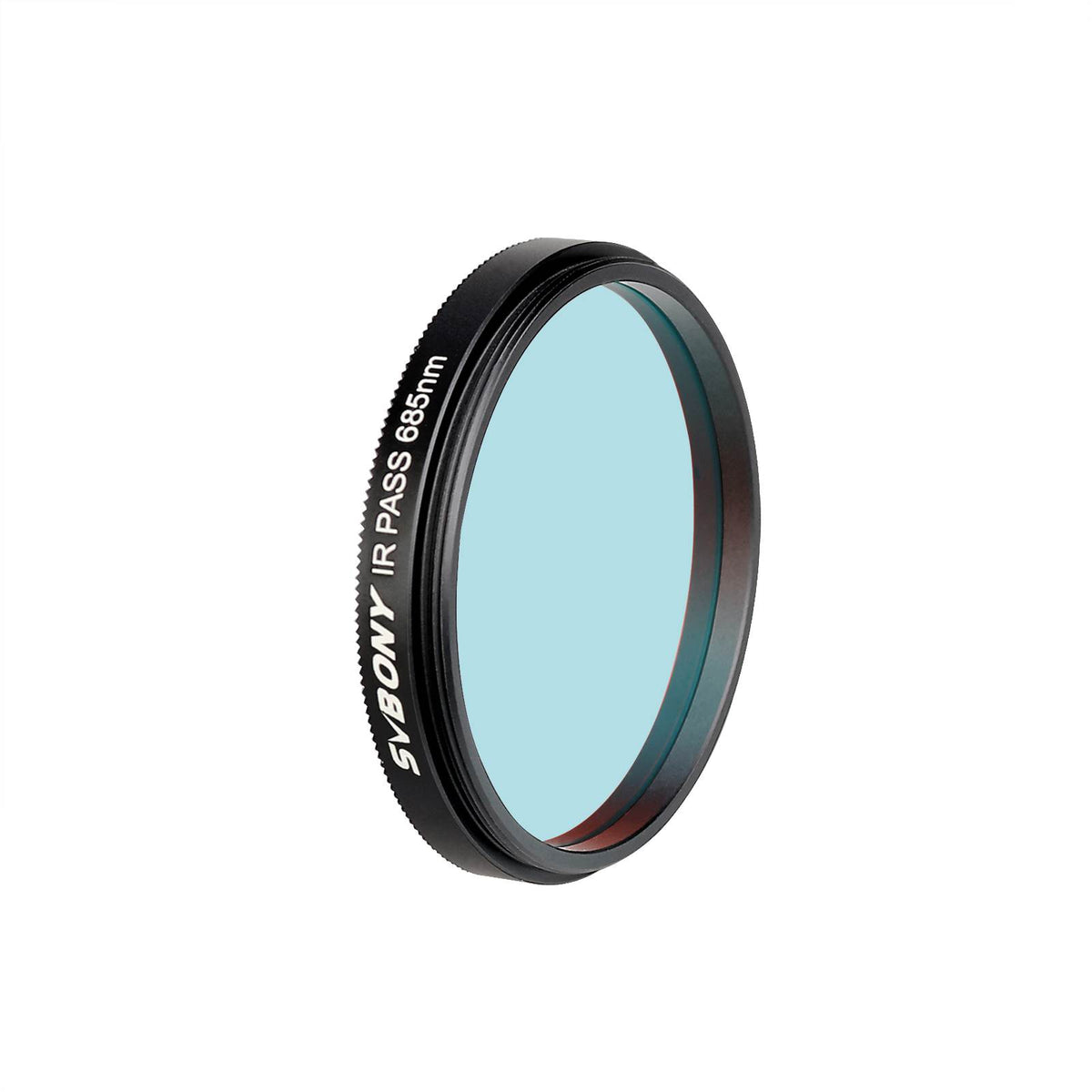
The SVBONY SV183 is a 1.25″ infrared pass filter for lunar and planetary imaging. It blocks visible light below its 670 nm cut-on (OD2 from 400–660 nm) and transmits more than 95% from 673 to 1100 nm. Longer wavelengths are less disturbed by atmospheric turbulence, so imaging in near-IR steadies the view in average seeing and raises contrast on the Moon and planets. The glass is SCHOTT B260, 1.1 mm thick, in a 6061-T6 aluminium cell with an M28.5×0.6 thread and a 26 mm clear aperture.

Who It's For
This is a good match if you image the Moon and planets with a camera that is sensitive in the near-infrared, such as a mono or colour planetary camera, and want sharper results when seeing is unsteady or when imaging in twilight.
Key Features & Design
- 670 nm cut-on: 50% transmission at 670 nm and over 95% from 673–1100 nm.
- OD2 blocking from 400–660 nm to remove visible light.
- SCHOTT B260 substrate: 1.1 mm thick, 60/40 surface quality, 1/4 λ surface parallelism and 30″ parallelism.
- Ion-assisted multi-coating for scratch resistance and stable wavelength performance.
- CNC aluminium cell: sand-blasted, black anodised and laser engraved, single-threaded M28.5×0.6.
- Supplied in a protective filter box.

Recommended Uses
- Lunar imaging in near-IR, where seeing effects are reduced.
- Planetary imaging of Mars, Jupiter, Saturn and Venus for contrast and steadiness.
- Twilight imaging: the filter darkens a bright dawn or dusk sky so the Moon and planets can be captured before full dark.
- Near-IR nature photography with a camera sensitive above 670 nm, such as a modified DSLR or webcam.

Compatibility and Accessory Notes
- Thread: M28.5×0.6 standard 1.25″ filter thread, for eyepiece barrels, camera nosepieces, filter wheels and drawers.
- Clear aperture: 26 mm.
- Camera: needs a camera with near-IR sensitivity above 670 nm; colour cameras record the result as a monochrome-like image.
- 2″ version: SVBONY also makes the SV183 in a 2″ M48×0.75 cell (44 mm clear aperture); contact us if you need that size.

Good to Know Before You Order
- Imaging only: the eye has very little sensitivity above 670 nm, so SVBONY states it does not work for visual observing.
- Camera sensitivity matters: results depend on how much near-IR response your sensor has.
- Net weight 8 g.
Frequently Asked Questions
Is it difficult to set up?
No. It threads into the 1.25″ nosepiece of your camera or into a filter wheel like any 1.25″ filter; refocus after fitting it, since IR focus differs slightly from visible.
Can I look through it with an eyepiece?
No. It blocks the visible spectrum and is designed for cameras only.
Why image in infrared?
Atmospheric turbulence affects longer wavelengths less, which steadies lunar and planetary detail and improves contrast.
Does it work with a colour camera?
Yes, provided the sensor responds above 670 nm.
Bottom Line
In short: a 1.25″ IR pass filter with a 670 nm cut-on, OD2 visible blocking and over 95% transmission to 1100 nm, for steadier, higher-contrast lunar and planetary images with an IR-sensitive camera.
| Model | SV183 (W9142A) |
|---|---|
| Size | 1.25″ |
| Thread | M28.5×0.6 |
| Clear aperture | 26 mm |
| Lens material | SCHOTT B260 |
| Frame material | Aviation aluminum 6061T6 |
| Substrate thickness | 1.1 mm |
| Surface quality | 60/40 |
| Surface parallelism | 1/4 λ |
| Parallelism | 30″ |
| Blocking | OD2 @ 400–660 nm |
| Wavelength range | 350–1100 nm |
| λ cut-on | 670 nm |
| Peak transmittance | 670 nm @ T=50%; 673–1100 nm @ T>95% |
| Net weight | 8 g / 0.3 oz |
You may also like
Recently viewed
Recent Blog Posts
View all
Your Guide Graph Is Lying to You
Read More

D-Size vs V-Size: A Complete Guide to Telescope Dovetail Systems
Read More

What Is Back Focus in Astrophotography? Telescope Reducers, Flatteners, and Spacing Explained
Read More