


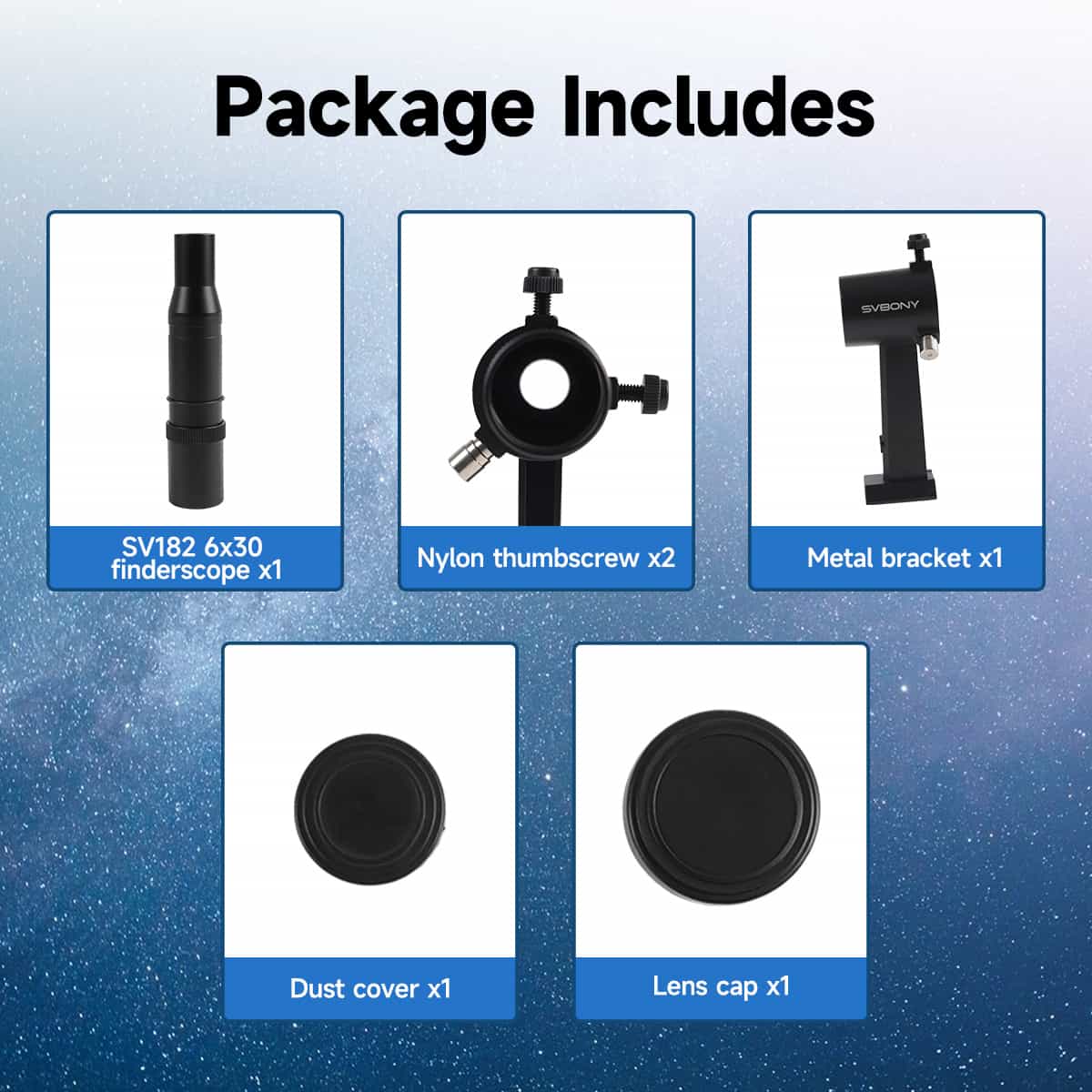


- Description
- Specifications

Product Overview
The SVBONY SV182 is a 6x30 optical finder scope with a straight-through view and correct-image optics, supplied with an X-Y spring bracket. Its 30 mm, two-element fully multi-coated objective and 120 mm focal length give 6x magnification, a 7.5° true field and a 5 mm exit pupil, with a brass crosshair reticle for centring targets. The image is upright and correctly oriented left to right, so what you see in the finder matches the sky chart and the view by eye. Net weight is 295 g.

Who It's For
This is a good match if you want a magnifying finder to replace or supplement a red-dot finder on a refractor, Newtonian or Maksutov, and you prefer looking straight along the tube with an image that is the right way up. It suits visual observers who star-hop to faint targets and imagers who need to place a target near the centre of the field before plate solving or guiding.
Key Features & Design
- 6x30 optics: 30 mm objective, 120 mm focal length, 6x magnification and a 7.5° true field.
- Correct-image view: up-down and left-right orientation matches the naked-eye view.
- Straight-through body: you sight directly along the finder, the same way you would point the telescope.
- Brass crosshair reticle: a fine, non-illuminated crosshair for centring.
- FMC two-element objective: fully multi-coated, with blackened lens edges to control stray light.
- Objective-thread focusing: focus is set by turning the objective cell.
- 15 mm eye relief and 5 mm exit pupil.


Optical Design
The objective is a two-element, single-group lens with full multi-coating. At 120 mm focal length and 6x, the 7.5° field is wide enough to recognise star patterns while still showing stars well below naked-eye limit, which makes the finder useful for stepping from a bright guide star to a faint target. An erecting system delivers the correct-image view, and the 5 mm exit pupil keeps the image bright at night.

Recommended Uses
- Aligning a telescope or GoTo mount on bright stars before handing over to the main optics.
- Star hopping to deep-sky objects with a correctly oriented view that matches a chart.
- Rough framing for imaging before plate solving.
- Daytime terrestrial spotting to align the finder with the main telescope on a distant object.

Compatibility and Accessory Notes
- Bracket: X-Y spring-type bracket; the two adjusting screws push the finder against a spring for alignment.
- Mounting: the bracket base fits a standard finder shoe on your telescope. If you are unsure whether your telescope's shoe matches, send us a photo and we will check it with you.
- Right-angle alternative: SVBONY also makes the SV182 6x30 as a right-angle correct-image finder, which we carry as a separate listing.


Good to Know Before You Order
- Straight-through view: near the zenith, a straight finder has you looking up along the tube; the right-angle SV182 is the option if you prefer a more comfortable head position.
- Non-illuminated reticle: the brass crosshair is not lit, so against a dark sky it is seen as a silhouette on the background.
- Net weight 295 g: light enough for most telescopes, though it adds a little front-end weight to balance on smaller mounts.
Frequently Asked Questions
Is it difficult to set up?
No. The bracket slides into the finder shoe, and you align it in daylight by centring a distant object in the telescope and then turning the two X-Y screws until the crosshair sits on the same object.
Is the image upside down?
No. The SV182 is a correct-image finder, so the view is upright and not mirror-reversed.
How much sky does it show?
A 7.5° true field at 6x.
How is it focused?
By turning the objective on its thread until stars are sharp.
Bottom Line
In short: a 6x30 straight-through finder with a correct-image view, a 7.5° field, a brass crosshair and an X-Y spring bracket, for aligning your telescope and star hopping with a view that matches the chart.
| Model | SV182 |
|---|---|
| Type | Straight-through correct-image finder scope |
| Lens diameter | 30 mm |
| Focal length | 120 mm |
| Magnification | 6x |
| Eye relief | 15 mm |
| Exit pupil | 5 mm |
| True field of view | 7.5° |
| Lens coating | FMC |
| Objective structure | 2 elements / 1 group |
| Blackened lens edges | Yes |
| Image orientation | Correct image |
| Reticle | Brass crosshair |
| Illuminated | No |
| Mounting bracket | X-Y spring type |
| Focusing method | Objective thread focusing |
| Observation angle | Straight-through view |
| Net weight | 295 g / 10.41 oz |
You may also like
Recently viewed
Recent Blog Posts
View all
Your Guide Graph Is Lying to You
Read More

D-Size vs V-Size: A Complete Guide to Telescope Dovetail Systems
Read More

What Is Back Focus in Astrophotography? Telescope Reducers, Flatteners, and Spacing Explained
Read More