




- Description
- Specifications

Product Overview
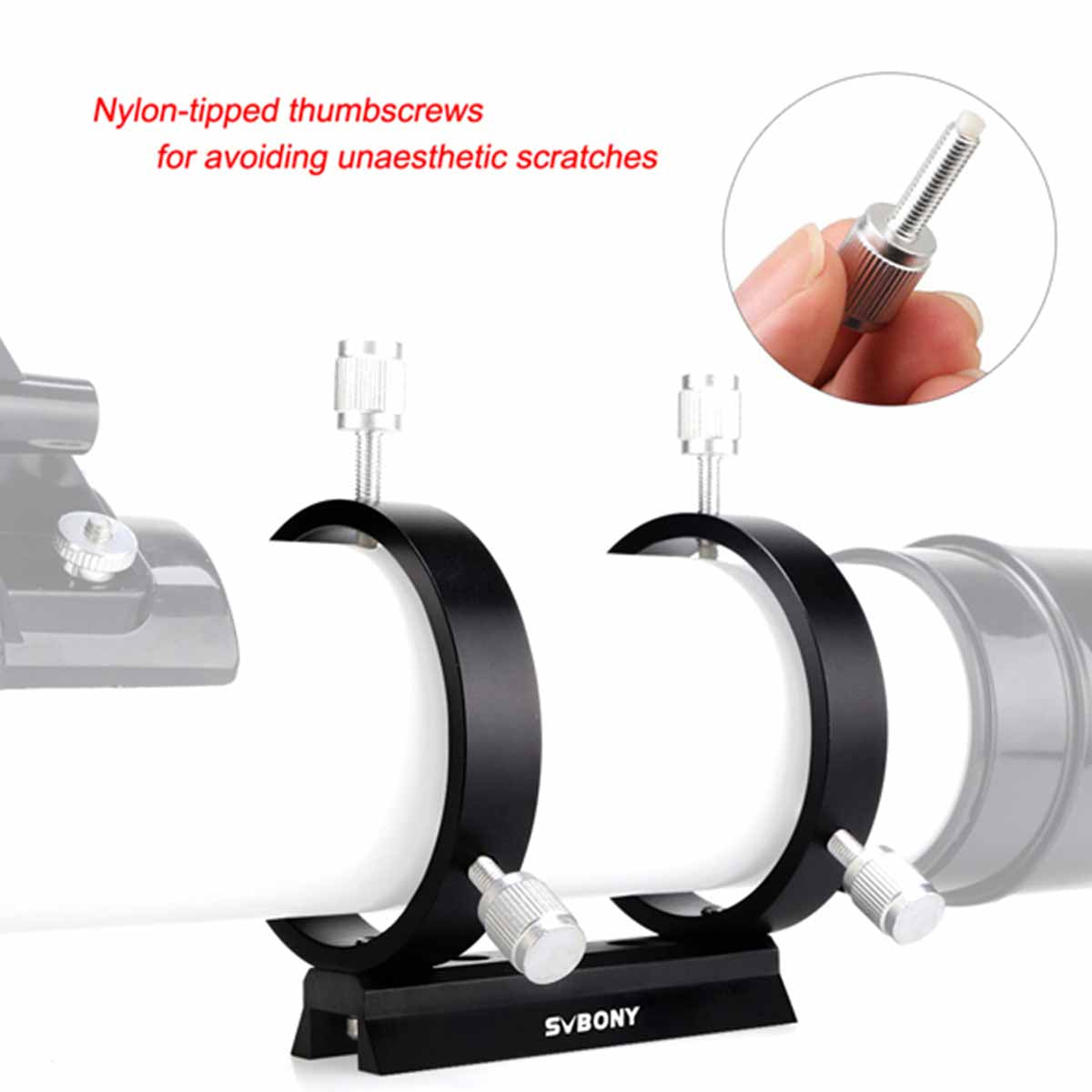
The SVBONY SV116 is a pair of adjustable metal rings for mounting a guide scope with a tube diameter of 43–70 mm parallel to your main telescope. Knurled 12 mm thumbscrews with nylon tips centre and aim the guide scope without marking its tube. The rings use M5 threads, and the base accepts M8, 1/4″-20 UNC and M6 fasteners, so it can bolt to a tube-ring top, a dovetail bar or another flat surface.

Who It's For
This is a good match if you autoguide with a separate guide scope and want to piggyback it on your imaging telescope with the ability to point it at a suitable guide star.
Key Features & Design
- 43–70 mm adjustable range: fits a wide span of guide scopes and finders.
- Nylon-tipped thumbscrews: soft tips protect the guide scope's finish.
- Knurled 12 mm screws: easy to turn by hand in the dark.
- Multiple base threads: M8, 1/4″-20 UNC and M6.
- Set of two rings.


Recommended Uses
- Mounting a guide scope on top of an imaging scope for autoguided astrophotography.
- Short dovetail setups: attaching the rings to a dovetail bar for a compact guide-scope assembly.
- Aligning a finder or guide scope on a bright star centred in the eyepiece or autoguider.

Compatibility and Accessory Notes
- Guide scope tube: 43–70 mm diameter.
- Mounting: M8, 1/4″-20 UNC and M6 base threads for tube-ring handles, dovetail bars and plates.
- Send us your telescope's ring or plate details and we will confirm which fastener fits.

What's in the Box
- Two guide scope rings with thumbscrews
Good to Know Before You Order
- Rings only: the dovetail bar or mounting plate is not part of the kit.
- Weight: SVBONY does not publish a usable weight for this item.
Frequently Asked Questions
Is it difficult to set up?
No. Bolt the rings to your tube rings or a dovetail bar, place the guide scope in them, and use the thumbscrews to centre a bright star.
What size guide scopes fit?
Tubes from 43 mm to 70 mm in diameter.
Will the screws scratch my guide scope?
The thumbscrews have nylon tips to protect the tube.
Bottom Line
In short: a pair of adjustable 43–70 mm guide scope rings with nylon-tipped knurled thumbscrews and M8, 1/4″-20 and M6 base threads for piggyback guiding.
| Model | SV116 |
|---|---|
| Inner diameter of the ring | 70 mm |
| Adjustable range | 43–70 mm |
| Metal screws | 12 mm diameter, knurled, nylon tipped |
| Guiding scope ring threads | M5 |
| Plate threads | M8, 1/4″-20 UNC, M6 |
| Included | 2 guide scope rings |
| Colour | Black |
| Weight | Not published by vendor |
| Use case | Mounting and aligning a guide scope on an imaging telescope |
You may also like
Recently viewed
Recent Blog Posts
View all
Your Guide Graph Is Lying to You
Read More

D-Size vs V-Size: A Complete Guide to Telescope Dovetail Systems
Read More

What Is Back Focus in Astrophotography? Telescope Reducers, Flatteners, and Spacing Explained
Read More