






- Description
- Specifications

Product Overview
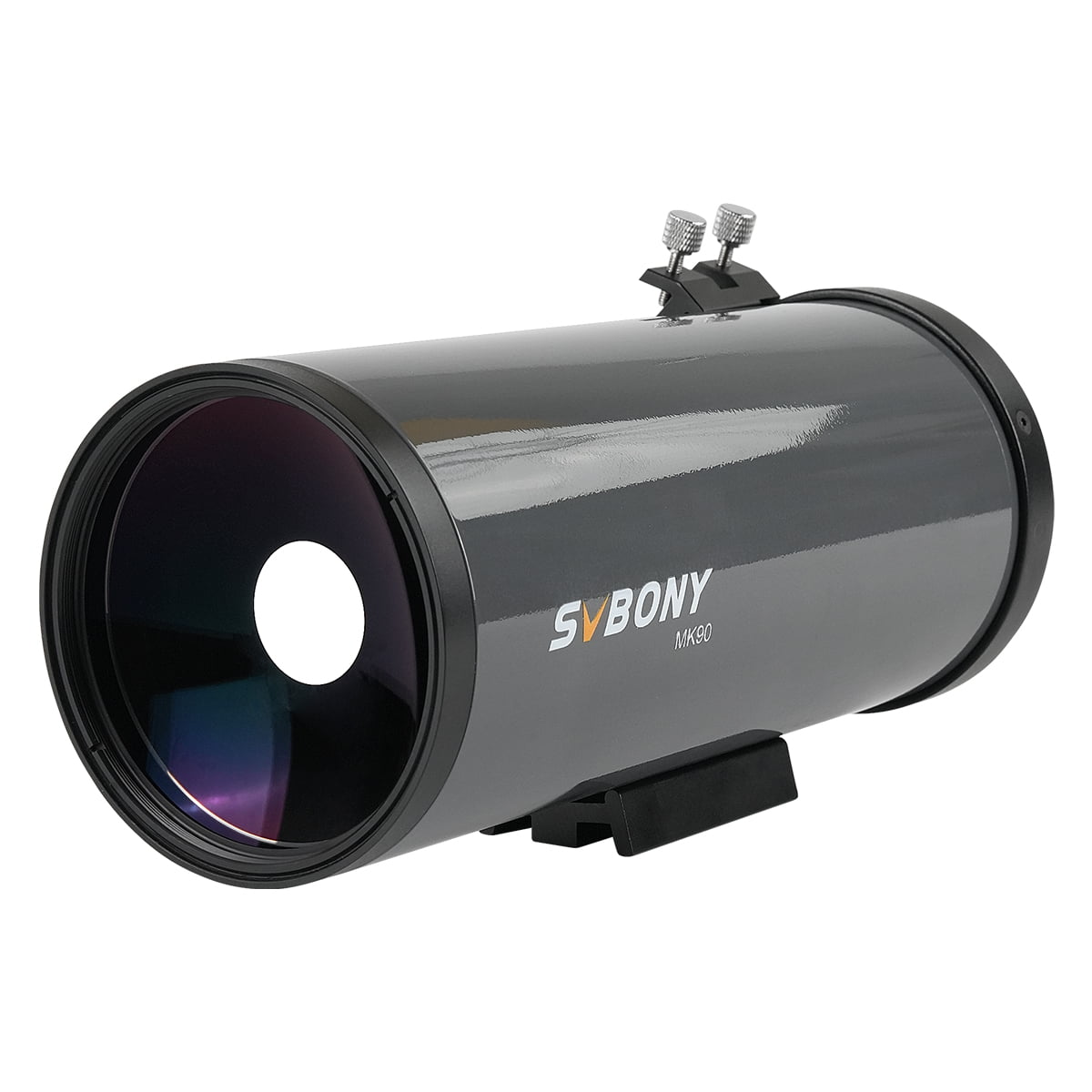
The SVBONY MK90 is a compact 90 mm Maksutov-Cassegrain optical tube with a 1250 mm focal length at f/13.9. A full-aperture meniscus corrector and a folded light path pack that long focal length into a short, closed tube, which suits high-magnification views of the Moon and planets as well as daytime nature viewing.
SVBONY collimates each tube at the factory through a three-stage process, fits a tapered internal baffle to cut stray light, and supplies a 70 mm Vixen-style dovetail plate on a mounting base. The tube weighs 1380 g, and the rear port takes T-ring and camera adapters on its M42 × 0.75 thread.
Who It's For
This is a good match if you:
- Want a small scope for the Moon and planets: 1250 mm of focal length gives high magnification with ordinary eyepieces.
- Travel or observe from a balcony: at 1380 g the MK90 sits on light photo tripods and small alt-az mounts.
- Watch birds and wildlife by day: the closed tube and long focal length make it a capable long-range terrestrial scope with an erecting diagonal.
- Are choosing a first telescope: there is no collimation to learn and nothing to align before observing.
Key Features & Design
- 90 mm aperture, 1250 mm focal length: f/13.9 native, rated by SVBONY at 180x light-gathering power.
- No periodic collimation: the meniscus corrector replaces a Schmidt plate, and the optics are set at the factory and held by three fixing screws and three pairs of collimation screws.
- Tapered baffle tube: blocks and absorbs stray light for higher image contrast.
- Internal focuser: focus is set by moving the primary mirror, so nothing extends from the rear of the tube.
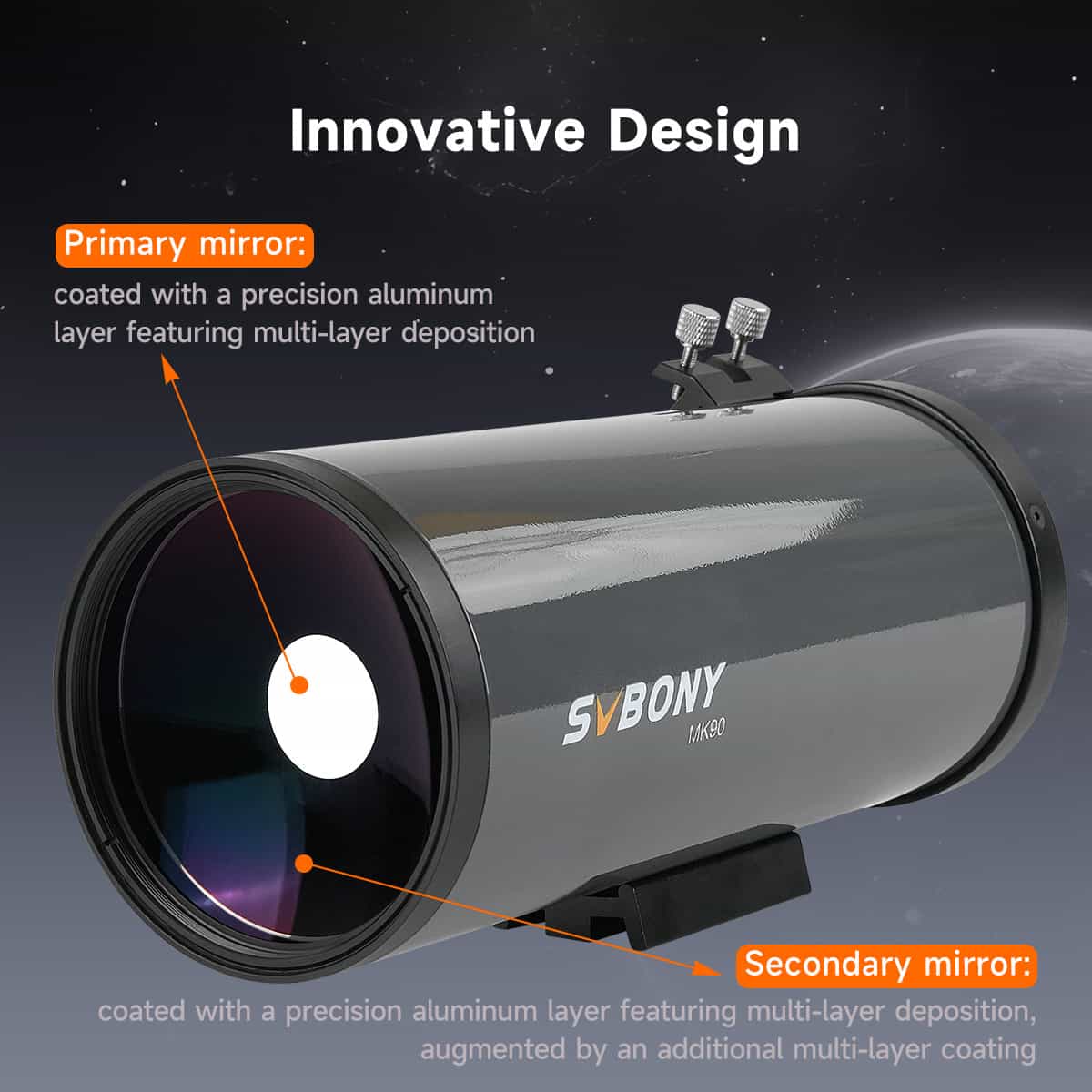
- Coatings: multi-coated precision aluminium coating on the primary; aluminium plus multi-coating on the secondary, with SVBONY quoting over 89% reflectance.
- Metal construction: a sturdy tube built for travel.


Optical Design
Light passes through the meniscus corrector, reflects from the spherical primary, and returns through the central hole in the primary after bouncing off the secondary. SVBONY describes the MK90 as a two-element Maksutov-Cassegrain optical system. Because the image is formed by mirrors, all colours come to the same focus, and the closed tube keeps dust and air currents away from the optics.
The long f/13.9 focal ratio keeps the field narrow and the image scale large, which is what you want for lunar craters, Jupiter's belts and Saturn's rings, and it is forgiving of eyepiece design at the edges of the field.

Recommended Uses
- Lunar and planetary observing: high magnification for crater detail, planetary discs and Saturn's rings.
- Double stars: a large image scale for splitting close pairs.
- Daytime nature observation: birds, wildlife and distant landscapes with an erecting diagonal.
- Lunar and planetary imaging: a T-ring or camera adapter threads to the M42 × 0.75 rear port.

Compatibility and Accessory Notes
- Rear thread: M42 × 0.75 for T-rings and camera adapters.
- Mounting: a 70 mm, 75° Vixen-standard dovetail plate on a versatile mounting base, plus a UNC 1/4″-20 photographic thread for direct mounting on a camera tripod.
- Visual accessories: a 1.25″ diagonal and eyepieces are needed for visual use; neither is included with the OTA.
- Combination sets: SVBONY also offers the MK90 as a mini mount and tripod set, a visual observation set, an EAA set and a birdwatching kit. This listing is the OTA; ask us if you would like one of the sets.


What's in the Box
- 1 x MK90 Maksutov-Cassegrain OTA
- 1 x versatile dovetail mounting base
- 1 x Vixen-style dovetail plate, 70 mm
- 1 x objective lens cover
- 1 x 1.25″ dust plug
Good to Know Before You Order
- Optical tube only: no mount, tripod, diagonal or eyepiece is included. The dovetail and 1/4″-20 thread fit most small mounts and photo tripods.
- Narrow field: at f/13.9 the MK90 frames planets and lunar detail rather than large star fields.
- Cool-down: like any closed-tube Maksutov it gives its sharpest views once the optics reach outdoor temperature, so setting it out a little before observing helps.
- Dew: the front meniscus faces the sky, and on humid nights a dew heater keeps it clear.
Frequently Asked Questions
Is it difficult to set up?
No. The tube arrives collimated, the dovetail drops into any Vixen-style saddle or the base threads onto a photo tripod, and a diagonal and eyepiece complete it.
Does it need collimation?
No periodic collimation is needed. SVBONY sets the optics at the factory and the meniscus design holds alignment well.
Can I use it for birdwatching?
Yes. SVBONY designs it for terrestrial nature observation as well as astronomy; an erecting diagonal gives a correctly oriented view.
Can I attach a camera?
Yes. The rear port is M42 × 0.75, which takes a T-ring for a DSLR or mirrorless camera, or a planetary camera adapter.
How heavy is it?
1380 g, light enough for small alt-az mounts and sturdy photo tripods.
Bottom Line
In short: a 90 mm, 1250 mm f/13.9 Maksutov-Cassegrain that arrives collimated, weighs 1380 g and mounts by Vixen dovetail or 1/4″-20 thread. Add a diagonal, an eyepiece and a small mount for high-power lunar, planetary and nature viewing.
| Brand | SVBONY |
|---|---|
| Model | MK90 |
| Optical type | Maksutov-Cassegrain |
| Aperture | 90 mm |
| Focal length | 1250 mm |
| Focal ratio | f/13.9 |
| Light gathering power | 180x |
| Primary mirror | Multi-coated precision aluminum coating |
| Secondary mirror | Multi-coated precision aluminum coating and multi coating |
| Reflectance | Over 89% |
| Focuser | Internal |
| Mounting | Vixen style, 1 mounting base; 70 mm dovetail plate |
| Photo thread | UNC 1/4″-20 |
| Adapter thread | M42 × 0.75 for T-ring |
| Net weight | 1380 g |
| Package dimensions | 360 × 170 × 170 mm |
| Included accessories | Dovetail mounting base; 70 mm Vixen-style dovetail plate; objective lens cover; 1.25″ dust plug |
| Recommended use | Lunar and planetary observing; terrestrial nature viewing; lunar and planetary imaging |
You may also like
Recently viewed
Recent Blog Posts
View all
Your Guide Graph Is Lying to You
Read More

D-Size vs V-Size: A Complete Guide to Telescope Dovetail Systems
Read More

What Is Back Focus in Astrophotography? Telescope Reducers, Flatteners, and Spacing Explained
Read More