


- Description
- Specifications
Product Overview
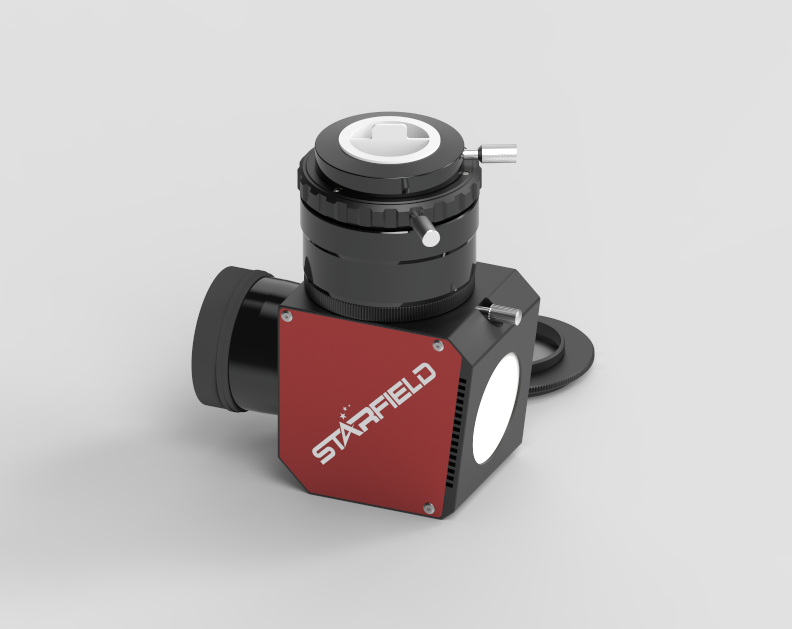
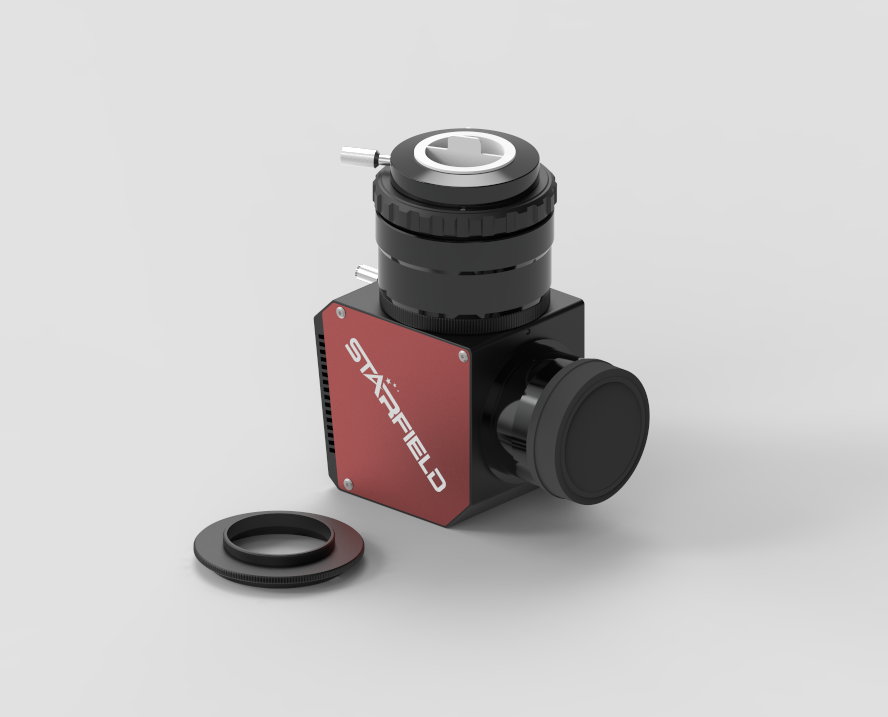
The Starfield Optics 2" Herschel Solar Wedge is a white-light solar device that takes the place of a standard 2" mirror or prism diagonal on a refractor. It shows the photosphere at high contrast — sunspots, penumbral structure and surface texture — with a built-in ND3 filter for attenuation and a polarizing system you adjust by rotating the 2" eyepiece holder. Clear aperture is 46 mm, it is recommended for refractors up to 150 mm (about 6"), and it adds roughly 115 mm of back focus measured to the top of the turret. A 2" to 1.25" adapter is included.
Who It's For
This is a good match if you observe or image the Sun in white light with a refractor of four to six inches and want the brightness control to sit inside the wedge rather than in front of the telescope. The rotating turret is the practical difference: you can tune brightness with a camera attached, which matters when you are chasing focus and exposure together on a target that changes through the day. If your refractor is 100 mm or smaller, the 1.25" Solar Wedge is the size to look at instead.
Key Features & Design
- 2" format for larger refractors and a wider light path.
- 46 mm clear aperture.
- Built-in ND3 filter for safe attenuation. It is a permanent part of the wedge and is not removed.
- Adjustable polarizing system: brightness is set by rotating the 2" eyepiece holder.
- Imaging-ready brightness control — the adjustment works with a camera in place, so nothing has to come off to change it.
- Replaces a standard 2" diagonal on the focuser.
- Recommended for refractors up to 150 mm (about 6").
- Adds approximately 115 mm of back focus, measured to the top of the 2" turret.
- 2" to 1.25" adapter included, for 1.25" eyepieces and camera trains.
Optical Design
A Herschel wedge works by rejection rather than by blocking. An angled prism sends a small fraction of the incoming light up to the eyepiece and passes the great majority of the Sun's energy straight out of the back of the housing, where it leaves as heat. Because the attenuation happens after the objective rather than in front of it, there is no filter surface facing the telescope lens — and that is where the contrast advantage comes from. A front-mounted film filter sits parallel to the objective and the two surfaces reflect light back and forth between them, laying a faint haze over the image. A wedge has no such pair of surfaces.
What reaches the eyepiece still needs attenuating, which is what the built-in ND3 filter does. Fine control on top of that comes from the polarizing system: rotating the 2" eyepiece holder turns one polarizer against the other and varies transmission continuously, so you can set the brightness that suits the seeing, the eyepiece and, when imaging, the exposure you are working toward. Because this all happens on the output side of the prism, none of it is exposed to the full solar load.
Recommended Uses
White-light observing of sunspots, active regions and surface granulation with a 100–150 mm refractor. Solar imaging, using the turret to trim brightness without breaking down the camera train. Tracking the progress of an active region across the disc over successive days. Partial solar eclipse and transit observing with a refractor. Outreach and public solar sessions, where high contrast makes sunspots obvious to a first-time viewer.
Compatibility and Accessory Notes
- Telescope type: refractors only.
- Aperture: recommended for refractors up to 150 mm (about 6"). For 100 mm and under, see the 1.25" Solar Wedge.
- Connection: goes into the focuser in place of a standard 2" diagonal.
- Eyepieces and cameras: takes 2" accessories directly, and 1.25" accessories through the included adapter.
- Back focus: approximately 115 mm to the top of the turret. On a focuser already near the end of its travel, or with a long camera train, this is the figure to check first — send us your telescope model and imaging train and we will work out whether you reach focus before you order.
- Additional filters: a continuum or contrast filter may be added on the output side, after the light has passed through the prism. Nothing goes on the input side.
Good to Know Before You Order
- Refractors only. A Herschel wedge is not for use with reflectors, Schmidt-Cassegrains or Maksutovs. Those designs bring the Sun's full energy onto a closed tube and secondary assembly, and the wedge is not designed for that.
- Never place a filter on the input or front side. Heat will crack glass and damage coatings. Filters belong on the output side only, after the prism.
- Never remove the built-in ND3 filter, and confirm before each session that it is securely in place.
- Remove or cover any finder or guide scope not made for solar use before aiming at the Sun. An uncapped finder is the most common way people are hurt during solar observing.
- Never leave the telescope unattended while it is pointed at the Sun.
- 115 mm of added back focus is a real constraint on some refractors. It is worth confirming your focuser travel rather than discovering it in daylight.
- Specifications are Starfield Optics' published figures.
Frequently Asked Questions
Is it difficult to set up?
No. It goes into the focuser exactly as a 2" diagonal does, the eyepiece or camera goes into the top, and brightness is set by rotating the eyepiece holder. The one thing to check before the first session is that your focuser has the travel for 115 mm of added back focus.
What does it actually show?
The solar photosphere in white light — sunspots with umbra and penumbra, and granulation across the surface. It is not a hydrogen-alpha device, so prominences and the chromosphere are not what it is for.
Can I use it on an SCT, Maksutov or Newtonian?
No. A Herschel wedge is for refractors only.
Can I add filters?
Yes, on the output side — after the light has passed through the prism. Never on the input side.
Will it reach focus on my refractor?
It adds approximately 115 mm of back focus. Most refractors handle that, but focuser travel varies — send us your telescope model and we will check it with you.
How is this different from a film solar filter?
A film filter mounts in front of the objective; a wedge attenuates after it. Removing that front filter surface removes the reflections between filter and lens, which is why a wedge gives the higher-contrast view.
Do I still need to adjust brightness during a session?
Usually yes, and that is the point of the rotating turret. Sun altitude, transparency and your choice of eyepiece all change what looks comfortable, and the adjustment works with a camera attached.
Bottom Line
In short: a 2" Herschel wedge for refractors up to 150 mm, with a 46 mm clear aperture, a built-in ND3 filter and continuous polarizing brightness control from the turret. It replaces your 2" diagonal, adds about 115 mm of back focus, and includes the 2" to 1.25" adapter.
| Model | Starfield Optics 2" Herschel Solar Wedge |
|---|---|
| Format | 2" Herschel solar wedge, white light |
| Clear aperture | 46 mm |
| Built-in filter | ND3 (permanent — do not remove) |
| Brightness control | Polarizing adjustment, by rotating the 2" turret / eyepiece holder |
| Back focus added | Approximately 115 mm, measured to the top of the 2" turret |
| Telescope type | Refractors only — not for reflectors, SCTs or Maksutovs |
| Recommended aperture | Refractors up to 150 mm (about 6") |
| Connection | Replaces a standard 2" diagonal in the focuser |
| Additional filters | Output side only, after the prism |
| In the box | 2" Herschel Solar Wedge, 2" to 1.25" eyepiece adapter |
| Source | Starfield Optics product data |
You may also like
Recently viewed
Recent Blog Posts
View all
Your Guide Graph Is Lying to You
Read More

D-Size vs V-Size: A Complete Guide to Telescope Dovetail Systems
Read More

What Is Back Focus in Astrophotography? Telescope Reducers, Flatteners, and Spacing Explained
Read More